Madrid Eva, Chandler John W, Coupland George
Max Planck Institute for Plant Breeding Research, Carl-von-Linné-Weg, Germany.
J Exp Bot. 2021 Jan 20;72(1):4-14. doi: 10.1093/jxb/eraa216.
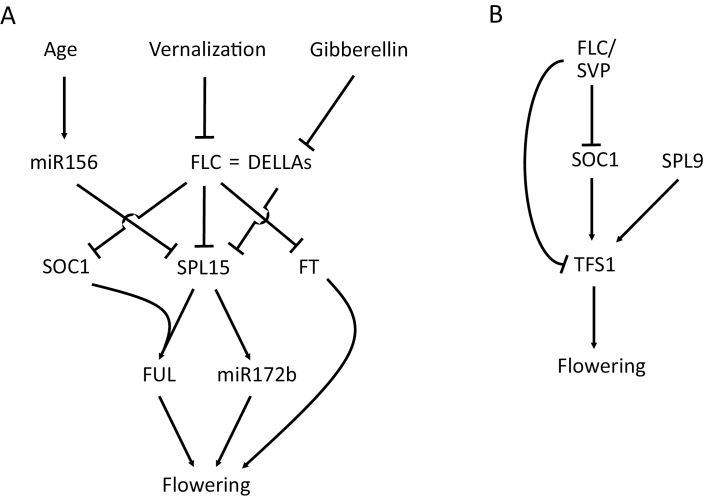
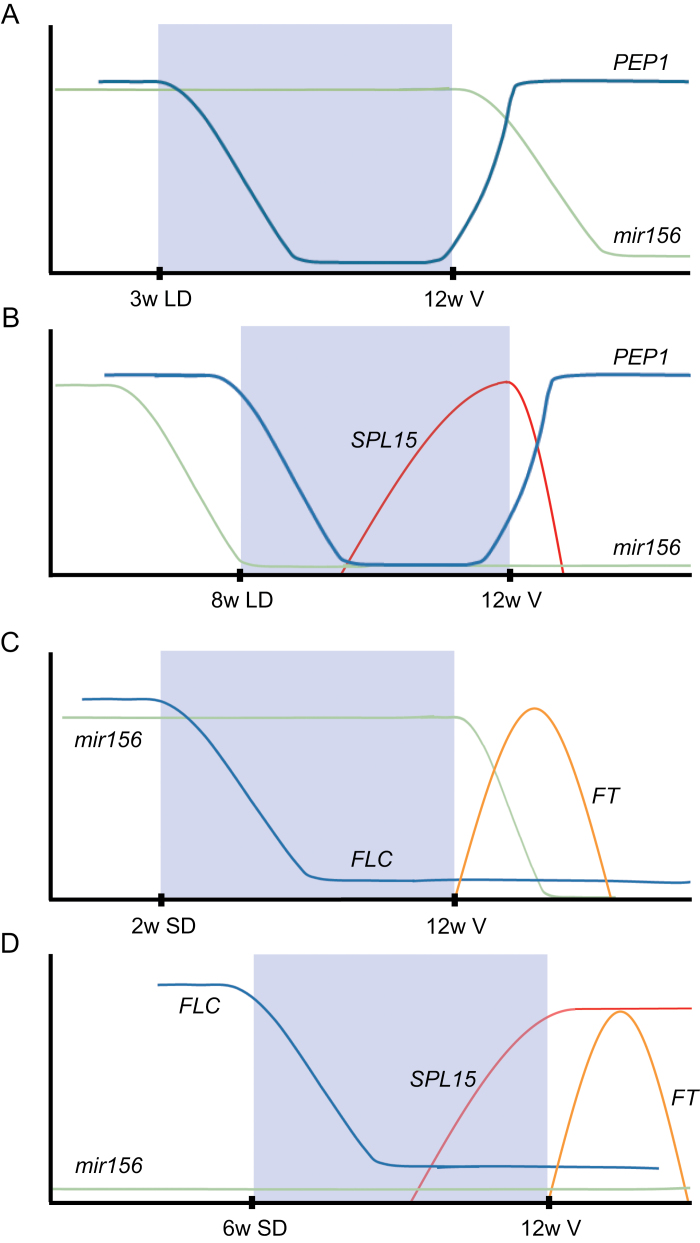
Responses to environmental cues synchronize reproduction of higher plants to the changing seasons. The genetic basis of these responses has been intensively studied in the Brassicaceae. The MADS-domain transcription factor FLOWERING LOCUS C (FLC) plays a central role in the regulatory network that controls flowering of Arabidopsis thaliana in response to seasonal cues. FLC blocks flowering until its transcription is stably repressed by extended exposure to low temperatures in autumn or winter and, therefore, FLC activity is assumed to limit flowering to spring. Recent reviews describe the complex epigenetic mechanisms responsible for FLC repression in cold. We focus on the gene regulatory networks controlled by FLC and how they influence floral transition. Genome-wide approaches determined the in vivo target genes of FLC and identified those whose transcription changes during vernalization or in flc mutants. We describe how studying FLC targets such as FLOWERING LOCUS T, SQUAMOSA PROMOTER BINDING PROTEIN-LIKE 15, and TARGET OF FLC AND SVP 1 can explain different flowering behaviours in response to vernalization and other environmental cues, and help define mechanisms by which FLC represses gene transcription. Elucidating the gene regulatory networks controlled by FLC provides access to the developmental and physiological mechanisms that regulate floral transition.
对环境信号的响应使高等植物的繁殖与季节变化同步。在十字花科中,对这些响应的遗传基础进行了深入研究。MADS结构域转录因子开花位点C(FLC)在响应季节信号控制拟南芥开花的调控网络中起核心作用。FLC阻止开花,直到其转录在秋季或冬季通过长时间暴露于低温而被稳定抑制,因此,FLC活性被认为将开花限制在春季。最近的综述描述了负责FLC在低温下抑制的复杂表观遗传机制。我们关注由FLC控制的基因调控网络以及它们如何影响花期转变。全基因组方法确定了FLC在体内的靶基因,并鉴定了那些在春化过程中或flc突变体中转录发生变化的基因。我们描述了研究FLC靶标,如开花位点T、SQUAMOSA启动子结合蛋白样15和FLC与SVP 1的靶标,如何能够解释对春化和其他环境信号的不同开花行为,并有助于确定FLC抑制基因转录的机制。阐明由FLC控制的基因调控网络有助于了解调节花期转变的发育和生理机制。