Centre intégré universitaire de santé et de services sociaux de l'Estrie - Centre Hospitalier Universitaire de Sherbrooke (CIUSSSE-CHUS), Quebec, Canada.
Université de Sherbrooke, Sherbrooke, Quebec, Canada.
RMD Open. 2020 May;6(1). doi: 10.1136/rmdopen-2020-001191.
BACKGROUND/PURPOSE: To evaluate biomarkers as predictors of impending erosion progression.
Variables were measured at baseline and annually up to 5 years in patients with recent-onset polyarthritis treated to zero swollen joints. Erosive status was defined as ≥5 Units in Sharp/van der Heijde Erosion Score; Rapid Erosive Progression (REP) was defined as an increase ≥5 Units in Erosion Scores between consecutive visits. Generalised estimating equations (GEEs) evaluated the effect on REP of positive anticyclic citrullinated peptides (ACPAs) and/or rheumatoid factor (RF), C-reactive protein ˃8.0 mg/L (High-CRP) and 14-3-3η protein ≥0.50 ng/mL (High-14-3-3η), alone and in combinations.
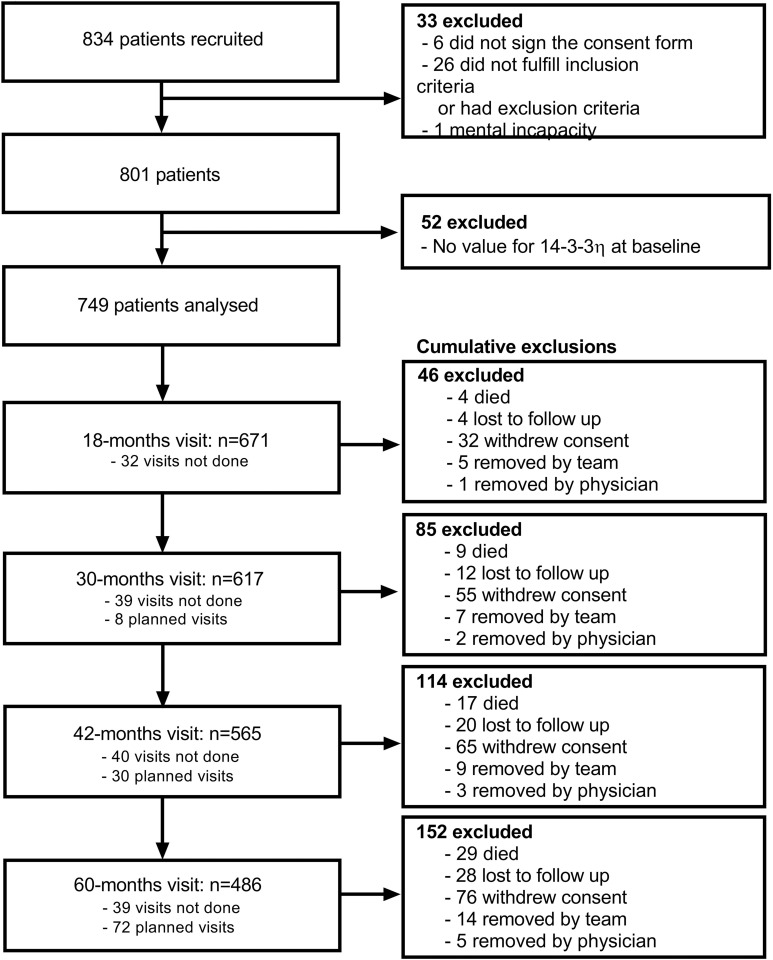
Out of 2155 evaluations in 749 consecutive patients, REP occurred after 186 (8.6%) visits, including 13 (2.2%) in patients recruited since 2010. Only 18/537 (3.4%; 6/411 (1.5%) in non-erosive vs 12/126 (9.5%) in patients already erosive) visits without any positive biomarker were followed by REP; at least one biomarker was positive prior to REP in 168/186 (90.3%) visits. Being positive for all four biomarkers conferred a positive predictive value (PPV) of 30.0% (RR 21.8) in patients non-erosive at the visit versus 35.5% (RR 3.07) in those already erosive. High-14-3-3η increased REP only in visits with High-CRP (eg, RR 2.5 to 3.9 when ACPA also positive) and in patients with non-erosive status (eg, RR from 4.3 to 9.4 when also High-CRP).
Adding High-14-3-3η to positive antibodies and CRP improves prediction of impending REP. Although REP is becoming rarer, signatures of biomarkers might help to adapt treatment strategies in at-risk individuals, even those already erosive.
背景/目的:评估生物标志物作为即将发生侵蚀进展的预测因子。
在接受治疗使肿胀关节数达到 0 的新发多关节炎患者中,在基线和每年进行评估,直至 5 年。侵蚀状态定义为 Sharp/van der Heijde 侵蚀评分≥5 个单位;快速侵蚀进展(REP)定义为连续就诊时侵蚀评分增加≥5 个单位。广义估计方程(GEE)评估了阳性抗环瓜氨酸肽(ACPA)和/或类风湿因子(RF)、C 反应蛋白>8.0mg/L(高 CRP)和 14-3-3η 蛋白≥0.50ng/mL(高 14-3-3η)对 REP 的影响,单独和联合使用。
在 749 例连续患者的 2155 次评估中,186 次(8.6%)就诊发生了 REP,其中 13 次(2.2%)就诊患者是在 2010 年后招募的。只有 18/537(3.4%;411 例非侵蚀性患者中 6 例(1.5%)和 126 例已有侵蚀性患者中 12 例(9.5%))无任何阳性生物标志物的就诊随后发生了 REP;在 168/186 次(90.3%)就诊前至少有一种生物标志物呈阳性。在非侵蚀性就诊患者中,所有四种生物标志物均为阳性的患者的阳性预测值(PPV)为 30.0%(RR 21.8),而在已有侵蚀性患者中的阳性预测值为 35.5%(RR 3.07)。高 14-3-3η 仅在高 CRP 就诊时增加 REP(例如,当 ACPA 也为阳性时,RR 为 2.5 至 3.9)和非侵蚀性状态就诊时增加 REP(例如,当也高 CRP 时,RR 从 4.3 至 9.4)。
将高 14-3-3η 与阳性抗体和 CRP 联合使用可提高对即将发生的 REP 的预测。尽管 REP 变得越来越罕见,但生物标志物的特征可能有助于适应高危人群的治疗策略,即使是那些已有侵蚀性的患者。