Department of Neurology, Charité - Universitätsmedizin Berlin, Berlin, Germany.
Yerevan State University, Yerevan, Armenia.
J Neurol Neurosurg Psychiatry. 2020 Jul;91(7):681-686. doi: 10.1136/jnnp-2020-322941. Epub 2020 May 5.
To determine the prevalence of antibodies to Epstein-Barr virus (EBV) in a large cohort of patients with early multiple sclerosis (MS).
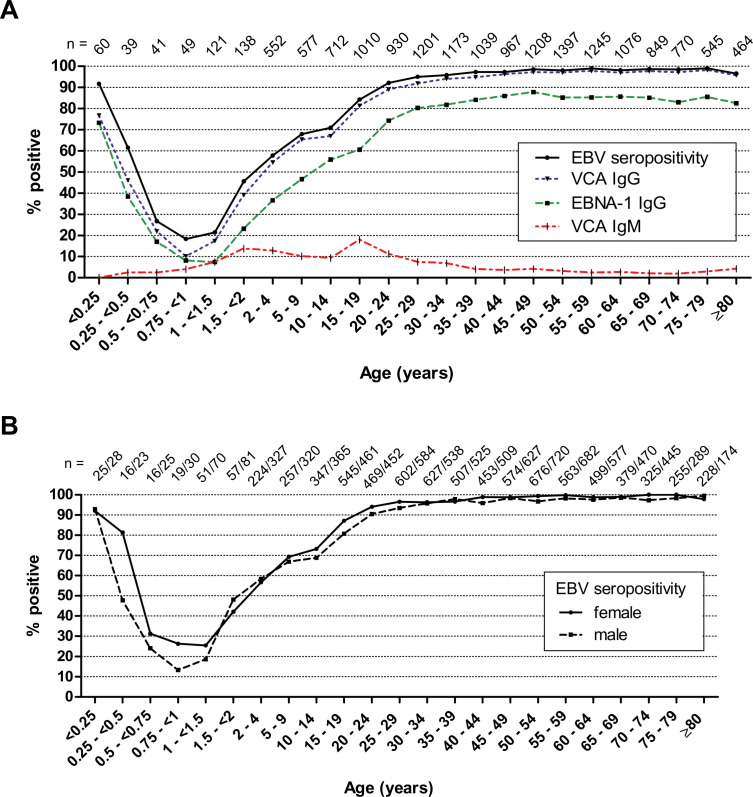
Serum samples were collected from 901 patients with a clinically isolated syndrome (CIS) or early relapsing-remitting multiple sclerosis (RRMS) participating in the German National MS cohort, a prospective cohort of patients with early MS with stringent inclusion criteria. Epstein-Barr nuclear antigen (EBNA)-1 and viral capsid antigen (VCA) antibodies were measured in diluted sera by chemiluminescence immunoassays (CLIAs). Sera of EBNA-1 and VCA antibody-negative patients were retested undiluted by an EBV IgG immunoblot. For comparison, we retrospectively analysed the EBV seroprevalence across different age cohorts, ranging from 0 to >80 years, in a large hospital population (N=16 163) from Berlin/Northern Germany.
EBNA-1 antibodies were detected by CLIA in 839 of 901 patients with CIS/RRMS. Of the 62 patients without EBNA-1 antibodies, 45 had antibodies to VCA as detected by CLIA. In all of the remaining 17 patients, antibodies to EBV were detected by immunoblot. Altogether, 901 of 901 (100%) patients with CIS/RRMS were EBV-seropositive. EBV seropositivity increased with age in the hospital population but did not reach 100% in any of the investigated age cohorts.
The complete EBV seropositivity in this large cohort of patients with early MS strengthens the evidence for a role of EBV in MS. It also suggests that a negative EBV serology in patients with suspected inflammatory central nervous system disease should alert clinicians to consider diagnoses other than MS.
在一大组早期多发性硬化症(MS)患者中确定针对 Epstein-Barr 病毒(EBV)的抗体流行率。
从参加德国国家多发性硬化症队列的 901 例临床孤立综合征(CIS)或早期复发缓解型多发性硬化症(RRMS)患者的血清样本中采集血清。德国国家 MS 队列是一个具有严格纳入标准的早期 MS 患者前瞻性队列。通过化学发光免疫分析(CLIAs)在稀释血清中测量 EBV 核抗原(EBNA)-1 和病毒衣壳抗原(VCA)抗体。EBNA-1 和 VCA 抗体阴性患者的血清用 EBV IgG 免疫印迹法未经稀释进行复测。为了比较,我们回顾性分析了来自柏林/德国北部的大型医院人群(N=16163)中不同年龄组(0 至>80 岁)的 EBV 血清流行率。
CLIA 检测到 901 例 CIS/RRMS 患者中有 839 例存在 EBNA-1 抗体。在 62 例没有 EBNA-1 抗体的患者中,45 例通过 CLIA 检测到 VCA 抗体。在其余的 17 例患者中,通过免疫印迹检测到 EBV 抗体。总共,901 例 CIS/RRMS 患者(100%)为 EBV 血清阳性。在医院人群中,EBV 血清阳性率随年龄增加而增加,但在任何研究年龄组中均未达到 100%。
在这个大型早期 MS 患者队列中,EBV 的完全血清阳性率加强了 EBV 在 MS 中的作用的证据。它还表明,在疑似炎症性中枢神经系统疾病的患者中 EBV 血清学阴性应提醒临床医生考虑除 MS 以外的其他诊断。