Forestry College, Fujian Agriculture and Forestry University, Fuzhou, 350002, P.R. China.
Chinese Fir Engineering Technology Research Center of the State Forestry and Grassland Administration, Fuzhou, 350002, P.R. China.
Sci Rep. 2020 May 5;10(1):7509. doi: 10.1038/s41598-020-64161-7.
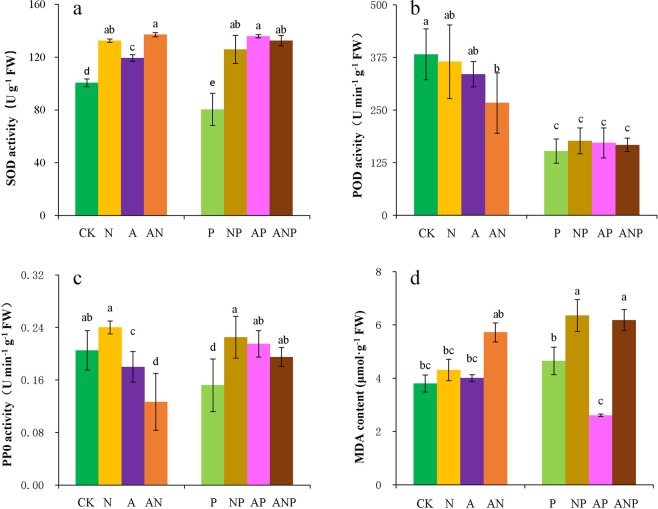
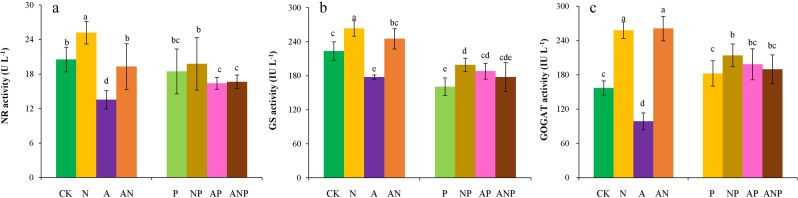
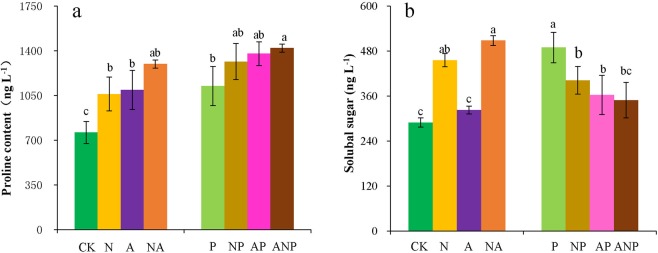
Water and nitrogen stresses are major constraints for agricultural and forest productivity. Although the effects of water scarcity or nitrogen stress on plant growth, physiology, and yield have been widely studied, few studies have assessed the combined effects of both stresses. In the present study, we investigated the effects of different nitrogen forms (NON, NH-N, and a combination of NON + NH-N) on antioxidant enzyme activity, osmotic regulatory substances, and nitrogen assimilation in Chinese fir (Cunninghamia lanceolata) plantlets under drought stress (induced by 10% polyethylene glycol). We found that different N ionic forms had different effects on drought-stressed plantlets. Nitrogen supply greatly increased the activities of superoxide dismutase (SOD), peroxidase (POD) and polyphenol oxidase (PPO) when plantlets were exposed to water stress. The malondialdehyde (MDA) contents significantly decreased under the NH + water stress treatment. The proline (Pr) contents significantly increased in both the NON and NH-N + water stress treatment. The nitrate reductase (NR) increased by 7.1% in the NO + water stress treatment, and the glutamine synthetase (GS), and the glutamate synthase (GOGAT) activity increased in all the nitrogen + water stress treatments. These results suggested that nitrogen supply could alleviate the adverse effects of drought stress on plants by enhancing antioxidant defense and improving nitrogen assimilation, while the effects on plant tolerance to drought stress varied with nitrogen ionic forms.
水和氮胁迫是农业和林业生产力的主要限制因素。尽管已经广泛研究了水分短缺或氮胁迫对植物生长、生理和产量的影响,但很少有研究评估这两种胁迫的综合影响。在本研究中,我们研究了不同氮形式(NON、NH-N 和 NON+NH-N 的组合)对干旱胁迫(由 10%聚乙二醇诱导)下杉木(Cunninghamia lanceolata)幼苗的抗氧化酶活性、渗透调节物质和氮同化的影响。我们发现,不同的 N 离子形式对干旱胁迫下的幼苗有不同的影响。氮供应在植物受到水分胁迫时大大增加了超氧化物歧化酶(SOD)、过氧化物酶(POD)和多酚氧化酶(PPO)的活性。丙二醛(MDA)含量在 NH+水胁迫处理下显著降低。脯氨酸(Pr)含量在 NON 和 NH-N+水胁迫处理中均显著增加。NO+水胁迫处理下硝酸还原酶(NR)增加了 7.1%,所有氮+水胁迫处理中谷氨酰胺合成酶(GS)和谷氨酸合酶(GOGAT)活性增加。这些结果表明,氮供应可以通过增强抗氧化防御和改善氮同化来减轻干旱胁迫对植物的不利影响,而氮离子形式对植物抗旱性的影响则有所不同。