Reilly Joseph, Jacobs Micah A, Friedman Bruce, Cleveland Kerry O, Lombardi David A, Castaneda-Ruiz Bibiana
Atlanticare Regional Medical Center, 65 W. Jimmie Leeds Rd, Pomona, NJ, 08240, USA.
Romano, Pontzer and Associates, 100 Delafield Rd #303, Pittsburgh, PA, 15215, USA.
Drugs Real World Outcomes. 2020 Sep;7(3):179-189. doi: 10.1007/s40801-020-00191-x.
Bacteremia and endocarditis caused by Staphylococcus aureus (S. aureus), particularly methicillin-resistant S. aureus (MRSA), are challenging to treat and are associated with high morbidity and mortality. Telavancin is a lipoglycopeptide antibacterial active against susceptible Gram-positive pathogens, including MRSA.
This registry study assessed the real-world use and clinical outcomes of telavancin in patients with bacteremia or endocarditis enrolled in the Telavancin Observation Use Registry (TOUR™).
The subset of patients enrolled in TOUR who were diagnosed with endocarditis and/or bacteremia with a known or unknown primary source (N = 151) were analyzed. Data including demographics, infection type, baseline pathogens, prior or concomitant antimicrobial therapy, dosing regimen, clinical response, treatment-emergent adverse events (TEAEs) of interest, and mortality were collected by retrospective medical chart review.
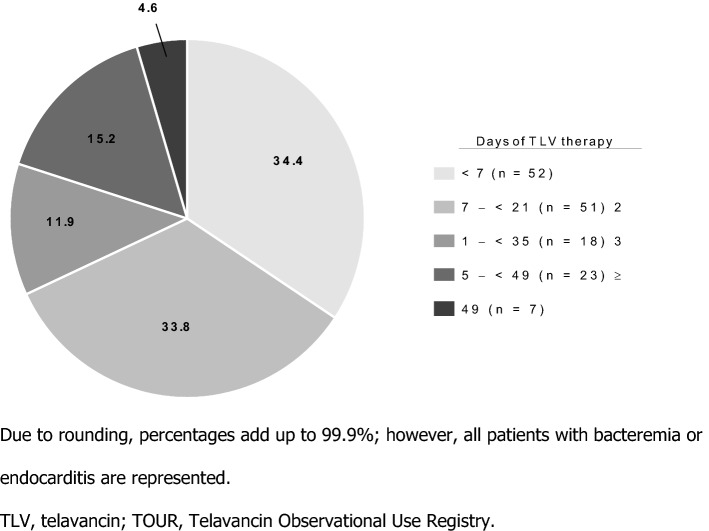
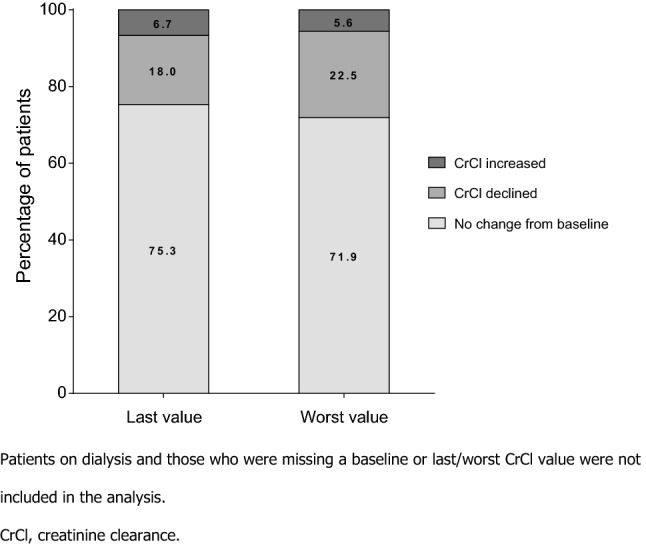
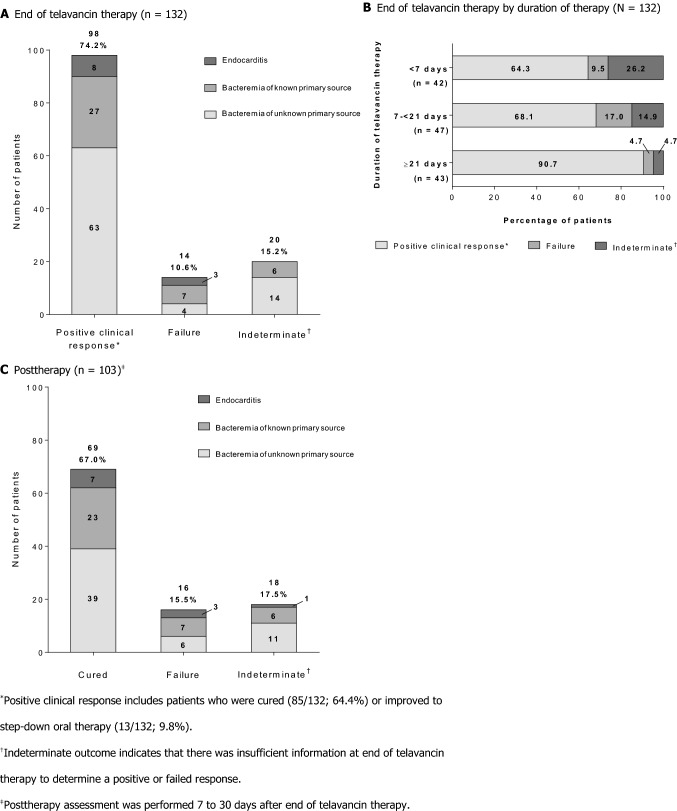
Telavancin was primarily used as a second-line or greater therapy (n = 132, 87.4%). MRSA was present in 87 (57.6%) patients. Median telavancin dose was 740.6 mg (interquartile range (IQR) 206.0 mg) and median duration of therapy was 9.0 days (IQR 24.0 days). Of the 132/151 (87.4%) patients with an available assessment at the end of telavancin therapy, a positive clinical response was achieved in 98/132 (74.2%), while 14/132 (10.6%) failed therapy and 20/132 (15.2%) had an indeterminant outcome. TEAEs occurred in 24 (15.9%) patients. The most frequent TEAE was renal failure (n = 12, 7.9%); seven of these patients were receiving concomitant nephrotoxic medications. There was no change in creatinine clearance for 67/89 (75.3%) patients with values recorded at the beginning and the end of telavancin therapy.
In real-world clinical practice, overall positive clinical outcomes are observed in patients with bacteremia or endocarditis treated with telavancin, including in those patients infected with MRSA or another S. aureus pathogen. Telavancin may be an alternative treatment option for these patients.
This trial was registered with clinicaltrials.gov (NCT02288234) on 11 November 2014.
由金黄色葡萄球菌(S. aureus)引起的菌血症和心内膜炎,尤其是耐甲氧西林金黄色葡萄球菌(MRSA)感染,治疗颇具挑战性,且与高发病率和死亡率相关。替拉万星是一种脂糖肽类抗菌药物,对包括MRSA在内的敏感革兰氏阳性病原体具有活性。
本登记研究评估了在替拉万星观察性使用登记处(TOUR™)登记的菌血症或心内膜炎患者中替拉万星的实际使用情况和临床结局。
对TOUR登记的诊断为心内膜炎和/或菌血症且原发感染源已知或未知的患者子集(N = 151)进行分析。通过回顾性病历审查收集数据,包括人口统计学、感染类型、基线病原体、先前或同时使用的抗菌治疗、给药方案、临床反应、关注的治疗中出现的不良事件(TEAE)以及死亡率。
替拉万星主要用作二线或更高级别的治疗(n = 132,87.4%)。87例(57.6%)患者存在MRSA感染。替拉万星的中位剂量为740.6 mg(四分位间距(IQR)为206.0 mg),中位治疗持续时间为9.0天(IQR为24.0天)。在替拉万星治疗结束时可进行评估的132/151例(87.4%)患者中,98/132例(74.2%)取得了阳性临床反应,14/132例(10.6%)治疗失败,20/132例(15.2%)结局不确定。24例(15.9%)患者发生了TEAE。最常见的TEAE是肾衰竭(n = 12,7.9%);其中7例患者同时接受了有肾毒性的药物治疗。在替拉万星治疗开始和结束时记录了肌酐清除率的89例患者中,67例(75.3%)患者的肌酐清除率没有变化。
在实际临床实践中,接受替拉万星治疗的菌血症或心内膜炎患者总体临床结局呈阳性,包括感染MRSA或其他金黄色葡萄球菌病原体的患者。替拉万星可能是这些患者的一种替代治疗选择。
本试验于2014年11月11日在clinicaltrials.gov(NCT02288234)注册。