Department of Psychology, Louisiana State University, 236 Audubon Hall, Baton Rouge, LA, 70803, USA.
Department of Psychology, University of Nebraska at Kearney, Kearney, NE, USA.
Cogn Res Princ Implic. 2020 May 5;5(1):20. doi: 10.1186/s41235-020-00211-y.
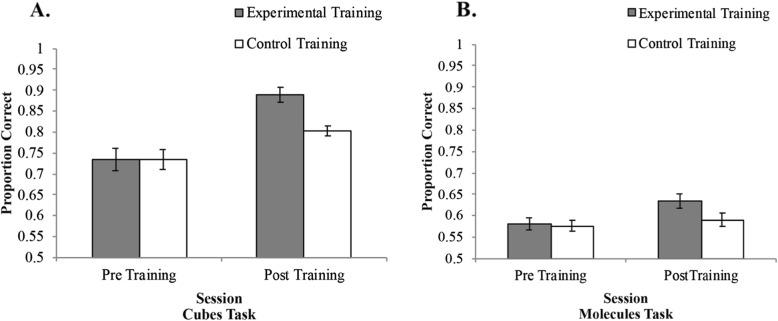
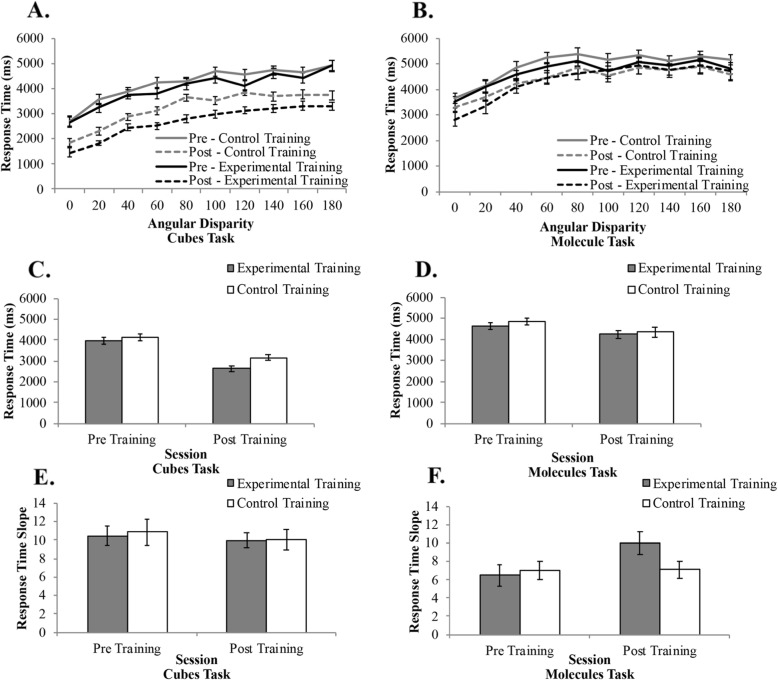
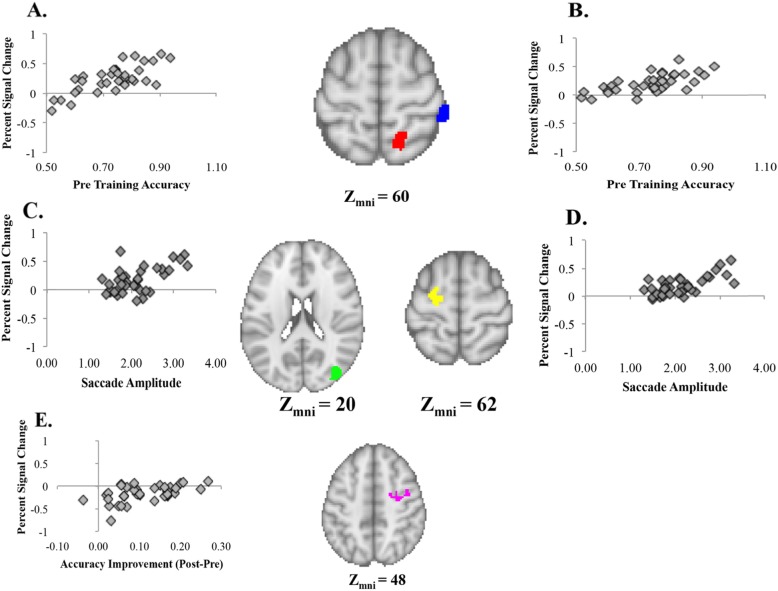
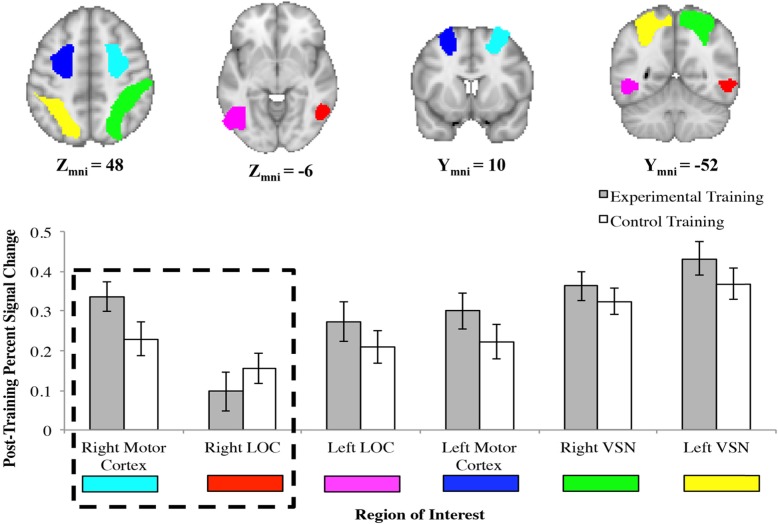
Spatial reasoning is a critical skill in many everyday tasks and in science, technology, engineering, and mathematics disciplines. The current study examined how training on mental rotation (a spatial reasoning task) impacts the completeness of an encoded representation and the ability to rotate the representation. We used a multisession, multimethod design with an active control group to determine how mental rotation ability impacts performance for a trained stimulus category and an untrained stimulus category. Participants in the experimental group (n = 18) showed greater improvement than the active control group (n = 18) on the mental rotation tasks. The number of saccades between objects decreased and saccade amplitude increased after training, suggesting that participants in the experimental group encoded more of the object and possibly had more complete mental representations after training. Functional magnetic resonance imaging data revealed distinct neural activation associated with mental rotation, notably in the right motor cortex and right lateral occipital cortex. These brain areas are often associated with rotation and encoding complete representations, respectively. Furthermore, logistic regression revealed that activation in these brain regions during the post-training scan significantly predicted training group assignment. Overall, the current study suggests that effective mental rotation training protocols should aim to improve the encoding and manipulation of mental representations.
空间推理是许多日常任务和科学、技术、工程和数学学科中的关键技能。本研究考察了心理旋转(一种空间推理任务)训练如何影响编码表示的完整性和表示的旋转能力。我们使用多会话、多方法设计和主动对照组来确定心理旋转能力如何影响训练刺激类别和未训练刺激类别的表现。实验组(n=18)的参与者在心理旋转任务上的表现比主动对照组(n=18)有更大的提高。训练后,物体之间的扫视次数减少,扫视幅度增加,这表明实验组参与者在训练后对物体进行了更多的编码,并且可能有更完整的心理表象。功能性磁共振成像数据显示与心理旋转相关的明显的神经激活,特别是在右侧运动皮层和右侧外侧枕叶皮层。这些大脑区域通常分别与旋转和编码完整的表象有关。此外,逻辑回归显示,在训练后扫描中这些脑区的激活显著预测了训练组的分配。总的来说,本研究表明,有效的心理旋转训练方案应该旨在提高心理表象的编码和操作。