Hestad Knut, Engedal Knut, Schirmer Henrik, Strand Bjørn Heine
Department of Health Studies, Inland Norway University of Applied Sciences, Elverum, Norway.
Department of Research, Innlandet Hospital Trust, Ottestad, Norway.
Front Psychol. 2020 Apr 21;11:607. doi: 10.3389/fpsyg.2020.00607. eCollection 2020.
The relationship between blood pressure (BP) and cognition is complex were age appears to be an intervening variable. High and low BP have been associated with cognitive deficits as part of the aging process, but more studies are needed, especially in more recent birth cohorts.
The study sample comprised 4,465 participants, with BP measured at baseline in the Tromsø Study, Wave 6 in 2007-2008 (T0), and cognition assessed at follow-up 8 years later, in 2015-2016 in Tromsø Study 7 (T1). Age at T0 was 45-74 years, and at T1 it was 53-82 years. Cognition was assessed with three tests: The Mini Mental State Examination (MMSE), the Digit Symbol Test, and the Twelve-word Test. The associations between BP and cognition were examined specifically for age and sex using linear regression analysis adjusted for baseline BP medication use, education and body mass index (kg/m).
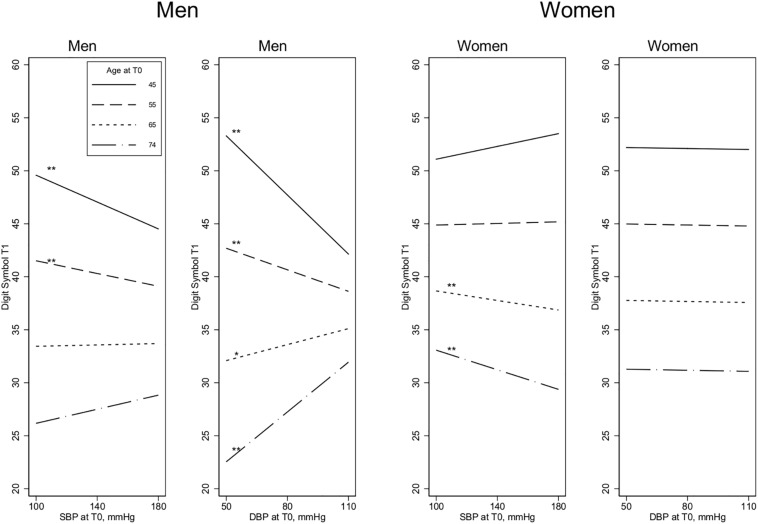
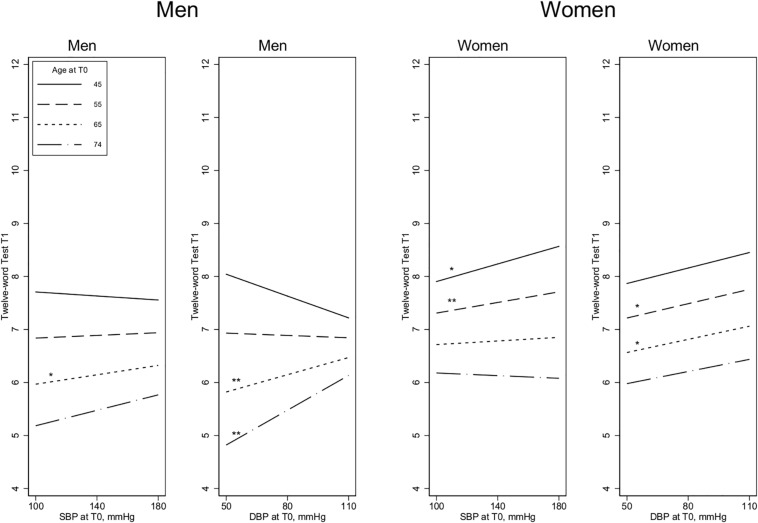
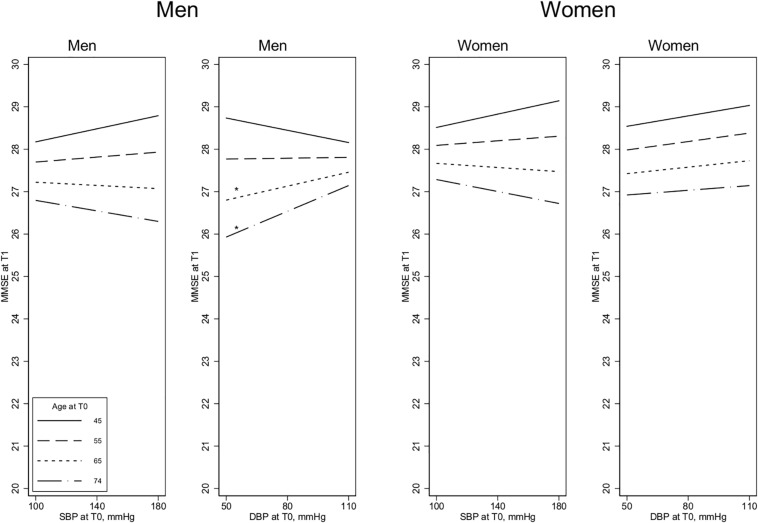
BP was associated with cognition at the 8-year follow-up, but the association differed according to age and sex. In men, higher systolic blood pressure (SBP) and diastolic blood pressure (DBP) at a young age (45-55 years of age) was associated with poorer cognition; the association was reversed at older ages, especially for those above 65 years of age. In women, the associations were generally weaker than for men, and sometimes in the opposite direction: For women, a higher SBP was associated with better cognition at a younger age and higher SBP poorer cognition at older ages - perhaps due to an age delay in women compared to men. Digit Symbol Test results correlated best with BP in a three-way interaction: BP by age by sex was significant for both SBP ( = 0.005) and DBP ( = 0.005).
Increased SBP and DBP at the younger age was clearly associated with poorer cognitive function in men 8 years later; in women the associations were weaker and sometimes in the opposite direction. Our findings clearly indicate that interactions between age and sex related to BP can predict cognitive performance over time. Men and women have different age trajectories regarding the influence of BP on cognition.
血压(BP)与认知之间的关系较为复杂,年龄似乎是一个干预变量。作为衰老过程的一部分,高血压和低血压都与认知缺陷有关,但仍需要更多研究,尤其是针对最近出生队列的研究。
研究样本包括4465名参与者,在特罗姆瑟研究的第6波(2007 - 2008年,T0)测量基线血压,并于8年后在特罗姆瑟研究第7波(2015 - 2016年,T1)随访时评估认知情况。T0时年龄为45 - 74岁,T1时年龄为53 - 82岁。通过三项测试评估认知:简易精神状态检查表(MMSE)、数字符号测试和十二词测试。使用针对基线血压药物使用、教育程度和体重指数(kg/m)进行调整的线性回归分析,具体针对年龄和性别研究血压与认知之间的关联。
在8年随访时,血压与认知相关,但这种关联因年龄和性别而异。在男性中,年轻时(45 - 55岁)收缩压(SBP)和舒张压(DBP)较高与较差的认知相关;在老年时这种关联则相反,尤其是65岁以上的人群。在女性中,这种关联通常比男性弱,有时甚至方向相反:对于女性,年轻时较高的SBP与较好的认知相关,而老年时较高的SBP与较差的认知相关——这可能是由于女性与男性相比存在年龄延迟。在三方交互作用中,数字符号测试结果与血压的相关性最佳:血压×年龄×性别对SBP(P = 0.005)和DBP(P = 0.005)均具有显著性。
年轻时SBP和DBP升高显然与8年后男性较差的认知功能相关;在女性中,这种关联较弱,有时甚至方向相反。我们的研究结果清楚地表明,与血压相关的年龄和性别之间的相互作用可以预测随时间变化的认知表现。在血压对认知的影响方面,男性和女性具有不同的年龄轨迹。