Ahkin Chin Tai Janiel K, Freeman Jennifer L
School of Health Sciences, Purdue University, West Lafayette, IN 47907 USA.
Toxicol Rep. 2020 Apr 2;7:559-570. doi: 10.1016/j.toxrep.2020.03.010. eCollection 2020.
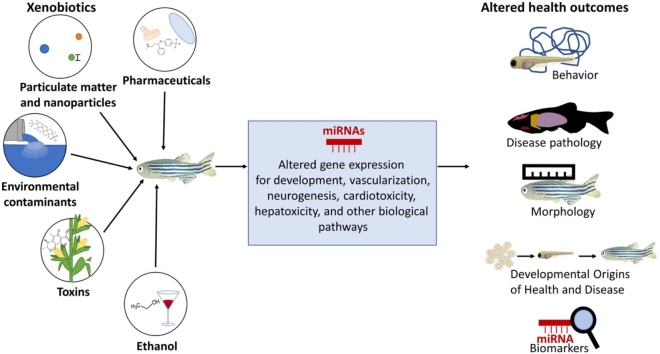
Zebrafish () are an integrative vertebrate model ideal for toxicity studies. The zebrafish genome is sequenced with detailed characterization of all life stages. With their genetic similarity to humans, zebrafish models are established to study biological processes including development and disease mechanisms for translation to human health. The zebrafish genome, similar to other eukaryotic organisms, contains microRNAs (miRNAs) which function along with other epigenetic mechanisms to regulate gene expression. Studies have now established that exposure to toxins and xenobiotics can change miRNA expression profiles resulting in various physiological and behavioral alterations. In this review, we cover the intersection of miRNA alterations from toxin or xenobiotic exposure with a focus on studies using the zebrafish model system to identify miRNA mechanisms regulating toxicity. Studies to date have addressed exposures to toxins, particulate matter and nanoparticles, various environmental contaminants including pesticides, ethanol, and pharmaceuticals. Current limitations of the completed studies and future directions for this research area are discussed.
斑马鱼是毒性研究的理想综合脊椎动物模型。斑马鱼基因组已测序,且对其所有生命阶段都有详细描述。由于斑马鱼与人类具有基因相似性,因此建立了斑马鱼模型来研究包括发育和疾病机制在内的生物学过程,以便转化应用于人类健康领域。与其他真核生物一样,斑马鱼基因组包含微小RNA(miRNA),它们与其他表观遗传机制共同作用来调节基因表达。现在的研究已经证实,接触毒素和异生物素会改变miRNA表达谱,从而导致各种生理和行为改变。在这篇综述中,我们涵盖了毒素或异生物素暴露导致的miRNA变化,重点是使用斑马鱼模型系统来识别调节毒性的miRNA机制的研究。迄今为止的研究涉及了对毒素、颗粒物和纳米颗粒以及包括农药、乙醇和药物在内的各种环境污染物的暴露。文中还讨论了已完成研究的当前局限性以及该研究领域的未来方向。