Department of Orthopaedics, First Affiliated Hospital of Zhengzhou University, Zhengzhou University, Zhengzhou, China.
Front Cell Infect Microbiol. 2020 Apr 21;10:160. doi: 10.3389/fcimb.2020.00160. eCollection 2020.
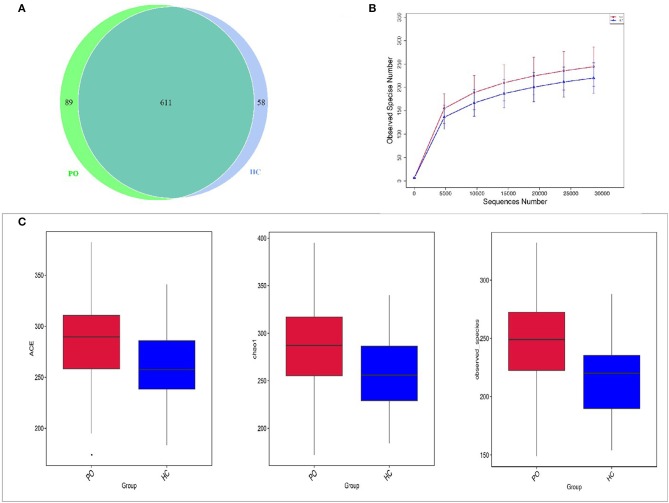
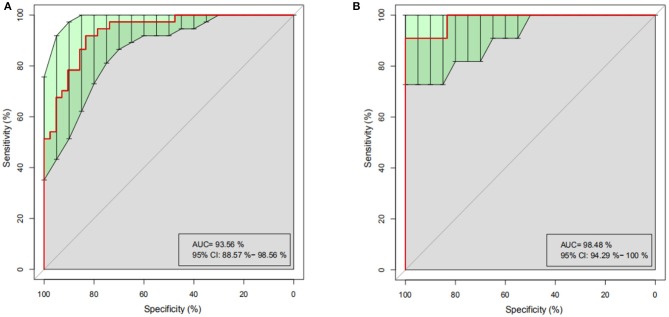
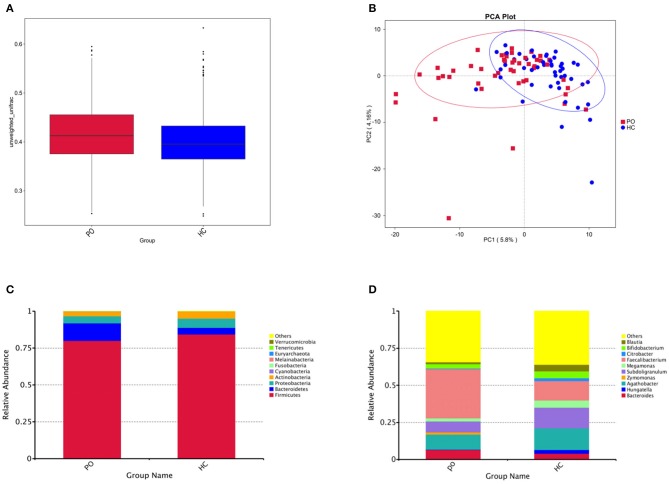
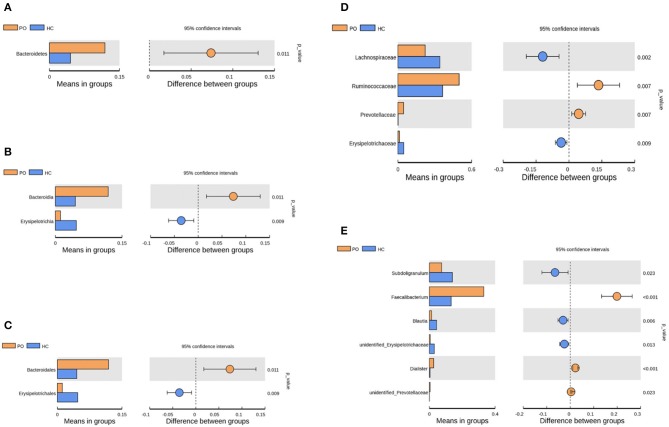
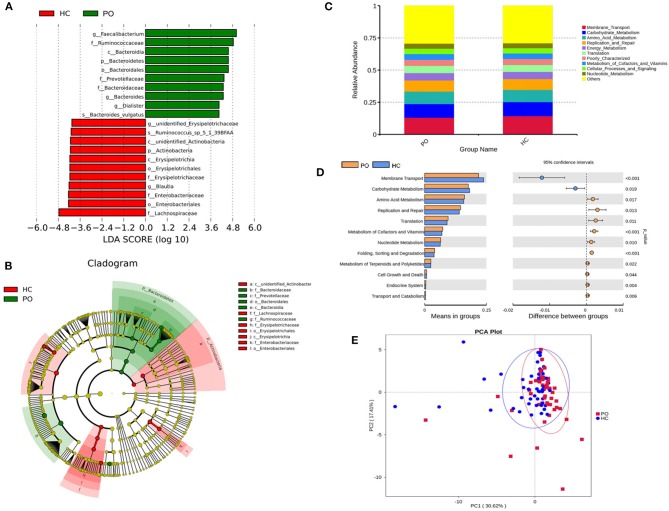
Primary osteoporosis (PO) is the most common bone disease, which is characterized by decreased bone mass, damage of bone tissue microstructure, increased bone fragility, and is prone to fracture. Gut microbiome may be involved in bone metabolism of PO through gut-brain axis regulation of immune system and endocrine system, however, the specific mechanism is still unclear. The purpose of this study was to characterize the gut microbiome of patients with PO and its possible role in the occurrence and development of the disease. Fecal samples were collected from 48 PO patients and 48 healthy controls (HC). The composition of gut microbiome community was analyzed by 16s rDNA amplification sequencing, and the difference of gut microbiome composition between PO patients and HC individuals was compared. PICRUSt was also used to predict the biological function of gut microbiome in patients with PO, and to explore its possible role in the occurrence and development of this disease. The classification model is constructed by random forest algorithm so as to screen the key biomarkers. The diversity of gut microorganisms in PO patients was significantly higher than that in HC group ( < 0.05) and there was significant difference in microbial composition in PO group. The abundance of Dialister (0.036 vs. 0.004, < 0.001) and Faecalibacterium (0.331 vs. 0.132, < 0.001) were significantly enriched which were the key flora related to PO. Although no significant correlation between bone mineral density and the richness of microbial communities are found, PICRUST results show that there are a wide range of potential pathways between gut microbiome and PO patients, including genetic information processing, metabolism, environmental information processing, cellular processes, human diseases, and organic systems. Notably, the discriminant model based on dominant microflora can effectively distinguish PO from HC (AUC = 93.56). The findings show that PO is related to the change of gut microbiome, especially the enriched Dialister and Faecalibacterium genera, which give new clues to understand the disease and provide markers for the diagnosis and new strategies for intervention treatment of the disease.
原发性骨质疏松症(PO)是最常见的骨骼疾病,其特征是骨量减少、骨组织微观结构受损、骨脆性增加,易发生骨折。肠道微生物群可能通过肠道-大脑轴调节免疫系统和内分泌系统参与 PO 的骨代谢,但具体机制尚不清楚。本研究旨在描述 PO 患者的肠道微生物群及其在疾病发生和发展中的可能作用。
收集了 48 例 PO 患者和 48 例健康对照(HC)的粪便样本。通过 16s rDNA 扩增测序分析肠道微生物群落组成,并比较 PO 患者和 HC 个体肠道微生物群落组成的差异。还使用 PICRUSt 预测 PO 患者肠道微生物群的生物学功能,探索其在疾病发生和发展中的可能作用。通过随机森林算法构建分类模型,筛选关键生物标志物。
PO 患者肠道微生物多样性明显高于 HC 组(<0.05),且 PO 组微生物组成存在显著差异。Dialister(0.036 比 0.004,<0.001)和 Faecalibacterium(0.331 比 0.132,<0.001)的丰度显著富集,这两种菌是与 PO 相关的关键菌群。虽然未发现骨密度与微生物群落丰富度之间存在显著相关性,但 PICRUST 结果表明肠道微生物群与 PO 患者之间存在广泛的潜在途径,包括遗传信息处理、代谢、环境信息处理、细胞过程、人类疾病和有机系统。值得注意的是,基于优势菌群的判别模型可以有效地将 PO 与 HC 区分开(AUC=93.56)。
研究结果表明,PO 与肠道微生物群的变化有关,尤其是富集的 Dialister 和 Faecalibacterium 属,为理解该疾病提供了新的线索,并为疾病的诊断和新的干预治疗策略提供了标志物。