Kobo Ofer, Saada Majdi, Meisel Simcha R, Hellou Elias, Frimerman Aaron, Fanne Rami Abu, Mohsen Jameel, Danon Asaf, Roguin Ariel
Department of Cardiology, Hillel Yaffe Medical Center, Hadera, Israel.
The Ruth & Bruce Rappaport Faculty of Medicine, Technion-Israel Institute of Technology, Haifa, Israel.
Rambam Maimonides Med J. 2020 Apr 29;11(2):e0017. doi: 10.5041/RMMJ.10403.
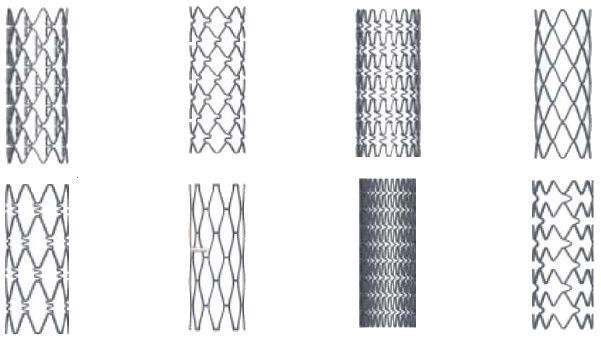
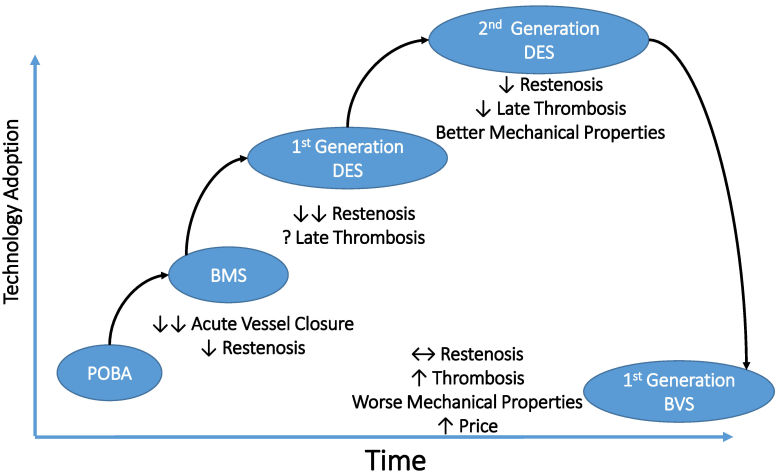
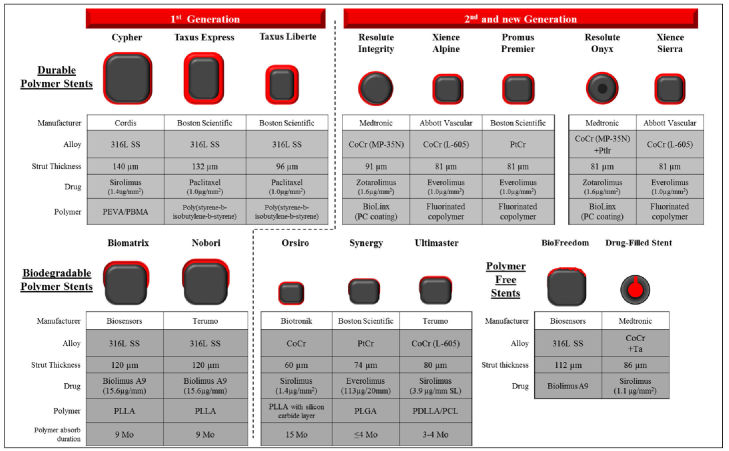
Coronary artery stenting is the treatment of choice for patients requiring coronary angioplasty. We describe the major advancements with this technology. There have been significant developments in the design of stents and adjunctive medical therapies. Newer-generation drug-eluting stents (DES) have almost negligible restenosis rates and, when combined with proper anti-platelet treatment and optimal deployment, a low risk of stent thrombosis. The introduction of newer-generation DES with thinner stent struts, novel durable or biodegradable polymer coatings, and new antiproliferative agents has further improved the safety profile of early-generation DES. In parallel the effectiveness has been kept, with a significant reduction in the risk of target lesion revascularization compared with the early-generation DES. However, to date, the development of completely bioresorbable vascular scaffolds has failed to achieve further clinical benefits and has been associated with increased thrombosis. Newer-generation DES-including both durable polymer as well as biodegradable polymer-have become the standard of care in all patient and lesion subsets, with excellent long-term results.
冠状动脉支架置入术是需要进行冠状动脉血管成形术患者的首选治疗方法。我们描述了这项技术的主要进展。支架设计和辅助药物治疗方面有了重大发展。新一代药物洗脱支架(DES)的再狭窄率几乎可以忽略不计,并且与适当的抗血小板治疗和最佳置入相结合时,支架血栓形成风险较低。新一代DES的出现,其支架小梁更薄、采用新型耐用或可生物降解的聚合物涂层以及新的抗增殖药物,进一步改善了早期DES的安全性。与此同时,其有效性得以保持,与早期DES相比,靶病变血运重建风险显著降低。然而,迄今为止,完全可生物吸收血管支架的发展未能带来进一步的临床益处,且与血栓形成增加有关。新一代DES——包括耐用聚合物和可生物降解聚合物——已成为所有患者和病变亚组的治疗标准,长期效果良好。