Department of Crop Science, School of Agriculture, College of Agriculture and Natural Sciences, University of Cape Coast, Cape Coast, Ghana.
Centre for Resource Management and Environmental Studies (CERMES), The University of the West Indies, Bridgetown, Barbados.
PLoS One. 2020 May 6;15(5):e0232595. doi: 10.1371/journal.pone.0232595. eCollection 2020.
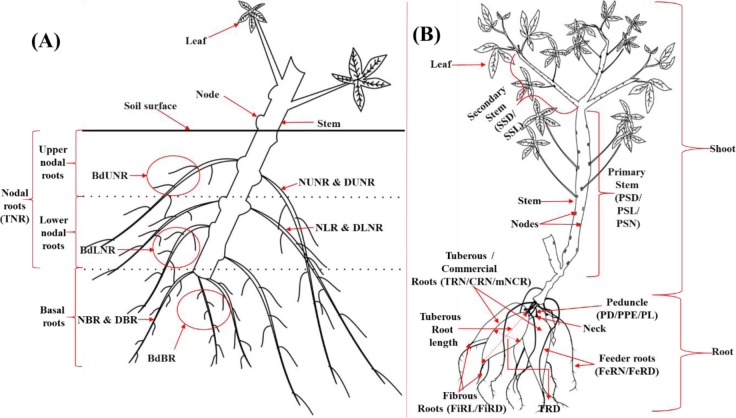
Cassava is the 6th most important source of dietary energy in the world but its root system architecture (RSA) had seldom been quantified. Ability to select superior genotypes at juvenile stages can significantly reduce the cost and time for breeding to bridge the large yield gap. This study adopted a simple approach to phenotyping RSA traits of juvenile and mature cassava plants to identify genotypic differences and the relationships between juvenile traits and harvest index of mature plants. Root classes were categorised and root and shoot traits of eight (8) juvenile pot-grown cassava genotypes, were measured at 30 and 45 days after planting (DAP). The same or related traits were measured at 7 months after planting of the same genotypes grown in the field while yield and yield components were measured in 12-months old field-grown plants. The field experiment was done in 2017 and repeated in 2018. Differences between genotypes for the measured traits were explored using analysis of variance (ANOVA) while traits in juvenile plants were correlated or regressed onto traits measured in 7- and 12-months old plants. The results show significant genotypic variations for most of the traits measured in both juvenile and 7-months old plants. In the 12-months old plants, differences between genotypes were consistent for both 2017 and 2018. Broad-sense heritability was highest for the number of commercial roots (0.87) and shoot fresh weight (0.78) and intermediate for the total number of roots (0.60), harvest index (0.58), fresh weight of roots (0.45). For all the sampling time points or growth stages, there were greater correlations between traits measured at a particular growth stage than between the same traits at different growth stages. However, some juvenile-mature plant trait relationships were significant, positive and consistent for both 2017 and 2018. For example, total root length and the total number of roots in 30 DAP, and branching density of upper nodal roots in 45 DAP, positively correlated with harvest index of 12-months old plants in both 2017 and 2018. Similarly, the diameter of nodal roots, for example, had a negative, significant correlation with fresh shoot biomass of mature plants in both 2017 and 2018. Regression of traits measured in 30 DAP explained up to 22% and 36% of the variation in HI of mature plants in 2017 and 2018, respectively. It is concluded that the simple, rapid, inexpensive phenotyping approach adopted in this study is robust for identifying genotypic variations in juvenile cassava using root system traits. Also, the results provide seminal evidence for the existence of useful relationships between traits of juvenile and mature cassava plants that can be explored to predict yield and yield components.
木薯是世界上第六大重要的膳食能量来源,但它的根系结构(RSA)很少被量化。在幼年阶段选择优良基因型的能力可以显著降低繁殖的成本和时间,从而缩小产量差距。本研究采用一种简单的方法来表型分析幼年和成熟木薯植株的 RSA 特性,以鉴定基因型差异以及幼年特性与成熟植株收获指数之间的关系。在种植后 30 和 45 天(DAP),对 8 种(8 种)盆栽木薯基因型的幼苗根系进行分类,并测量了根系和地上部性状。在同一田间种植的相同基因型的植物中,在种植后 7 个月测量了相同或相关的性状,而在 12 个月的田间种植植物中测量了产量和产量构成。田间试验于 2017 年进行,并于 2018 年重复进行。使用方差分析(ANOVA)探索基因型之间测量性状的差异,同时将幼年植物的性状与 7 个月和 12 个月大的植物中测量的性状进行相关或回归分析。结果表明,在幼年和 7 个月大的植物中,大多数测量性状都存在显著的基因型变异。在 12 个月大的植物中,2017 年和 2018 年之间基因型差异一致。商业根数量(0.87)和地上部鲜重(0.78)的广义遗传力最高,总根数量(0.60)、收获指数(0.58)、根鲜重(0.45)居中。对于所有采样时间点或生长阶段,在特定生长阶段测量的性状之间的相关性大于不同生长阶段相同性状之间的相关性。然而,一些幼年-成熟植物性状关系在 2017 年和 2018 年都具有显著的正相关。例如,在 30 DAP 时的总根长和总根数量,以及在 45 DAP 时的上节点根分枝密度,与 2017 年和 2018 年 12 个月大的植物的收获指数呈正相关。同样,例如节点根的直径与 2017 年和 2018 年成熟植物的地上部鲜生物量呈负相关。在 30 DAP 测量的性状的回归解释了 2017 年和 2018 年成熟植物 HI 变异的 22%和 36%。因此,研究结论认为,本研究采用的简单、快速、廉价的表型分析方法,在使用根系特性鉴定幼年木薯基因型的遗传变异方面是可靠的。此外,结果为幼年和成熟木薯植株之间存在有用关系提供了重要证据,可以探索这些关系来预测产量和产量构成。