Sammad Abdul, Wang Ya Jing, Umer Saqib, Lirong Hu, Khan Imran, Khan Adnan, Ahmad Baseer, Wang Yachun
College of Animal Science and Technology, China Agricultural University, Beijing100193, China.
Institute of Animal Sciences, Chinese Academy of Agricultural Sciences, Beijing100193, China.
Animals (Basel). 2020 May 3;10(5):793. doi: 10.3390/ani10050793.
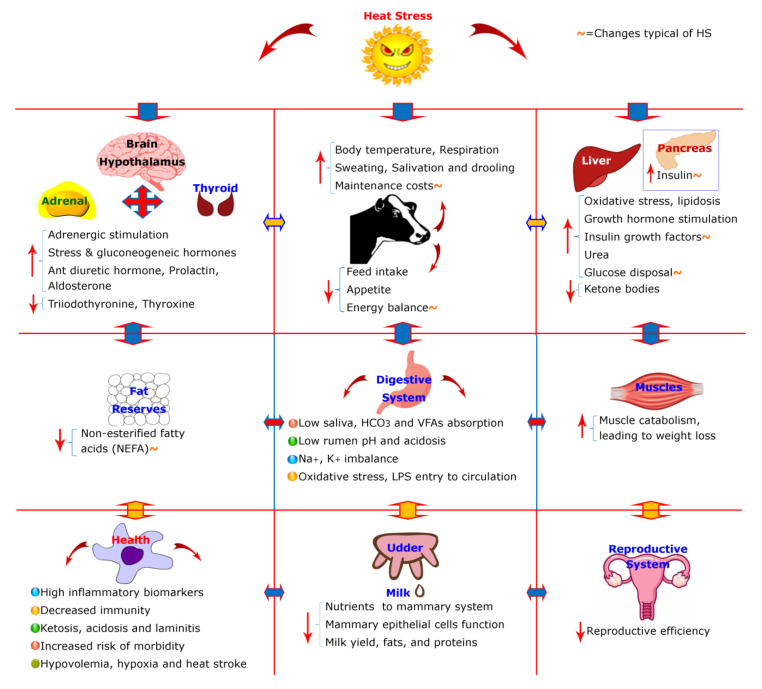
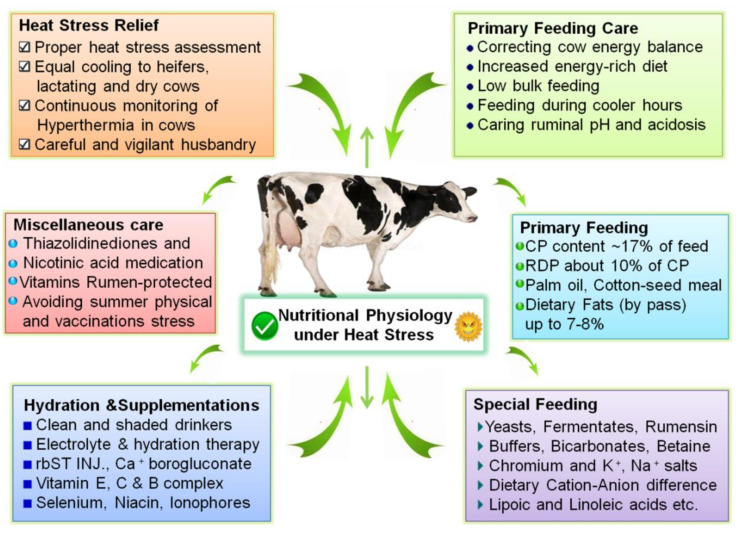
Higher milk yield and prolificacy of the modern dairy cattle requires high metabolism activities to support them. It causes high heat production by the body, which coupled with increasing environmental temperatures results in heat stress (HS). Production, health, and welfare of modern cattle are severely jeopardized due to their low adaptability to hot conditions. Animal activates a variety of physiological, endocrine, and behavioral mechanisms to cope with HS. Traditionally, decreased feed intake is considered as the major factor towards negative energy balance (NEBAL) leading to a decline in milk production. However, reciprocal changes related to insulin; glucose metabolism; failure of adipose mobilization; and skeletal muscle metabolism have appeared to be the major culprits behind HS specific NEBAL. There exists high insulin activity and glucose become preferential energy fuel. Physiological biochemistry of the heat stressed cows is characterized by low-fat reserves derived NEFA (non-esterified fatty acids) response, despite high energy demands. Besides these, physiological and gut-associated changes and poor feeding practices can further compromise the welfare and production of the heat-stressed cows. Better understanding of HS specific nutritional physiology and metabolic biochemistry of the dairy cattle will primarily help to devise practical interventions in this context. Proper assessment of the HS in cattle and thereby applying relevant cooling measures at dairy seems to be the basic mitigation approach. Score of the nutritional strategies be applied in the eve of HS should target supporting physiological responses of abatement and fulfilling the deficiencies possessed, such as water and minerals. Second line of abatement constitutes proper feeding, which could augment metabolic activities and synergizes energy support. The third line of supplemental supports should be directed towards modulating the metabolic (propionates, thiazolidinediones, dietary buffers, probiotics, and fermentates) and antioxidant responses (vitamins). Comprehensive understanding of the energetic metabolism dynamics under the impact of incremental heat load and complete outlook of pros and cons of the dietary ameliorating substances together with the discovery of the newer relevant supplementations constitutes the future avenues in this context.
现代奶牛的高产奶量和多产性需要高代谢活动来支持。这导致身体产生大量热量,再加上环境温度升高,就会引发热应激(HS)。由于现代奶牛对炎热条件的适应能力较低,其生产、健康和福利受到严重威胁。动物会激活各种生理、内分泌和行为机制来应对热应激。传统上,采食量减少被认为是导致负能量平衡(NEBAL)从而使产奶量下降的主要因素。然而,与胰岛素、葡萄糖代谢、脂肪动员失败和骨骼肌代谢相关的相互变化似乎是热应激特异性负能量平衡背后的主要原因。存在高胰岛素活性,葡萄糖成为优先的能量燃料。热应激奶牛的生理生化特征是尽管能量需求高,但来自非酯化脂肪酸(NEFA)的脂肪储备反应较低。除此之外,生理和肠道相关的变化以及不良的饲养方式会进一步损害热应激奶牛的福利和生产。更好地了解奶牛热应激特异性营养生理学和代谢生物化学将主要有助于在这种情况下制定实际的干预措施。正确评估奶牛的热应激情况,从而在奶牛场应用相关的降温措施似乎是基本的缓解方法。在热应激前夕应用的营养策略得分应旨在支持缓解的生理反应并弥补所存在的不足,如水和矿物质。第二道缓解措施是适当的饲养,这可以增强代谢活动并协同提供能量支持。第三道补充支持应针对调节代谢(丙酸盐、噻唑烷二酮、日粮缓冲剂、益生菌和发酵产物)和抗氧化反应(维生素)。全面了解增量热负荷影响下的能量代谢动态以及日粮改善物质的利弊全貌,再加上发现新的相关补充剂,构成了这方面未来的研究方向。