Department of Public Health Sciences, Penn State College of Medicine and Cancer Institute, 90 Hope Drive, Hershey, PA, 17033, USA.
Penn State Cancer Institute, Hershey, PA, USA.
BMC Cancer. 2020 May 6;20(1):394. doi: 10.1186/s12885-020-06902-5.
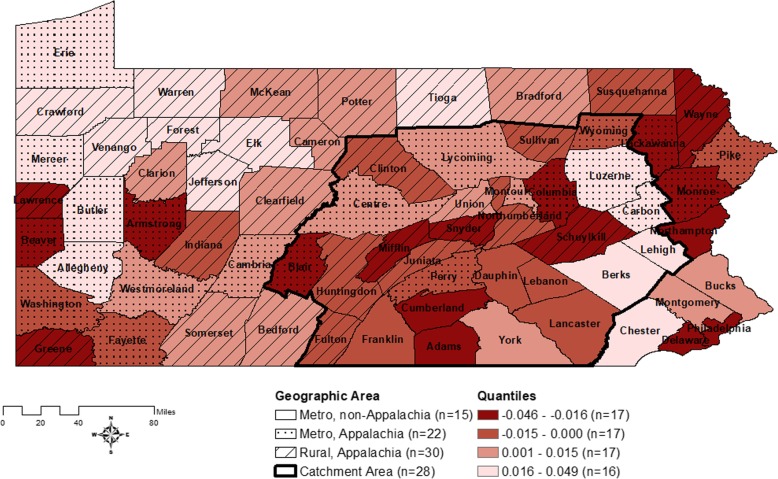
Spatial heterogeneity of prostate cancer-specific mortality in Pennsylvania remains unclear. We utilized advanced geospatial survival regressions to examine spatial variation of prostate cancer-specific mortality in PA and evaluate potential effects of individual- and county-level risk factors.
Prostate cancer cases, aged ≥40 years, were identified in the 2004-2014 Pennsylvania Cancer Registry. The 2018 County Health Rankings data and the 2014 U.S. Environmental Protection Agency's Environmental Quality Index were used to extract county-level data. The accelerated failure time models with spatial frailties for geographical correlations were used to assess prostate cancer-specific mortality rates for Pennsylvania and by the Penn State Cancer Institute (PSCI) 28-county catchment area. Secondary assessment based on estimated spatial frailties was conducted to identify potential health and environmental risk factors for mortality.
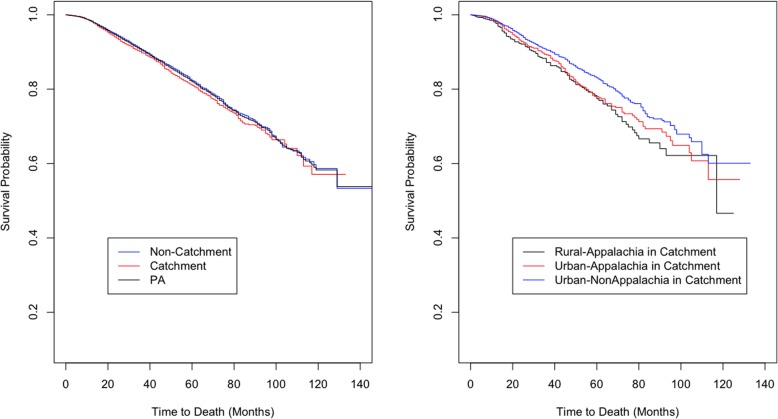
There were 94,274 cases included. The 5-year survival rate in PA was 82% (95% confidence interval, CI: 81.1-82.8%), with the catchment area having a lower survival rate 81% (95% CI: 79.5-82.6%) compared to the non-catchment area rate of 82.3% (95% CI: 81.4-83.2%). Black men, uninsured, more aggressive prostate cancer, rural and urban Appalachia, positive lymph nodes, and no definitive treatment were associated with lower survival. Several county-level health (i.e., poor physical activity) and environmental factors in air and land (i.e., defoliate chemical applied) were associated with higher mortality rates.
Spatial variations in prostate cancer-specific mortality rates exist in Pennsylvania with a higher risk in the PSCI's catchment area, in particular, rural-Appalachia. County-level health and environmental factors may contribute to spatial heterogeneity in prostate cancer-specific mortality.
宾夕法尼亚州前列腺癌特异性死亡率的空间异质性仍不清楚。我们利用先进的地理空间生存回归来检查宾夕法尼亚州前列腺癌特异性死亡率的空间变化,并评估个体和县级风险因素的潜在影响。
在 2004-2014 年宾夕法尼亚州癌症登记处确定年龄≥40 岁的前列腺癌病例。使用 2018 年县卫生排名数据和 2014 年美国环境保护署的环境质量指数提取县级数据。使用具有地理相关性空间脆弱性的加速失效时间模型评估宾夕法尼亚州和宾夕法尼亚州立癌症研究所(PSCI)28 县集水区的前列腺癌特异性死亡率。根据估计的空间脆弱性进行二次评估,以确定死亡的潜在健康和环境风险因素。
共纳入 94274 例病例。宾夕法尼亚州的 5 年生存率为 82%(95%置信区间,CI:81.1-82.8%),集水区的生存率为 81%(95%CI:79.5-82.6%)低于非集水区的 82.3%(95%CI:81.4-83.2%)。黑人男性、没有保险、更具侵袭性的前列腺癌、农村和城市阿巴拉契亚、阳性淋巴结和没有明确治疗与生存率降低相关。空气和土地中的一些县级健康(即体力活动差)和环境因素(即使用落叶化学物质)与更高的死亡率相关。
宾夕法尼亚州存在前列腺癌特异性死亡率的空间差异,特别是在 PSCI 的集水区,风险更高。县级健康和环境因素可能导致前列腺癌特异性死亡率的空间异质性。