School of Medicine, Division of Cardiovascular Diseases, Pontificia Universidad Católica de Chile, Diagonal Paraguay 362, Piso 7, 8320000, Santiago, Chile.
Center for New Drugs for Hypertension (CENDHY), Pontificia Universidad Católica de Chile, Santiago, Chile.
Cardiovasc Diabetol. 2020 May 6;19(1):56. doi: 10.1186/s12933-020-01027-2.
The intracellular ROCK signaling pathway is an important modulator of blood pressure and of cardiovascular and renal remodeling when Rho-kinase activity is increased. Besides, in preclinical models of diabetes, ROCK activation has also a role in abnormal glucose metabolism as well as in subsequent vascular and myocardial dysfunction. In humans, there are a few data assessing ROCK activation in patients with type 2 diabetes mellitus (T2D) and no studies assessing upstream/downstream components of the ROCK pathway. We assessed here levels of ROCK activation and some of the RhoA/ROCK cascade molecules in peripheral blood mononuclear cells (PBMCs) in T2D patients under current treatment.
Cross-sectional observational study comparing 28 T2D patients under current antidiabetic treatment with 31 consecutive healthy subjects, matched by age and gender. Circulating levels of malondialdehyde, angiotensin II and inflammatory cytokines IL-6 and IL-8 were determined in all subjects. ROCK activation in PMBCs, upstream and downstream cascade proteins, and levels of the proinflammatory molecules VCAM, ICAM-1 and IL-8 were determined in their PMBCs by Western blot.
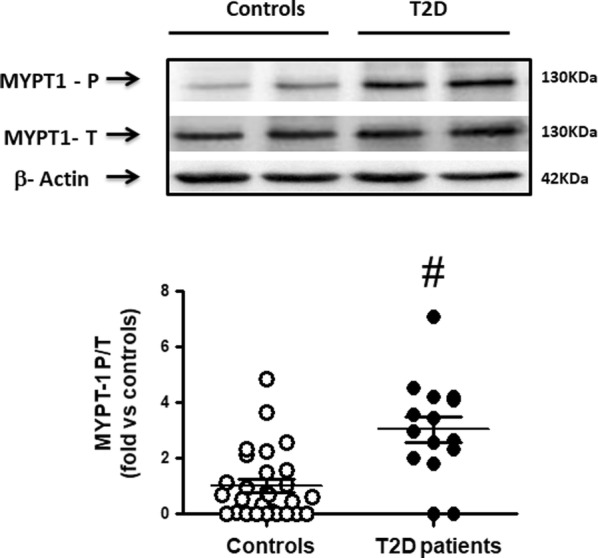
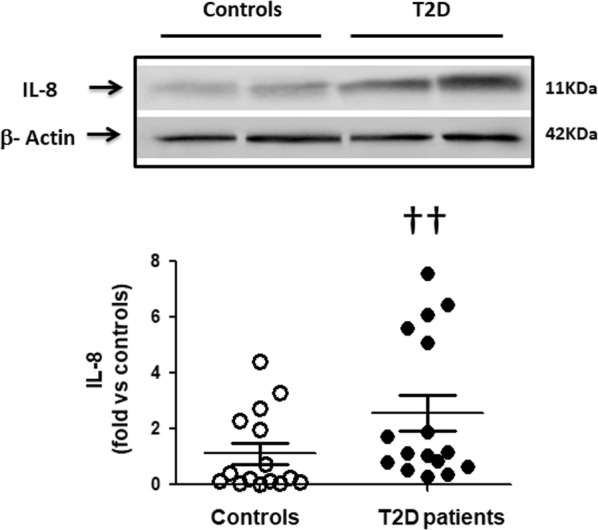
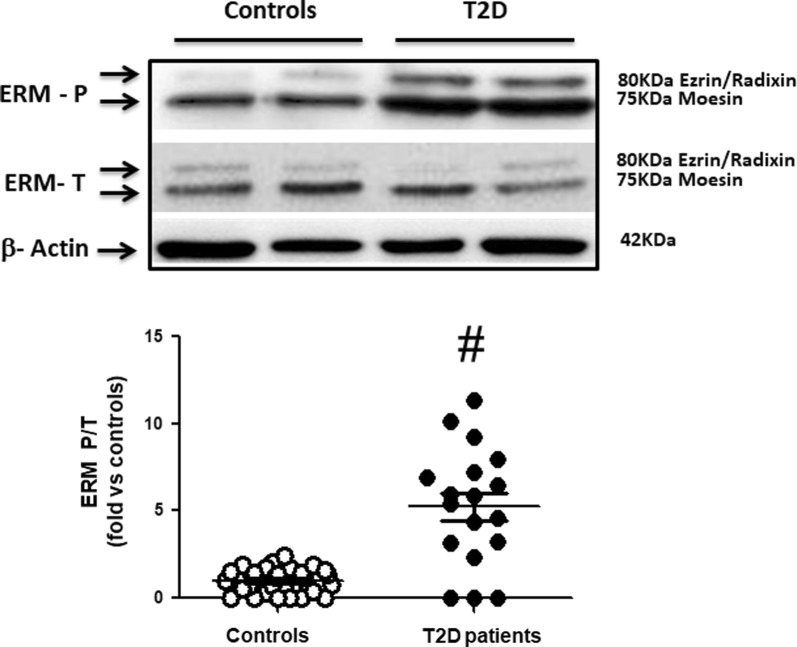
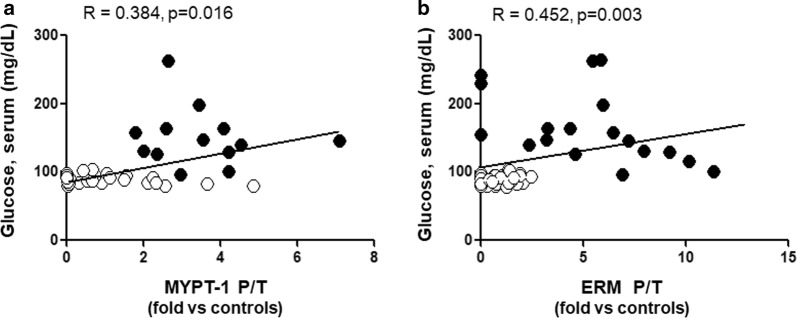
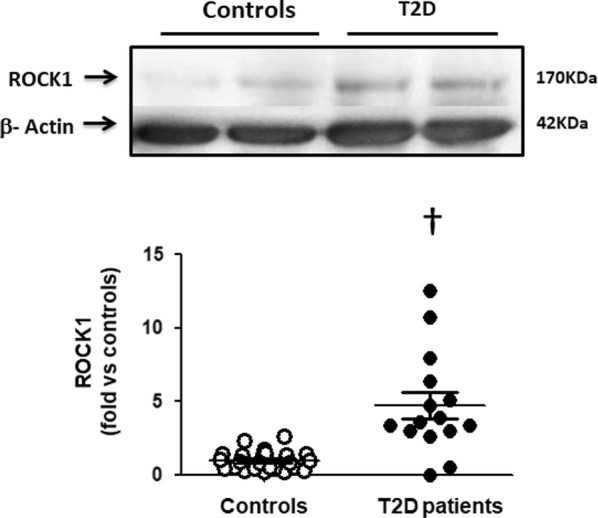
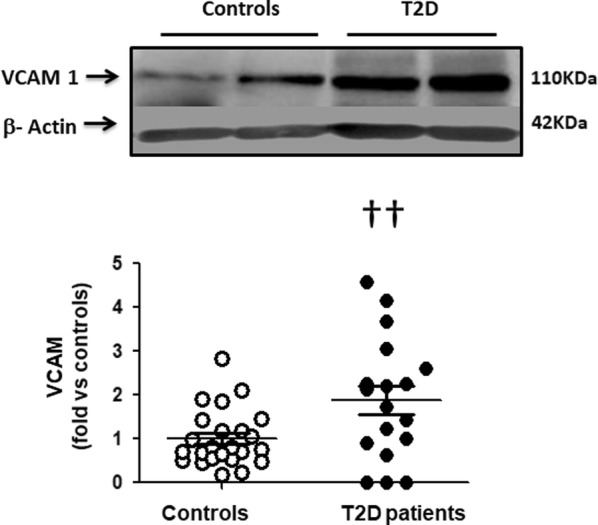
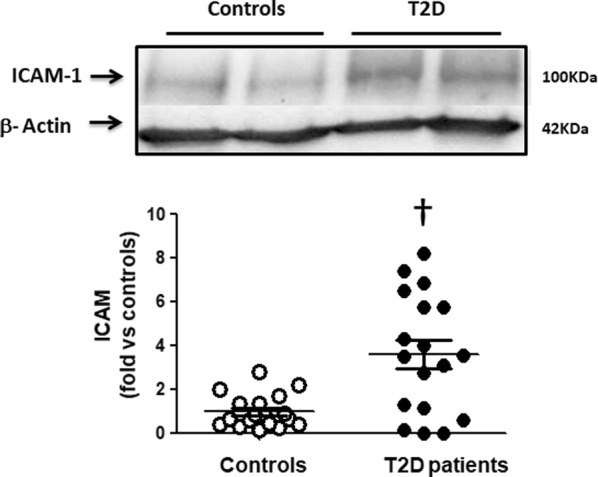
Compared to healthy controls, ROCK activation in T2D patients measured by 2 direct ROCK targets in PBMCs was increased by 420 and 570% (p < 0001) and it correlated significantly with serum glucose levels. p38 MAPK phosphorylation (downstream from ROCK) and JAK-2 (upstream from ROCK) were significantly higher in the T2D patients by 580% and 220%, respectively. In T2D patients, significantly increased PBMC levels of the proinflammatory molecules VCAM-1, ICAM-1 and IL-8 were observed compared to control subjects (by 180%, 360% and 260%, respectively). Circulating levels of Ang II and MDA were significantly higher in T2D patients by 29 and 63%, respectively.
T2D patients under treatment with glucose-lowering drugs, antihypertensive treatment as well as with statins have significantly increased ROCK activation in their circulating leukocytes along with higher phosphorylation of downstream cascade proteins despite pharmacologic treatment, along with increased plasma angiotensin II and MDA levels. ROCK inhibition might have an additional role in the prevention and treatment of T2D.
当 Rho-激酶活性增加时,细胞内的 ROCK 信号通路是调节血压以及心血管和肾脏重塑的重要调节剂。此外,在糖尿病的临床前模型中,ROCK 的激活在异常葡萄糖代谢以及随后的血管和心肌功能障碍中也发挥作用。在人类中,评估 2 型糖尿病(T2D)患者 ROCK 激活的研究很少,也没有研究评估 ROCK 通路的上游/下游成分。在这里,我们评估了在接受当前抗糖尿病治疗的 T2D 患者的外周血单核细胞(PBMC)中的 ROCK 激活水平以及 RhoA/ROCK 级联分子。
这是一项横断面观察性研究,比较了 28 名接受当前抗糖尿病治疗的 T2D 患者和 31 名连续健康受试者,这些受试者按年龄和性别匹配。所有受试者均测定循环丙二醛、血管紧张素 II 和炎症细胞因子 IL-6 和 IL-8 的水平。通过 Western blot 测定 PBMC 中的 ROCK 激活、上游和下游级联蛋白以及促炎分子 VCAM、ICAM-1 和 IL-8 的水平。
与健康对照组相比,T2D 患者 PBMC 中通过 2 种直接 ROCK 靶标测量的 ROCK 激活增加了 420%和 570%(p<0.0001),并且与血清葡萄糖水平显著相关。T2D 患者的 p38 MAPK 磷酸化(ROCK 的下游)和 JAK-2(ROCK 的上游)分别增加了 580%和 220%。与对照组相比,T2D 患者的 PBMC 中促炎分子 VCAM-1、ICAM-1 和 IL-8 的水平显著增加(分别增加 180%、360%和 260%)。T2D 患者的循环 Ang II 和 MDA 水平分别增加了 29%和 63%。
尽管进行了药物治疗,但接受降糖药物、降压治疗以及他汀类药物治疗的 T2D 患者,其循环白细胞中的 ROCK 激活明显增加,下游级联蛋白的磷酸化增加,同时血浆血管紧张素 II 和 MDA 水平升高。ROCK 抑制可能在 T2D 的预防和治疗中具有额外作用。