Department of Clinical Medicine, PET-Centre, Aarhus University, Aarhus, Denmark.
Department of Nuclear Medicine and PET Centre, Aarhus University Hospital, DK-8200, Aarhus N, Denmark.
J Neuroinflammation. 2020 May 6;17(1):151. doi: 10.1186/s12974-020-01820-6.
The aim of this longitudinal study was to assess with positron emission tomography (PET) the relationship between levels of inflammation and the loads of aggregated β-amyloid and tau at baseline and again after 2 years in prodromal Alzheimer's disease.
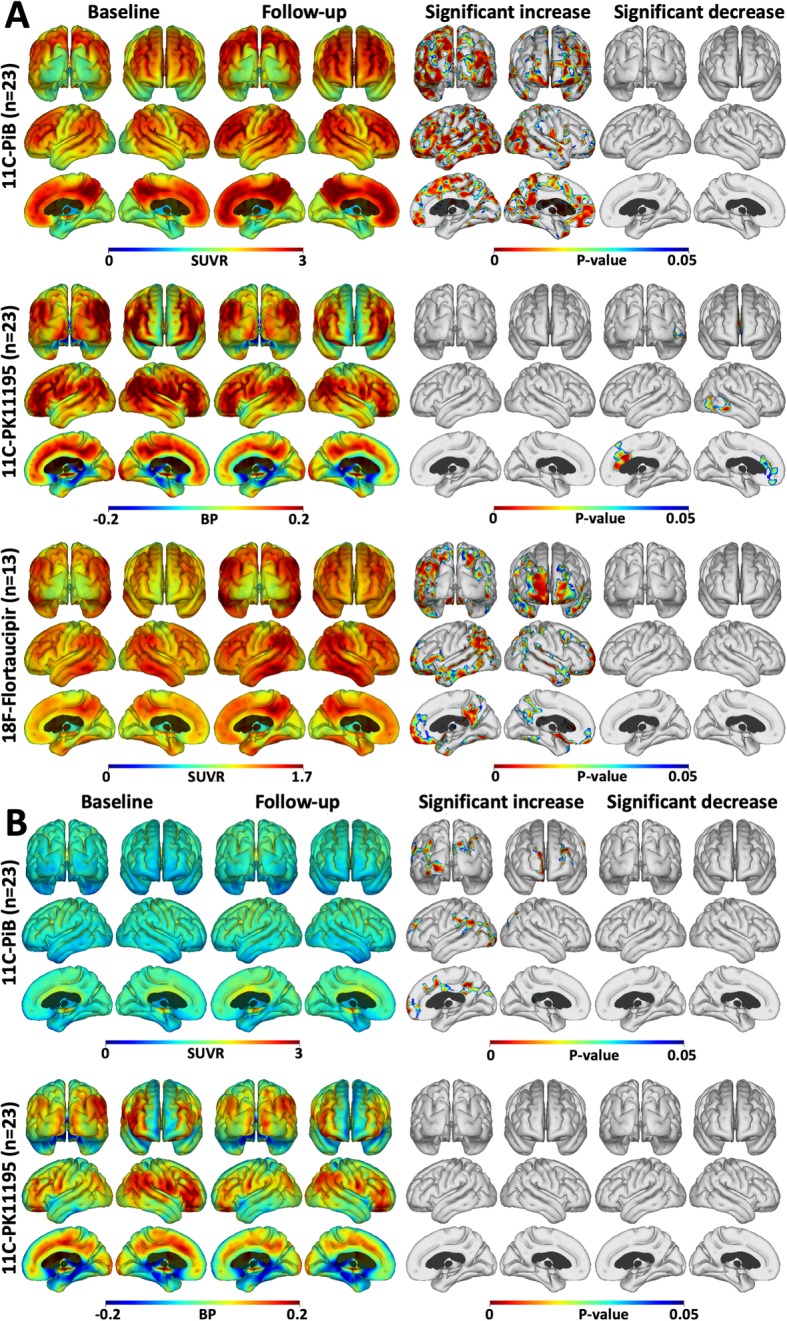
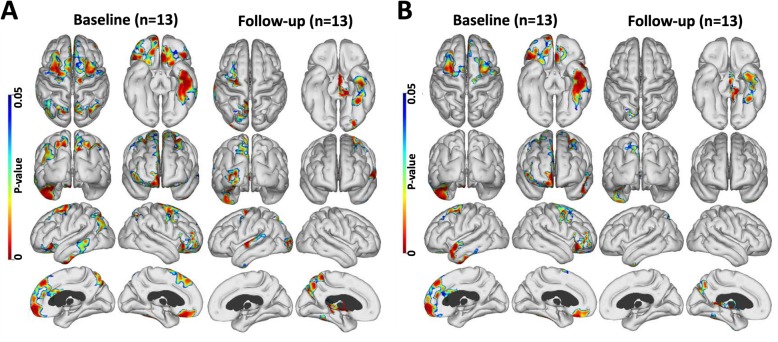
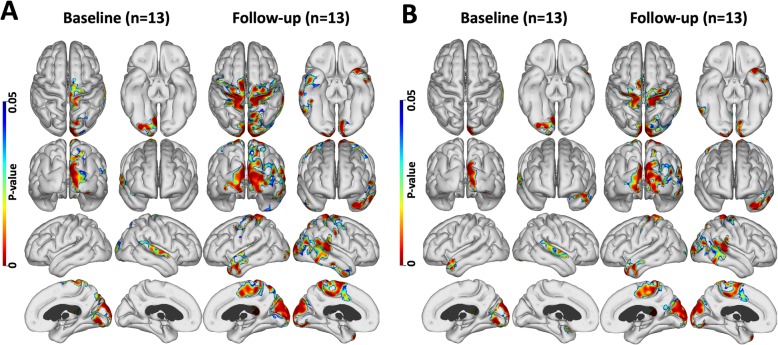
Forty-three subjects with mild cognitive impairment (MCI) had serial C-PK11195 PET over 2 years to measure inflammation changes, and C-PiB PET to determine β-amyloid fibril load; 22 also had serial F-Flortaucipir PET to determine tau tangle load. Cortical surface statistical mapping was used to localise areas showing significant changes in tracer binding over time and to interrogate correlations between tracer binding of the tracers at baseline and after 2 years.
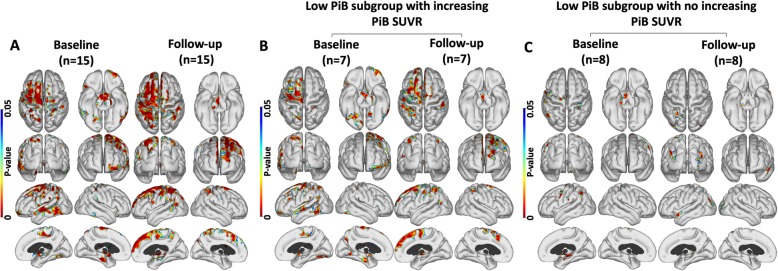
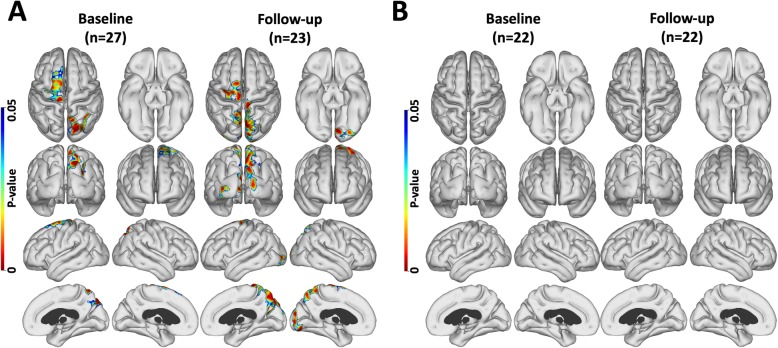
Those MCI subjects with high C-PiB uptake at baseline (classified as prodromal Alzheimer's disease) had raised inflammation levels which significantly declined across cortical regions over 2 years although their β-amyloid levels continued to rise. Those MCI cases who had low/normal C-PiB uptake at baseline but their levels then rose over 2 years were classified as prodromal AD with low Thal phase 1-2 amyloid deposition at baseline. They showed levels of cortical inflammation which correlated with their rising β-amyloid load. Those MCI cases with baseline low C-PiB uptake that remained stable were classified as non-AD, and they showed no correlated inflammation levels. Finally, MCI cases which showed both high C-PiB and F-Flortaucipir uptake at baseline (MCI due to AD) showed a further rise in their tau tangle load over 2 years with a correlated rise in levels of inflammation.
Our baseline and 2-year imaging findings are compatible with a biphasic trajectory of inflammation in Alzheimer's disease: MCI cases with low baseline but subsequently rising β-amyloid load show correlated levels of microglial activation which then later decline when the β-amyloid load approaches AD levels. Later, as tau tangles form in β-amyloid positive MCI cases with prodromal AD, the rising tau load is associated with higher levels of inflammation.
本纵向研究旨在通过正电子发射断层扫描(PET)评估炎症水平与淀粉样β蛋白和tau 聚集物负荷之间的关系,在前驱阿尔茨海默病患者中,基线和 2 年后再次评估。
43 名轻度认知障碍(MCI)患者在 2 年内进行连续 C-PK11195 PET 以测量炎症变化,并进行 C-PiB PET 以确定淀粉样蛋白纤维负荷;22 名患者还进行了连续 F-Flortaucipir PET 以确定 tau 缠结负荷。皮质表面统计映射用于定位示踪剂结合在时间上发生显著变化的区域,并探讨基线和 2 年后示踪剂结合之间的相关性。
基线时 C-PiB 摄取量高(归类为前驱阿尔茨海默病)的 MCI 患者炎症水平升高,尽管他们的淀粉样蛋白水平持续升高,但在 2 年内,皮质区域的炎症水平显著下降。那些基线时 C-PiB 摄取量低/正常但随后在 2 年内升高的 MCI 病例被归类为前驱阿尔茨海默病伴低 Thal 期 1-2 淀粉样蛋白沉积。他们的皮质炎症水平与不断升高的β-淀粉样蛋白负荷相关。基线时 C-PiB 摄取量低且稳定的 MCI 病例被归类为非 AD,他们没有相关的炎症水平。最后,基线时 C-PiB 和 F-Flortaucipir 摄取量均高的 MCI 病例(AD 引起的 MCI)在 2 年内 tau 缠结负荷进一步升高,炎症水平也随之升高。
我们的基线和 2 年影像学发现与阿尔茨海默病炎症的双相轨迹一致:基线时β-淀粉样蛋白负荷低但随后升高的 MCI 病例显示与小胶质细胞激活相关的水平,当β-淀粉样蛋白负荷接近 AD 水平时,小胶质细胞激活水平随后下降。之后,在具有前驱 AD 的β-淀粉样蛋白阳性 MCI 病例中形成 tau 缠结时,不断升高的 tau 负荷与更高水平的炎症相关。