Graduate School of Health and Sports Science, Juntendo University, Inzai, Chiba, Japan.
Sportology Center, Juntendo University Graduate School of Medicine, Bunkyo-ku, Tokyo, Japan; and.
J Strength Cond Res. 2022 May 1;36(5):1290-1296. doi: 10.1519/JSC.0000000000003622. Epub 2020 May 5.
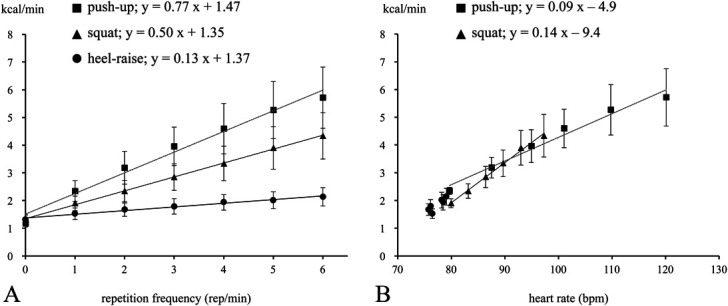
Nakagata, T, Yamada, Y, and Naito, H. Estimating energy cost of body weight resistance exercise using a multistage exercise test. J Strength Cond Res 36(5): 1290-1296, 2022-The purpose of this study was to examine energy cost of body weight resistance exercises with slow movement in young men using a multistage exercise test. Fifteen men aged 21-29 years performed 3 exercises (heel-raise, squat, and push-up) at different frequencies (1, 2, 3, 4, 5, and 6 repetitions·min-1). Oxygen consumption was measured using indirect calorimetry; we then computed a simple linear regression between aerobic energy expenditure (EE) and repetition frequency. The slope coefficient in the regression represents the energy cost of those exercises; we compared the extrapolated EE for a frequency of 10 repetitions·min-1. Gross EE increased linearly with repetition frequency in all subjects (y = ax + b). Energy cost was significantly greater in the case of the push-up than in the case of the squat {squat: 0.50 ± 0.14 (95% confidence interval [CI], 0.42-0.58); push-up: 0.77 ± 0.20 kcal (95% CI, 0.66-0.88); and the heel-raise elicited the lowest energy cost: 0.13 ± 0.04 kcal (95% CI, 0.11-0.15)}. Extrapolated EE at 10 repetitions·min-1 was 2.7 ± 0.5 kcal (2.3 metabolic equivalents [METs]), 6.3 ± 1.4 kcal (5.4 METs), and 9.2 ± 2.1 kcal (7.8 METs), respectively, according to the regression based on aerobic EE. These results will be useful for health professionals in prescribing resistance exercise programs improving muscle fitness and considering for weight management.
中田、山田和内藤。使用多级运动测试估计体重阻力运动的能量消耗。J 力量与调理研究 36(5):1290-1296,2022-本研究的目的是使用多级运动测试检查年轻人缓慢运动的体重阻力运动的能量消耗。15 名年龄在 21-29 岁的男性以不同频率(1、2、3、4、5 和 6 次·分钟-1)进行 3 种运动(脚跟抬高、深蹲和俯卧撑)。使用间接测热法测量耗氧量;然后,我们在有氧能量消耗 (EE) 和重复频率之间进行简单的线性回归。回归中的斜率系数代表这些练习的能量消耗;我们比较了频率为 10 次·分钟-1时的 EE 外推值。所有受试者的总 EE 均随重复频率呈线性增加(y = ax + b)。与深蹲相比,俯卧撑的能量消耗明显更高{深蹲:0.50 ± 0.14(95%置信区间 [CI],0.42-0.58);俯卧撑:0.77 ± 0.20 千卡(95% CI,0.66-0.88);而脚跟抬高的能量消耗最低:0.13 ± 0.04 千卡(95% CI,0.11-0.15)}。根据基于有氧 EE 的回归,在 10 次·分钟-1时的 EE 外推值分别为 2.7 ± 0.5 千卡(2.3 代谢当量 [MET])、6.3 ± 1.4 千卡(5.4 MET)和 9.2 ± 2.1 千卡(7.8 MET)。这些结果对于制定提高肌肉健康并考虑体重管理的阻力运动计划的健康专业人员将非常有用。