Center for Access & Delivery Research & Evaluation (CADRE), Iowa City VA Health Care System, Iowa City, Iowa, USA.
Primary Care Analytics Team-Iowa City, Iowa City VA Health Care System, Iowa City, Iowa, USA.
J Am Geriatr Soc. 2020 Sep;68(9):2006-2014. doi: 10.1111/jgs.16498. Epub 2020 May 7.
To identify the perceived organizational resources required by healthcare workers to deliver geriatric primary care in a geriatric patient aligned care team (GeriPACT).
Cross-sectional observational study using deductive analyses of qualitative interviews conducted with GeriPACT team members.
GeriPACTs practicing at eight geographically dispersed Department of Veterans Affairs (VA) healthcare systems.
GeriPACT clinicians, nurses, clerical associates, clinical pharmacists, and social workers (n = 67).
Semistructured qualitative interviews conducted in person, transcribed, and then analyzed using the PACT Resources Framework.
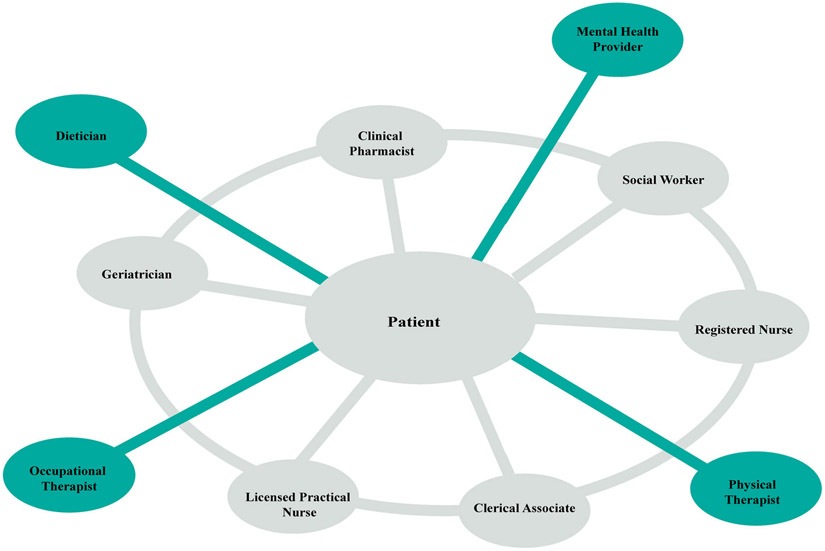
Using the PACT Resources Framework, we identified facility-, clinic-, and team-level resources critical for GeriPACT implementation. Resources within each level reflect how the needs of older adults with complex comorbidity intersect with general population primary care medical home practice. GeriPACT implementation is facilitated by attention to patient characteristics such as cognitive impairment, ambulatory limitations, or social support services in staffing and resourcing teams.
Models of geriatric primary care such as GeriPACT must be implemented with an eye toward the most effective use of our most limited resource-trained geriatricians. In contrast to much of the literature on medical home teams serving a general adult population, interviews with GeriPACT members emphasize how patient needs inform all aspects of practice design including universal accessibility, near real-time response to patient needs, and ongoing interdisciplinary care coordination. Examination of GeriPACT implementation resources through the lens of traditional primary care teams illustrates the importance of tailoring primary care design to the needs of older adults with complex comorbidity.
确定医疗保健工作者在老年患者一致护理团队(GeriPACT)中提供老年初级保健所需的感知组织资源。
使用与 GeriPACT 团队成员进行的定性访谈的演绎分析进行的横断面观察性研究。
在八个地理位置分散的退伍军人事务部(VA)医疗保健系统中实践的 GeriPACT。
GeriPACT 临床医生、护士、办事员、临床药师和社会工作者(n = 67)。
在现场进行半结构化定性访谈,转录,然后使用 PACT 资源框架进行分析。
使用 PACT 资源框架,我们确定了设施、诊所和团队层面对于 GeriPACT 实施至关重要的资源。每个层面的资源反映了具有复杂合并症的老年人的需求与普通人群初级保健医疗之家实践的交集。通过在人员配备和资源团队中关注认知障碍、活动能力受限或社会支持服务等患者特征,促进了 GeriPACT 的实施。
像 GeriPACT 这样的老年初级保健模式必须着眼于最有效地利用我们最有限的资源——老年医学专家。与服务一般成年人口的医疗之家团队的大部分文献相比,对 GeriPACT 成员的采访强调了患者需求如何告知实践设计的各个方面,包括普遍可及性、对患者需求的近乎实时响应以及持续的跨学科护理协调。通过传统初级保健团队的视角检查 GeriPACT 的实施资源,说明了根据患有复杂合并症的老年人的需求调整初级保健设计的重要性。