Clinical Epidemiology and Biostatistics, School of Medical Sciences, Örebro University, 70182, Örebro, Sweden.
Faculty of Medicine and Health, School of Medical Sciences, Department of Surgery, Örebro University, Örebro, Sweden.
BMC Med Inform Decis Mak. 2020 May 7;20(1):86. doi: 10.1186/s12911-020-1100-9.
Geriatric patients frequently undergo emergency general surgery and accrue a greater risk of postoperative complications and fatal outcomes than the general population. It is highly relevant to develop the most appropriate care measures and to guide patient-centered decision-making around end-of-life care. Portsmouth - Physiological and Operative Severity Score for the enumeration of Mortality and morbidity (P-POSSUM) has been used to predict mortality in patients undergoing different types of surgery. In the present study, we aimed to evaluate the relative importance of the P-POSSUM score for predicting 90-day mortality in the elderly subjected to emergency laparotomy from statistical aspects.
One hundred and fifty-seven geriatric patients aged ≥65 years undergoing emergency laparotomy between January 1st, 2015 and December 31st, 2016 were included in the study. Mortality and 27 other patient characteristics were retrieved from the computerized records of Örebro University Hospital in Örebro, Sweden. Two supervised classification machine methods (logistic regression and random forest) were used to predict the 90-day mortality risk. Three scalers (Standard scaler, Robust scaler and Min-Max scaler) were used for variable engineering. The performance of the models was evaluated using accuracy, sensitivity, specificity and area under the receiver operating characteristic curve (AUC). Importance of the predictors were evaluated using permutation variable importance and Gini importance.
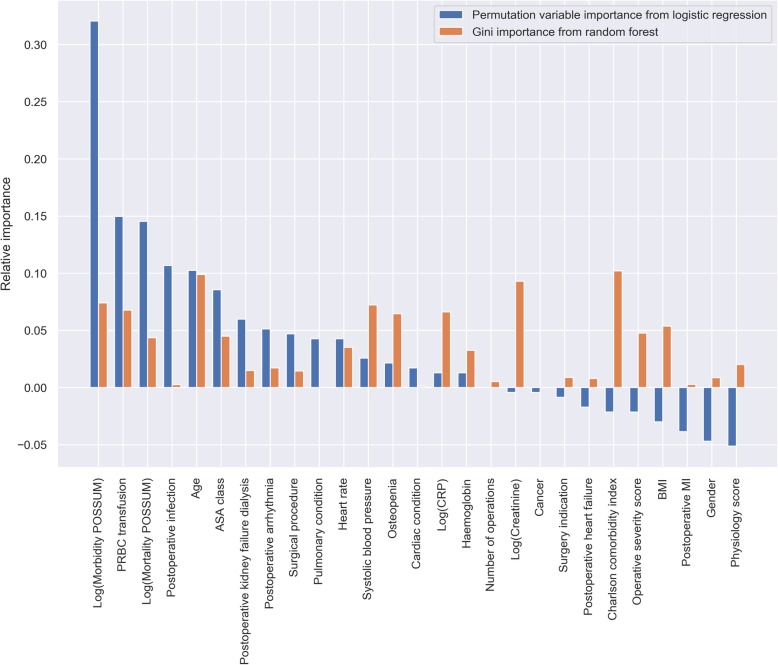
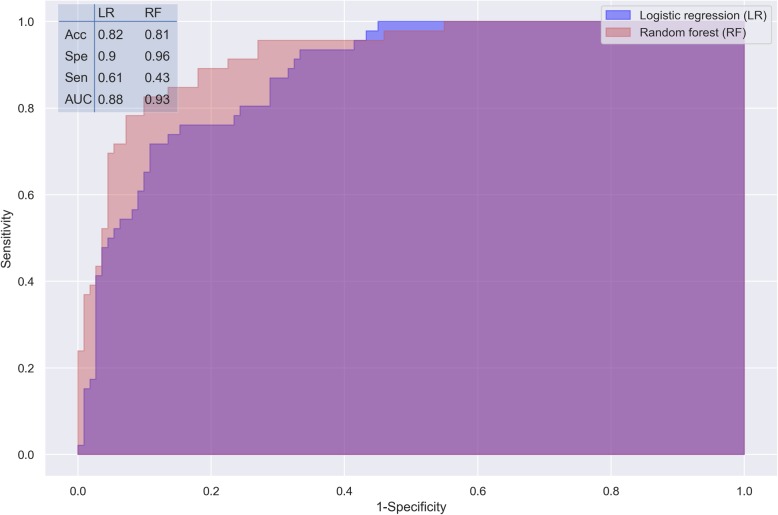
The mean age of the included patients was 75.4 years (standard deviation =7.3 years) and the 90-day mortality rate was 29.3%. The most common indication for surgery was bowel obstruction occurring in 92 (58.6%) patients. Types of post-operative complications ranged between 7.0-36.9% with infection being the most common type. Both the logistic regression and random forest models showed satisfactory performance for predicting 90-day mortality risk in geriatric patients after emergency laparotomy, with AUCs of 0.88 and 0.93, respectively. Both models had an accuracy > 0.8 and a specificity ≥0.9. P-POSSUM had the greatest relative importance for predicting 90-day mortality in the logistic regression model and was the fifth important predictor in the random forest model. No notable change was found in sensitivity analysis using different variable engineering methods with P-POSSUM being among the five most accurate variables for mortality prediction.
P-POSSUM is important for predicting 90-day mortality after emergency laparotomy in geriatric patients. The logistic regression model and random forest model may have an accuracy of > 0.8 and an AUC around 0.9 for predicting 90-day mortality. Further validation of the variables' importance and the models' robustness is needed by use of larger dataset.
老年患者经常接受急诊普通外科手术,比普通人群更容易发生术后并发症和致命后果。开发最合适的护理措施并指导以患者为中心的临终关怀决策非常重要。朴茨茅斯-生理和手术严重度评分用于死亡率和发病率的评估(P-POSSUM)已被用于预测接受不同类型手术的患者的死亡率。在本研究中,我们旨在从统计学角度评估 P-POSSUM 评分对预测接受急诊剖腹手术的老年患者 90 天死亡率的相对重要性。
纳入了 2015 年 1 月 1 日至 2016 年 12 月 31 日期间在瑞典于默奥大学医院接受急诊剖腹手术的 157 名年龄≥65 岁的老年患者。从计算机记录中检索了死亡率和 27 个其他患者特征。使用两种监督分类机方法(逻辑回归和随机森林)来预测 90 天死亡率风险。使用三种标度器(标准标度器、鲁棒标度器和最小-最大标度器)进行变量工程。使用准确性、敏感性、特异性和接收器工作特征曲线下面积(AUC)评估模型的性能。使用置换变量重要性和基尼重要性评估预测因子的重要性。
纳入患者的平均年龄为 75.4 岁(标准差=7.3 岁),90 天死亡率为 29.3%。手术的最常见指征是肠梗阻,有 92 例(58.6%)患者发生。术后并发症类型在 7.0-36.9%之间,感染是最常见的类型。逻辑回归和随机森林模型在预测接受急诊剖腹手术后老年患者 90 天死亡率方面均表现出令人满意的性能,AUC 分别为 0.88 和 0.93。两个模型的准确性均>0.8,特异性均≥0.9。P-POSSUM 在逻辑回归模型中对预测 90 天死亡率具有最重要的相对重要性,并且是随机森林模型中第五个最重要的预测因子。使用不同的变量工程方法进行敏感性分析时,发现敏感性没有明显变化,P-POSSUM 是死亡率预测中五个最准确的变量之一。
P-POSSUM 对于预测老年患者急诊剖腹手术后 90 天死亡率很重要。逻辑回归模型和随机森林模型可能具有>0.8 的准确性和 0.9 左右的 AUC,用于预测 90 天死亡率。需要使用更大的数据集进一步验证变量重要性和模型稳健性。