Department of Physical Therapy, Faculty of Health Science, Health Science University, 7187 Kodachi, Fujikawaguchiko-machi, Minamitsuru-gun, Yamanashi 401-0380, Japan.
Department of Physical Therapy, Saitama Medical University, 981 Kawakado, Moroyama-machi, Iruma-gun, Saitama 350-0496, Japan.
Medicina (Kaunas). 2020 May 6;56(5):219. doi: 10.3390/medicina56050219.
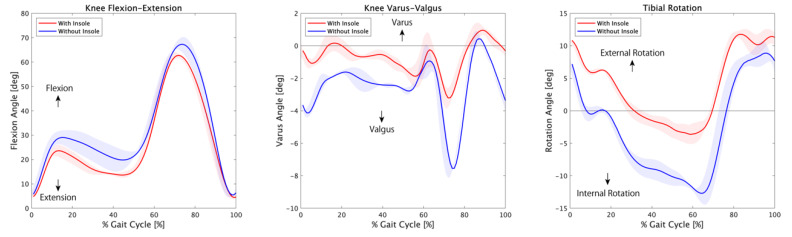
: Patients with Down syndrome have many orthopedic problems including flat foot. Insertion of an insole for a flat foot provides support to the medial longitudinal arch; thus, insole therapy is often used to treat a flat foot. However, the influence of an insole insertion on the knee joint kinematics for a patient with Down syndrome is unknown. This study aimed to elucidate the influence of an insole for a flat foot on the knee kinematics during gait for a patient with Down syndrome. : The subject was a 22-year-old male with Down syndrome who had a flat foot. The knee joint angle during the gait was measured using a 3D motion capture system that consisted of eight infrared cameras. : The gait analysis demonstrated a reduction in the knee flexion angle during double knee action. The knee valgus and tibial internal rotation angles also decreased during the loading response phase while wearing shoes that contained the insole. : As the angle of the knee joint decreased during the gait, it was considered that the stability of the knee joint improved by inserting the insole. In particular, there was a large difference in the tibial internal rotation angle when the insole was inserted. It is thus hypothesized that the insole contributes to the rotational stability of the knee joint. This study suggests that knee stability may improve and that gait becomes more stable when a Down syndrome patient with a flat foot wears an insole.
唐氏综合征患者有许多骨科问题,包括扁平足。为扁平足插入鞋垫可提供对内侧纵弓的支撑;因此,鞋垫疗法常用于治疗扁平足。然而,对于唐氏综合征患者,鞋垫插入对膝关节运动学的影响尚不清楚。本研究旨在阐明为扁平足患者插入鞋垫对唐氏综合征患者步态时膝关节运动学的影响。
研究对象为一名 22 岁男性唐氏综合征患者,患有扁平足。使用由八个红外摄像机组成的 3D 运动捕捉系统测量膝关节角度。
步态分析显示,在双膝动作期间,膝关节的屈曲角度减小。在穿鞋时,在负重反应阶段,膝关节外翻和胫骨内旋角度也减小。
由于膝关节角度在步态过程中减小,因此可以认为插入鞋垫可以提高膝关节的稳定性。特别是当插入鞋垫时,胫骨内旋角度有很大差异。因此,可以假设鞋垫有助于膝关节的旋转稳定性。本研究表明,当患有扁平足的唐氏综合征患者穿鞋垫时,膝关节的稳定性可能会提高,步态也会变得更加稳定。