Institute of Applied Health Research, University of Birmingham, Birmingham, UK.
Clinical Epidemiology Program, Ottawa Hospital Research Institute, Ottawa, ON, Canada.
Int J Epidemiol. 2020 Jun 1;49(3):1043-1052. doi: 10.1093/ije/dyaa077.
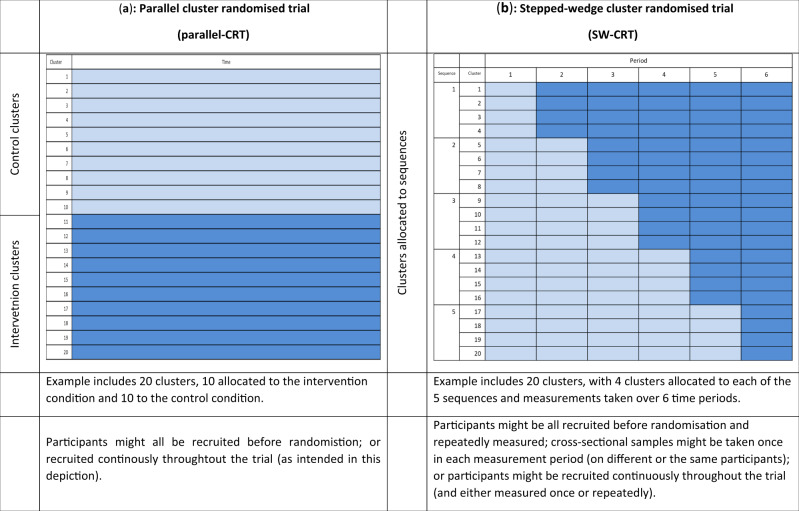
The stepped-wedge cluster randomized trial (SW-CRT) involves the sequential transition of clusters (such as hospitals, public health units or communities) from control to intervention conditions in a randomized order. The use of the SW-CRT is growing rapidly. Yet the SW-CRT is at greater risks of bias compared with the conventional parallel cluster randomized trial (parallel-CRT). For this reason, the CONSORT extension for SW-CRTs requires that investigators provide a clear justification for the choice of study design. In this paper, we argue that all other things being equal, the SW-CRT is at greater risk of bias due to misspecification of the secular trends at the analysis stage. This is particularly problematic for studies randomizing a small number of heterogeneous clusters. We outline the potential conditions under which an SW-CRT might be an appropriate choice. Potentially appropriate and often overlapping justifications for conducting an SW-CRT include: (i) the SW-CRT provides a means to conduct a randomized evaluation which otherwise would not be possible; (ii) the SW-CRT facilitates cluster recruitment as it enhances the acceptability of a randomized evaluation either to cluster gatekeepers or other stakeholders; (iii) the SW-CRT is the only feasible design due to pragmatic and logistical constraints (for example the roll-out of a scare resource); and (iv) the SW-CRT has increased statistical power over other study designs (which will include situations with a limited number of clusters). As the number of arguments in favour of an SW-CRT increases, the likelihood that the benefits of using the SW-CRT, as opposed to a parallel-CRT, outweigh its risks also increases. We argue that the mere popularity and novelty of the SW-CRT should not be a factor in its adoption. In situations when a conventional parallel-CRT is feasible, it is likely to be the preferred design.
阶梯式群组随机试验 (SW-CRT) 涉及以随机顺序将群组(如医院、公共卫生单位或社区)从对照条件逐步过渡到干预条件。SW-CRT 的使用正在迅速增加。然而,与传统的平行群组随机试验 (parallel-CRT) 相比,SW-CRT 更容易出现偏差。出于这个原因,SW-CRT 的 CONSORT 扩展要求研究人员对研究设计的选择提供明确的理由。在本文中,我们认为,在其他条件相同的情况下,由于在分析阶段对季节性趋势的指定不正确,SW-CRT 更容易出现偏差。对于随机分配少量异质群组的研究来说,这尤其成问题。我们概述了 SW-CRT 可能成为适当选择的潜在条件。进行 SW-CRT 的潜在适当且经常重叠的理由包括:(i) SW-CRT 提供了一种进行随机评估的方法,否则这将是不可能的;(ii) SW-CRT 促进了群组招募,因为它提高了群组管理员或其他利益相关者对随机评估的接受程度;(iii) SW-CRT 是唯一可行的设计,因为实际和后勤方面的限制(例如,稀缺资源的推出);(iv) SW-CRT 相对于其他研究设计具有更高的统计效力(这将包括集群数量有限的情况)。随着支持 SW-CRT 的论点数量的增加,使用 SW-CRT 而不是 parallel-CRT 的好处超过其风险的可能性也会增加。我们认为,SW-CRT 的流行度和新颖性本身不应成为其采用的因素。在可行的情况下,传统的平行 CRT 很可能是首选设计。