Modes Matthew E, Heckbert Susan R, Engelberg Ruth A, Nielsen Elizabeth L, Curtis J Randall, Kross Erin K
Division of Pulmonary, Critical Care and Sleep Medicine, University of Washington, Seattle, Washington, USA; Cambia Palliative Care Center of Excellence, University of Washington, Seattle, Washington, USA.
Department of Epidemiology, University of Washington, Seattle, Washington, USA.
J Pain Symptom Manage. 2020 Oct;60(4):765-773. doi: 10.1016/j.jpainsymman.2020.04.026. Epub 2020 May 7.
Goal-concordant care is an important indicator of high-quality care in serious illness.
To estimate the prevalence of patient-reported receipt of goal-concordant care among seriously ill outpatients and identify factors associated with the absence of patient-reported goal concordance.
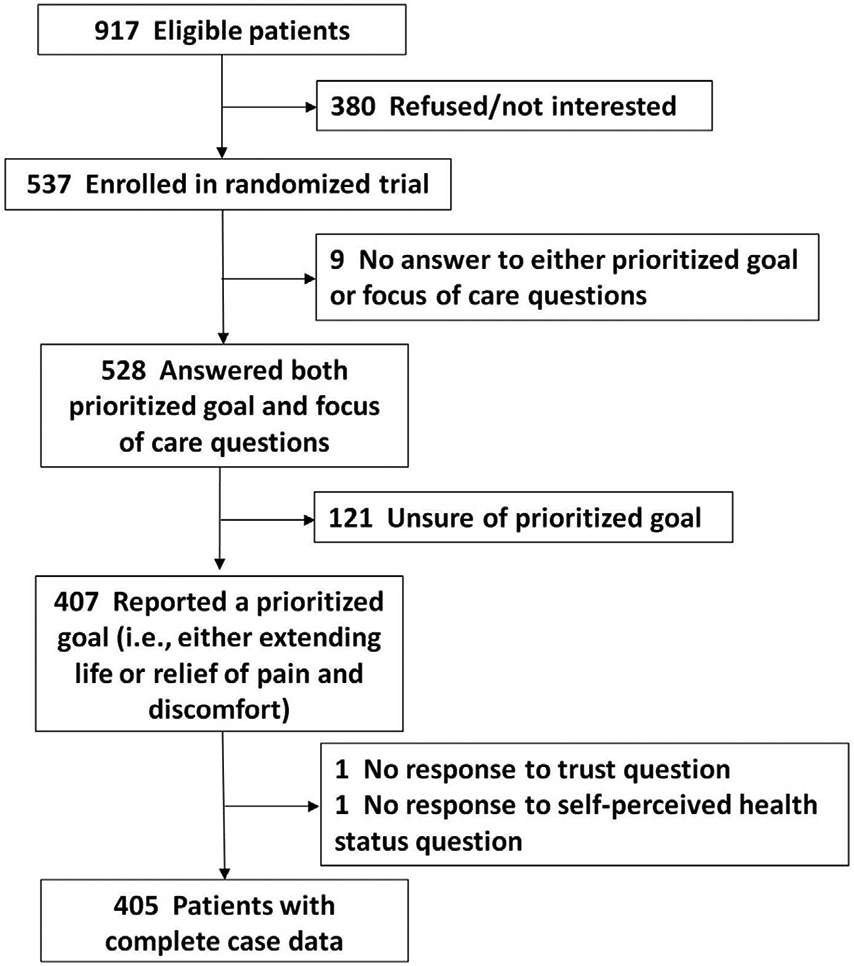
Analysis of enrollment surveys from a multicenter cluster-randomized trial of outpatients with serious illness. Patients reported their prioritized health care goal and the focus of their current medical care; these items were matched to define receipt of goal-concordant care.
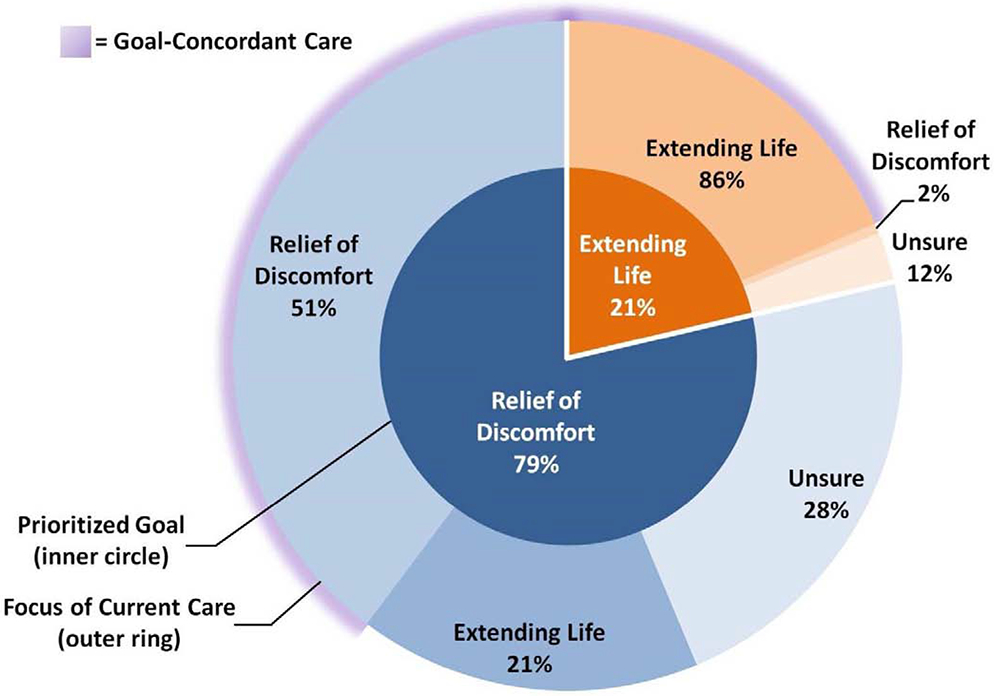
Of 405 patients with a prioritized health care goal, 58% reported receipt of goal-concordant care, 17% goal-discordant care, and 25% were uncertain of the focus of their care. Patient-reported receipt of goal concordance differed by patient goal. For patients who prioritized extending life, 86% reported goal-concordant care, 2% goal-discordant care, and 12% were uncertain of the focus of their care. For patients who prioritized relief of pain and discomfort, 51% reported goal-concordant care, 21% goal-discordant care, and 28% were uncertain of the focus of their care. Patients who prioritized a goal of relief of pain and discomfort were more likely to report goal-discordant care than patients who prioritized a goal of extending life (relative risk ratio 22.20; 95% CI 4.59, 107.38).
Seriously ill outpatients who prioritize a goal of relief of pain and discomfort are less likely to report receipt of goal-concordant care than patients who prioritize extending life. Future interventions designed to improve receipt of goal-concordant care should focus on identifying patients who prioritize relief of pain and discomfort and promoting care aligned with that goal.
目标一致的照护是重症患者高质量照护的重要指标。
评估重症门诊患者报告的目标一致照护的接受率,并确定与患者报告的目标不一致相关的因素。
对一项针对重症门诊患者的多中心整群随机试验的入组调查进行分析。患者报告其优先的医疗保健目标和当前医疗照护的重点;将这些项目进行匹配以确定目标一致照护的接受情况。
在405名有优先医疗保健目标的患者中,58%报告接受了目标一致照护,17%报告接受了目标不一致照护,25%不确定其照护重点。患者报告的目标一致接受情况因患者目标而异。对于将延长生命作为优先目标的患者,86%报告接受了目标一致照护,2%报告接受了目标不一致照护,12%不确定其照护重点。对于将缓解疼痛和不适作为优先目标的患者,51%报告接受了目标一致照护,21%报告接受了目标不一致照护,28%不确定其照护重点。将缓解疼痛和不适作为优先目标的患者比将延长生命作为优先目标的患者更有可能报告目标不一致照护(相对风险比22.20;95%置信区间4.59,107.38)。
与将延长生命作为优先目标的患者相比,将缓解疼痛和不适作为优先目标的重症门诊患者报告接受目标一致照护的可能性较小。未来旨在改善目标一致照护接受情况的干预措施应侧重于识别将缓解疼痛和不适作为优先目标的患者,并促进与该目标一致的照护。