Shen Jun, Tozer Daniel J, Markus Hugh S, Tay Jonathan
From the Stroke Research Group, Department of Clinical Neurosciences, University of Cambridge, United Kingdom (J.S., D.J.T., H.S.M., J.T.).
Department of Neurology, Zhongnan Hospital of Wuhan University, China (J.S.).
Stroke. 2020 Jun;51(6):1682-1689. doi: 10.1161/STROKEAHA.119.028587. Epub 2020 May 11.
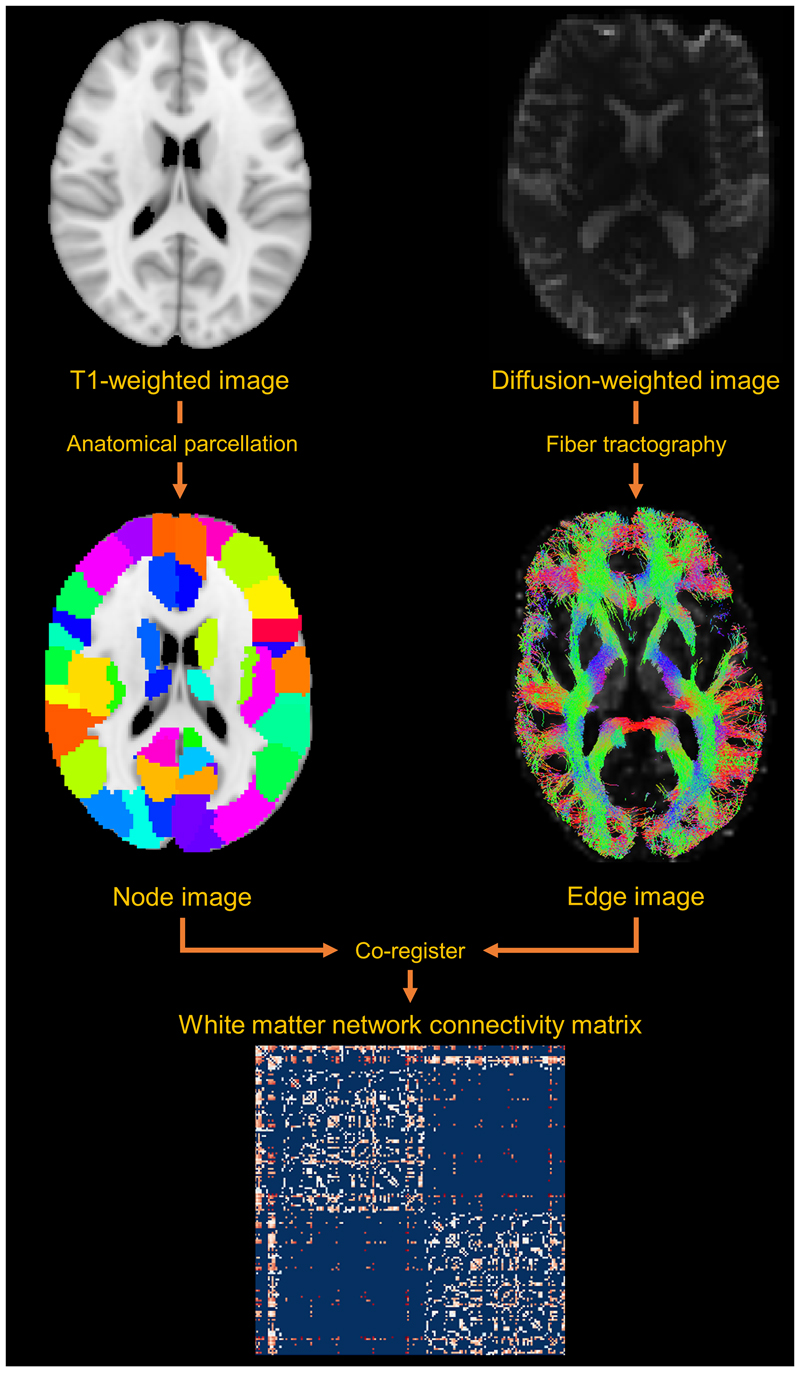
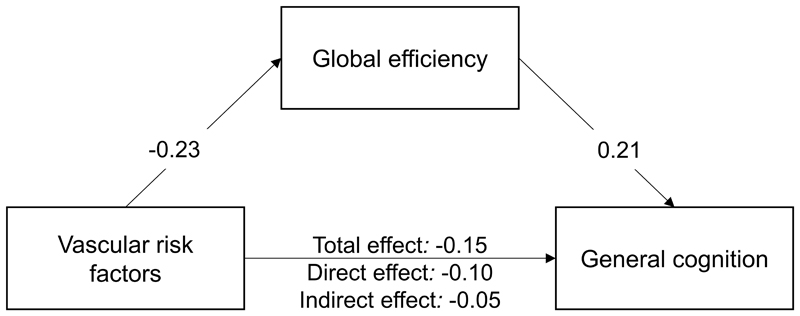
Background and Purpose- Cerebrovascular disease contributes to age-related cognitive decline, but the mechanisms underlying this phenomenon remain incompletely understood. We hypothesized that vascular risk factors would lead to cognitive impairment through the disruption of brain white matter network efficiency. Methods- Participants were 19 346 neurologically healthy individuals from UK Biobank that underwent diffusion MRI and cognitive testing (mean age=62.6). Global efficiency, a measure of network integration, was calculated from white matter networks constructed using deterministic diffusion tractography. First, we determined whether demographics (age, sex, ethnicity, socioeconomic status, and education), vascular risk factors (hypertension, hypercholesterolemia, diabetes mellitus, smoking, body mass index), and white matter hyperintensities were related to global efficiency using multivariate linear regression. Next, we used structural equation modeling to model a multiple regression. The dependent variable was a latent cognition variable using all cognitive data, while independent variables were a latent factor including all vascular risk factors (vascular burden), demographic variables, white matter hyperintensities, and global efficiency. Finally, we used mediation analysis to determine whether global efficiency explained the relationship between vascular burden and cognition. Results- Hypertension and diabetes mellitus were consistently associated with reduced global efficiency even after controlling for white matter hyperintensities. Structural equation models revealed that vascular burden was associated with cognition (=0.023), but not after adding global efficiency to the model (=0.09), suggesting a mediation effect. Mediation analysis revealed a significant indirect effect of global efficiency on cognition through vascular burden (<0.001), suggesting a partial mediation effect. Conclusions- Vascular burden is associated with reduced global efficiency and cognitive impairment in the general population. Network efficiency partially mediates the relationship between vascular burden and cognition. This suggests that treating specific risk factors may prevent reductions in brain network efficiency and preserve cognitive functioning in the aging population.
背景与目的——脑血管疾病导致与年龄相关的认知衰退,但其潜在机制仍未完全明确。我们推测血管危险因素会通过破坏脑白质网络效率导致认知障碍。方法——研究对象为来自英国生物银行的19346名神经健康个体,他们接受了弥散磁共振成像和认知测试(平均年龄=62.6岁)。全局效率是网络整合的一种度量,通过使用确定性弥散张量成像构建的白质网络计算得出。首先,我们使用多元线性回归确定人口统计学因素(年龄、性别、种族、社会经济地位和教育程度)、血管危险因素(高血压、高胆固醇血症、糖尿病、吸烟、体重指数)和白质高信号是否与全局效率相关。接下来,我们使用结构方程模型对多元回归进行建模。因变量是使用所有认知数据的潜在认知变量,而自变量是一个潜在因素,包括所有血管危险因素(血管负担)、人口统计学变量、白质高信号和全局效率。最后,我们使用中介分析来确定全局效率是否解释了血管负担与认知之间的关系。结果——即使在控制了白质高信号后,高血压和糖尿病仍与全局效率降低持续相关。结构方程模型显示血管负担与认知相关(β=0.023),但在模型中加入全局效率后则不相关(β=0.09),提示存在中介效应。中介分析显示全局效率通过血管负担对认知有显著的间接效应(p<0.001),提示存在部分中介效应。结论——血管负担与普通人群的全局效率降低和认知障碍相关。网络效率部分介导了血管负担与认知之间的关系。这表明治疗特定危险因素可能预防脑网络效率降低,并在老年人群中维持认知功能。