Yao Youli, Ying Ying, Deng Qiyu, Zhang Wenjiang, Zhu Huazhang, Lin Zhenglong, Zhang Shengli, Ma Junxian, Zhao Yingying
Department of Physiology, School of Basic Medical Sciences, Shenzhen University Health Science Center, Shenzhen University, Shenzhen, China.
College of Electronics and Information Engineering, Shenzhen University, Shenzhen, China.
Front Physiol. 2020 Apr 24;11:294. doi: 10.3389/fphys.2020.00294. eCollection 2020.
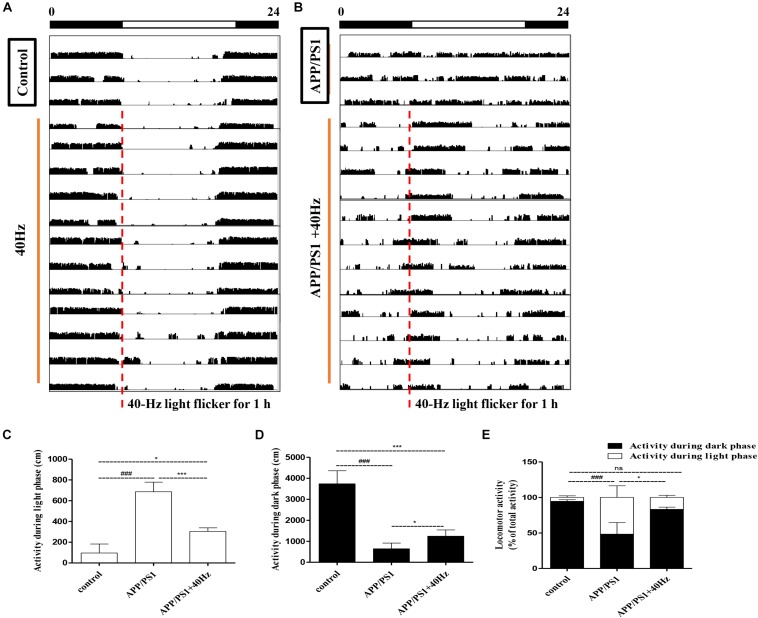
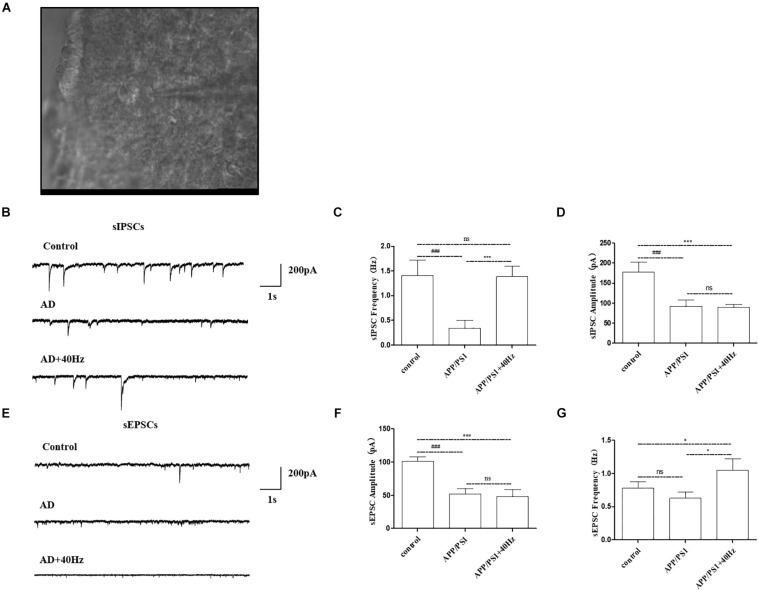
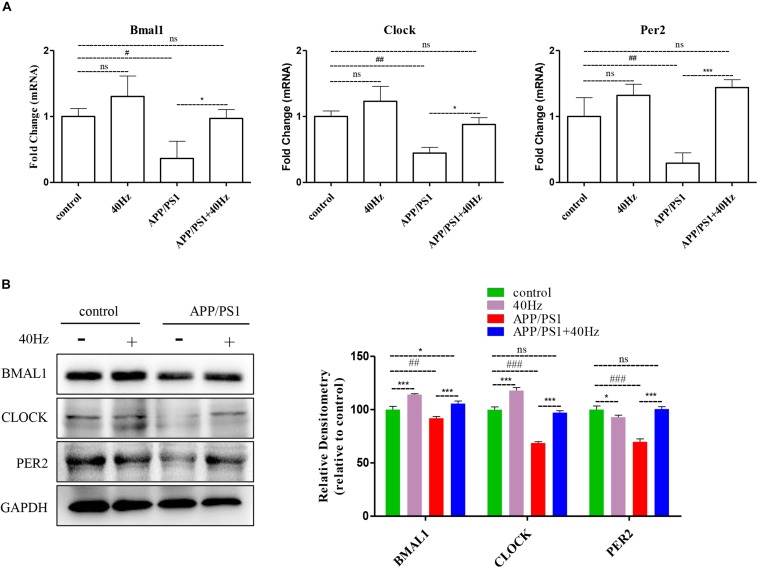
Alzheimer's disease (AD) patients often exhibit perturbed circadian rhythm with fragmented sleep before disease onset. This study was designed to evaluate the effect of a 40-Hz light flicker on circadian rhythm in an AD mouse model (APP/PS1). Locomotor rhythms recordings were conducted to examine the circadian clock rhythm in APP/PS1 mice. Molecular biology analyses, including western blot and real-time qPCR assays, were conducted to assess the changes in circadian locomotor output cycles kaput (CLOCK), brain and muscle arnt-like protein-1 (BMAL1), and period 2 (PER2). In addition to determining the direct effect of a 40-Hz light flicker on hypothalamic central clock, whole-cell voltage-clamp electrophysiology was employed to record individual neurons of suprachiasmatic nucleus (SCN) sections. The results reported herein demonstrate that a 40-Hz light flicker relieves circadian rhythm disorders in APP/PS1 mice and returns the expression levels of key players in the central circadian clock, including Clock, Bmal1, and Per2, to baseline. Moreover, the frequency of spontaneous inhibitory postsynaptic currents (sIPSCs) in SCN neurons is significantly lower in APP/PS1 mice than in the control, and the amplitude of sIPSCs is decreased. Exposure to a 40-Hz light flicker significantly increases the sIPSC frequency in SCN neurons of APP/PS1 mice, with little effect on the amplitude. However, the frequency and amplitude of spontaneous excitatory postsynaptic currents (sEPSCs) are both unaffected by a 40-Hz light flicker. The data suggest that a 40-Hz light flicker can ameliorate AD-associated circadian rhythm disorders, presenting a new type of therapeutic treatment for rhythm disorders caused by AD.
阿尔茨海默病(AD)患者在疾病发作前常表现出昼夜节律紊乱且睡眠碎片化。本研究旨在评估40赫兹光闪烁对AD小鼠模型(APP/PS1)昼夜节律的影响。通过记录运动节律来检测APP/PS1小鼠的生物钟节律。进行了包括蛋白质免疫印迹和实时定量聚合酶链反应分析在内的分子生物学分析,以评估昼夜运动输出周期蛋白(CLOCK)、脑和肌肉芳香烃受体核转运蛋白样蛋白1(BMAL1)以及周期蛋白2(PER2)的变化。除了确定40赫兹光闪烁对下丘脑中央生物钟的直接影响外,还采用全细胞膜片钳电生理学方法记录视交叉上核(SCN)切片中的单个神经元。本文报道的结果表明,40赫兹光闪烁可缓解APP/PS1小鼠的昼夜节律紊乱,并使中央生物钟关键蛋白(包括Clock、Bmal1和Per2)的表达水平恢复到基线。此外,APP/PS1小鼠SCN神经元中自发性抑制性突触后电流(sIPSC)的频率显著低于对照组,且sIPSC的幅度降低。暴露于40赫兹光闪烁可显著增加APP/PS1小鼠SCN神经元中的sIPSC频率,而对幅度影响较小。然而,40赫兹光闪烁对自发性兴奋性突触后电流(sEPSC)的频率和幅度均无影响。数据表明,40赫兹光闪烁可改善与AD相关的昼夜节律紊乱,为AD引起的节律紊乱提供了一种新型治疗方法。