Varimo Eveliina, Saastamoinen Leena K, Rättö Hanna, Mogk Hannu, Aronen Eeva T
Child Psychiatry, University of Helsinki and Helsinki University Hospital, Helsinki, Finland.
Laboratory of Developmental Psychopathology, Pediatric Research Center, Children's Hospital, University of Helsinki and Helsinki University Hospital, Helsinki, Finland.
Front Psychiatry. 2020 Apr 24;11:316. doi: 10.3389/fpsyt.2020.00316. eCollection 2020.
Recently, prescribing antipsychotics for children and adolescents has been increasing in many countries. These drugs are often prescribed off-label, although antipsychotics have been associated with adverse effects. We determined the recent incidence of antipsychotic use among children and adolescents in Finland.
Finnish National Prescription Register including all Finnish inhabitants receiving reimbursement for pharmaceuticals was searched for subjects of 1 to 17 years of age who had started an antipsychotic drug between January 1, 2008, and December 31, 2017 (n = 26,353). Between 2008 and 2017, the range of number of Finnish children and adolescents aged 1 to 17 years was 1.01 to 1.03 million/year. The incidence was calculated by dividing the number of new users by all age- and sex-matched Finnish inhabitants in the year.
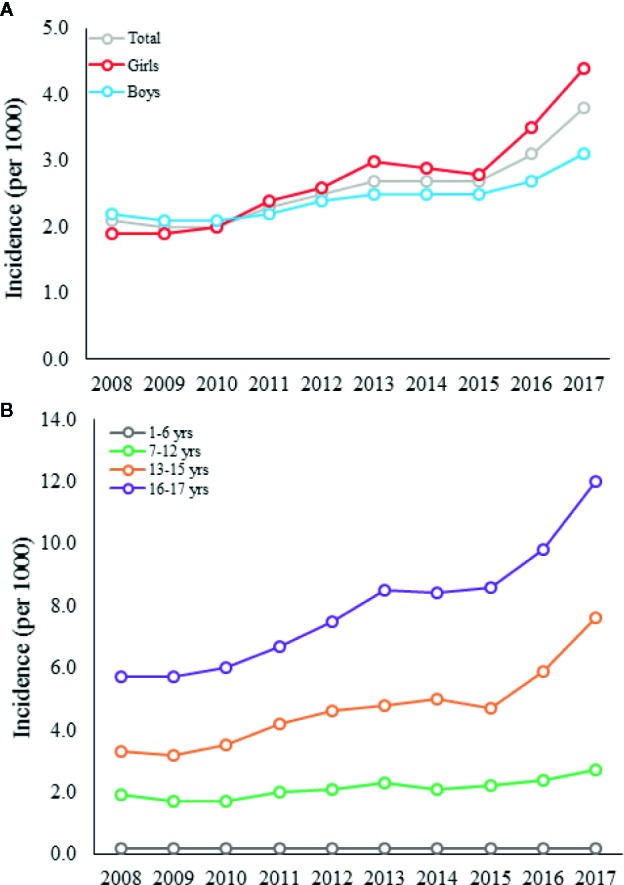
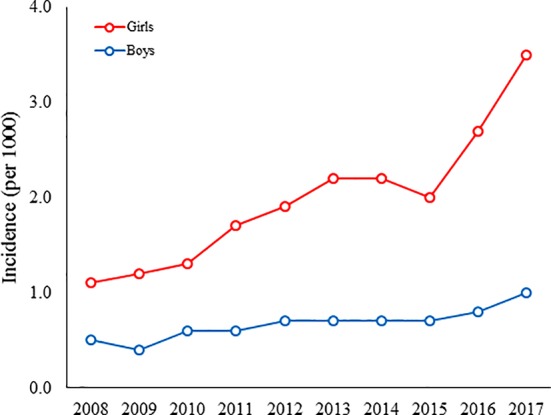
Between 2008 and 2017, the incidence of antipsychotic use among children and adolescents increased from 2.1 to 3.8 per 1000 individuals, respectively. In children aged 7 to 12 years, the incidence of antipsychotic use 1.4-folded (from 1.9 (95% CI: 1.8-2.0) to 2.7 (95% CI: 2.5-2.9) per 1000) with a cumulative increase of 0.2% per year (χ = 51.0, < 0.0001). In adolescents aged 13 to 17 years, the incidence 2.2-folded (from 4.3 (95% CI: 4.1-4.5) to 9.4 (95% CI: 9.1-9.8) per 1000) with a cumulative increase of 0.6% per year (χ = 590.3, < 0.0001). The increase in the incidence of use was steeper in girls (2.3-fold) than in boys (1.4-fold) (χ = 85.6, < 0.0001), especially between 2015 and 2017 (1.6-fold and 1.2-fold, respectively) (χ = 151.7, < 0.0001). The year 2011 was the turning point when the incidence in girls exceeded the incidence in boys, and the incidence of quetiapine use exceeded that of risperidone use.
The incidence of antipsychotic use increased between 2008 and 2017, especially in adolescent girls. The use of quetiapine increased, although it has few official indications in children and adolescents. Future studies should investigate the reasons for increasing use of antipsychotics, especially quetiapine, in children and adolescents.
最近,许多国家为儿童和青少年开具抗精神病药物的情况呈上升趋势。尽管抗精神病药物存在不良反应,但这些药物经常被超适应症使用。我们确定了芬兰儿童和青少年近期使用抗精神病药物的发生率。
在芬兰国家处方登记处搜索了2008年1月1日至2017年12月31日期间开始使用抗精神病药物的1至17岁受试者(n = 26353),该登记处包括所有获得药品报销的芬兰居民。2008年至2017年期间,芬兰1至17岁儿童和青少年的数量范围为每年101万至103万。发生率通过将新使用者数量除以该年份所有年龄和性别匹配的芬兰居民数量来计算。
2008年至2017年期间,儿童和青少年使用抗精神病药物的发生率分别从每1000人2.1例增加到3.8例。在7至12岁的儿童中,抗精神病药物的使用发生率增加了1.4倍(从每1000人1.9例(95%置信区间:1.8 - 2.0)增加到2.7例(95%置信区间:2.5 - 2.9)),每年累计增加0.2%(χ = 51.0,P < 0.0001)。在13至17岁的青少年中,发生率增加了2.2倍(从每1000人4.3例(95%置信区间:4.1 - 4.5)增加到9.4例(95%置信区间:9.1 - 9.8)),每年累计增加0.6%(χ = 590.3,P < 0.0001)。使用发生率的增加在女孩中(2.3倍)比在男孩中(1.4倍)更显著(χ = 85.6,P < 0.0001),特别是在2015年至2017年期间(分别为1.6倍和1.2倍)(χ = 151.7,P < 0.0001)。2011年是转折点,此时女孩的发生率超过男孩,且喹硫平的使用发生率超过利培酮。
2008年至2017年期间,抗精神病药物的使用发生率增加,尤其是在青春期女孩中。喹硫平的使用增加,尽管其在儿童和青少年中的官方适应症较少。未来的研究应调查儿童和青少年中抗精神病药物,尤其是喹硫平使用增加的原因。