Keeratichamroen Siriporn, Subhasitanont Pantipa, Chokchaichamnankit Daranee, Weeraphan Churat, Saharat Kittirat, Sritana Narongrit, Kantathavorn Nuttavut, Wiriyaukaradecha Kriangpol, Sricharunrat Thaniya, Paricharttanakul N Monique, Auewarakul Chirayu, Svasti Jisnuson, Srisomsap Chantragan
Laboratory of Biochemistry, Chulabhorn Research Institute, Bangkok 10210, Thailand.
Department of Molecular Biotechnology and Bioinformatics, Faculty of Science, Prince of Songkla University, Songkhla, Songkhla 90110, Thailand.
Oncol Lett. 2020 Jun;19(6):3815-3826. doi: 10.3892/ol.2020.11519. Epub 2020 Apr 7.
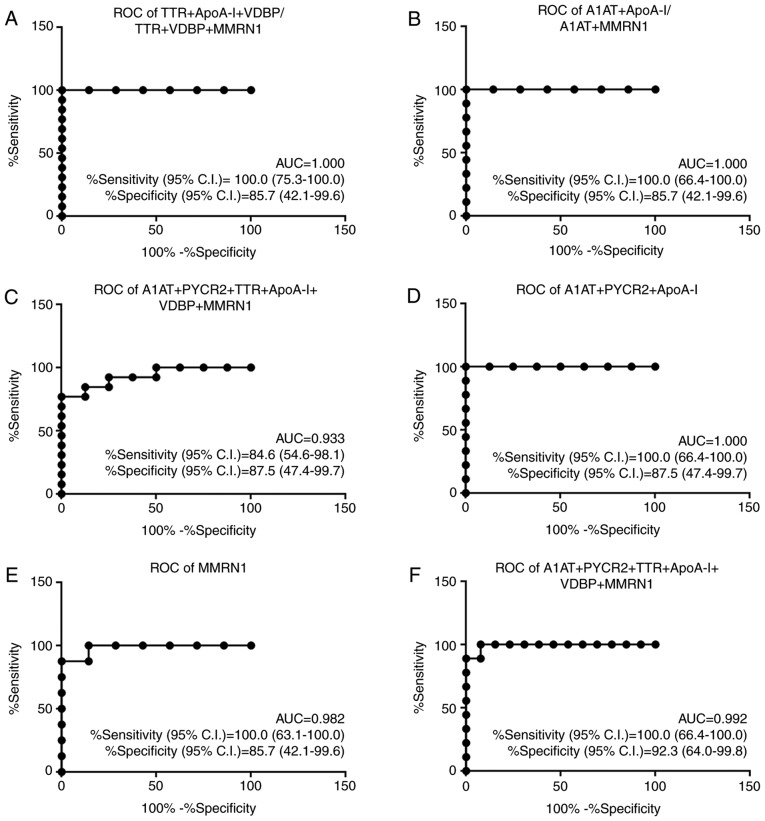
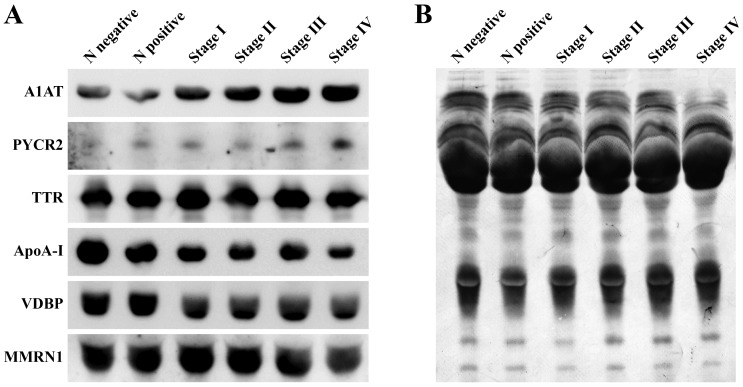
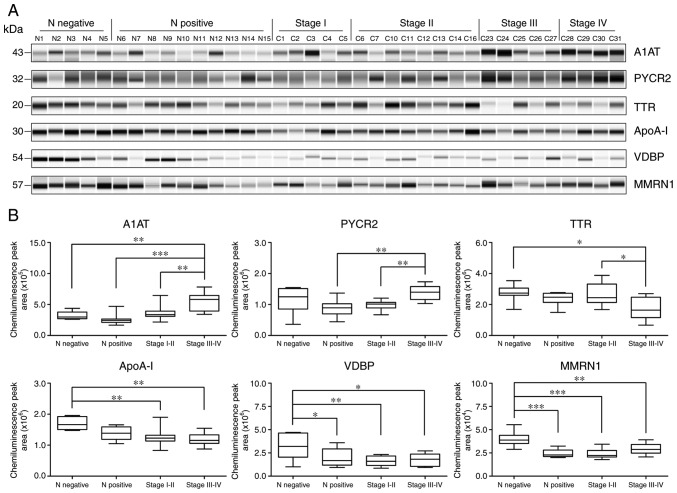
Cervical cancer is one of the most common causes of cancer-associated mortality in females worldwide. Serum biomarkers are important tools for diagnosis, disease staging, monitoring treatment and detecting recurrence in different types of cancer. However, only a small number of established biomarkers have been used for clinical diagnosis of cervical cancer. Therefore, the identification of minimally invasive, sensitive and highly specific biomarkers for detection of cervical cancer may improve outcomes. In the present pilot study, changes in disease-relevant proteins in 31 patients with cervical cancer were compared with 16 healthy controls. The Human 14 Multiple Affinity Removal system was used to deplete the 14 most abundant serum proteins to decrease sample complexity and to enrich proteins that exhibited decreased levels of abundance in the serum samples. Immunoaffinity-depleted serum samples were analyzed by in-gel digestion, followed by liquid chromatography mass spectrometry analysis and data processing. Automated quantitative western blot assays and receiver operating characteristic (ROC) curves were used to evaluate the differential protein expression levels between the two groups. Capillary electrophoresis-based western blot analysis was performed to quantitatively determine serum levels of the candidate biomarkers. Significantly increased levels of α-1-antitrypsin (A1AT) and pyrroline-5-carboxylate reductase 2 (PYCR2) were detected, whereas the levels of transthyretin (TTR), apolipoprotein A-I (ApoA-I), vitamin D binding protein (VDBP) and multimerin-1 (MMRN1) were significantly decreased in patients with cervical cancer compared with the healthy controls. ROC curve analysis indicated that the sensitivity and specificity was improved through the combination of the 6 candidate biomarkers. In summary, the results demonstrated that 6 candidate biomarkers (A1AT, PYCR2, TTR, ApoA-I, VDBP and MMRN1) exhibited significantly different expression between serum samples from healthy controls and patients with cervical cancer. These proteins may represent potential biomarkers for distinguishing patients with cervical cancer from healthy controls and for differentiation of patient subgroups.
宫颈癌是全球女性癌症相关死亡的最常见原因之一。血清生物标志物是诊断、疾病分期、监测治疗以及检测不同类型癌症复发的重要工具。然而,仅有少数已确立的生物标志物用于宫颈癌的临床诊断。因此,鉴定用于检测宫颈癌的微创、敏感且高度特异的生物标志物可能会改善治疗结果。在本初步研究中,将31例宫颈癌患者与16例健康对照者疾病相关蛋白的变化进行了比较。使用人类14种多重亲和去除系统去除14种最丰富的血清蛋白,以降低样品复杂性并富集血清样品中丰度降低的蛋白。通过凝胶内消化分析免疫亲和去除后的血清样品,随后进行液相色谱质谱分析和数据处理。使用自动定量蛋白质印迹分析和受试者工作特征(ROC)曲线评估两组之间的差异蛋白表达水平。进行基于毛细管电泳的蛋白质印迹分析以定量测定候选生物标志物的血清水平。检测到α-1-抗胰蛋白酶(A1AT)和吡咯啉-5-羧酸还原酶2(PYCR2)水平显著升高,而与健康对照相比,宫颈癌患者中甲状腺素转运蛋白(TTR)、载脂蛋白A-I(ApoA-I)、维生素D结合蛋白(VDBP)和多聚蛋白-1(MMRN1)水平显著降低。ROC曲线分析表明,通过组合6种候选生物标志物,敏感性和特异性得到了提高。总之,结果表明6种候选生物标志物(A1AT、PYCR2、TTR、ApoA-I、VDBP和MMRN1)在健康对照者和宫颈癌患者的血清样品之间表现出显著不同的表达。这些蛋白可能代表用于区分宫颈癌患者与健康对照者以及区分患者亚组的潜在生物标志物。