Rieckmann Karoline, Pendzialek Sophia-Mareike, Vahlenkamp Thomas, Baums Christoph G
1Institute of Bacteriology and Mycology, Centre for Infectious Diseases, Faculty of Veterinary Medicine, University Leipzig, An den Tierkliniken 29, 04103 Leipzig, Germany.
2Institute of Virology, Centre for Infectious Diseases, Faculty of Veterinary Medicine, University Leipzig, Leipzig, Germany.
Porcine Health Manag. 2020 May 6;6:12. doi: 10.1186/s40813-020-00150-6. eCollection 2020.
is a major porcine pathogen causing high morbidity worldwide. This includes well-managed herds with high hygiene standards. In Europe, no licensed vaccine is available. As practitioners are obliged to reduce the use of antibiotics, autogenous vaccines have become very popular in Europe.
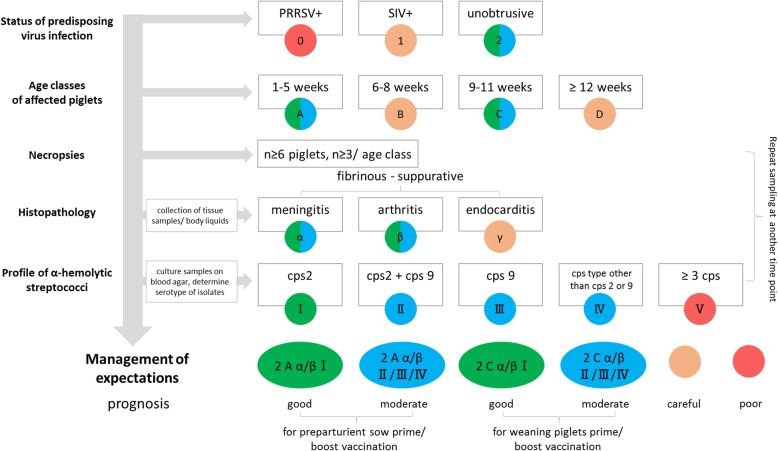
Autogenous vaccines (AV) are generally neither tested for safety, immunogenicity nor protective efficacy, which leads to substantial uncertainties regarding control of disease and return on investment. Here, publications are reviewed that include important data on epidemiology, pathologies and bacterin vaccination relevant for the use of AV in the field. Differences between herds such as the porcine reproductive and respiratory syndrome virus infection status and the impact of specific pathotypes are probably highly relevant for the outcome of immunoprophylaxis using autogenous bacterins. Thus, a profound diagnosis of the herd status is crucial for management of expectations and successful implementation of AV as a tool to control disease. Induction of opsonizing antibodies is an in vitro correlate of protective immunity elicited by bacterins. However, opsonophagocytosis assays are difficult to include in the portfolio of diagnostic services.
Autogenous bacterins are associated with limitations and risks of failure, which can partly be managed through improvement of diagnostics.
是一种主要的猪病原体,在全球范围内导致高发病率。这包括卫生标准高的管理良好的猪群。在欧洲,没有可用的许可疫苗。由于从业者有义务减少抗生素的使用,自体疫苗在欧洲变得非常流行。
自体疫苗(AV)通常既不进行安全性、免疫原性测试,也不进行保护效力测试,这导致在疾病控制和投资回报方面存在很大的不确定性。在此,对一些出版物进行综述,这些出版物包含了与现场使用AV相关的流行病学、病理学和菌苗接种的重要数据。猪群之间的差异,如猪繁殖与呼吸综合征病毒感染状况以及特定致病型的影响,可能与使用自体菌苗进行免疫预防的结果高度相关。因此,对猪群状况进行深入诊断对于管理预期以及成功将AV作为控制疾病的工具至关重要。调理素抗体的诱导是菌苗引发的保护性免疫的体外相关指标。然而,调理吞噬作用检测很难纳入诊断服务项目中。
自体菌苗存在局限性和失败风险,部分可以通过改进诊断来管理。