Haider Stefan P, Burtness Barbara, Yarbrough Wendell G, Payabvash Seyedmehdi
1Department of Radiology and Biomedical Imaging, Division of Neuroradiology, Yale School of Medicine, New Haven, CT USA.
2Department of Otorhinolaryngology, University Hospital of Ludwig Maximilians University of Munich, Munich, Germany.
Cancers Head Neck. 2020 May 4;5:6. doi: 10.1186/s41199-020-00053-7. eCollection 2020.
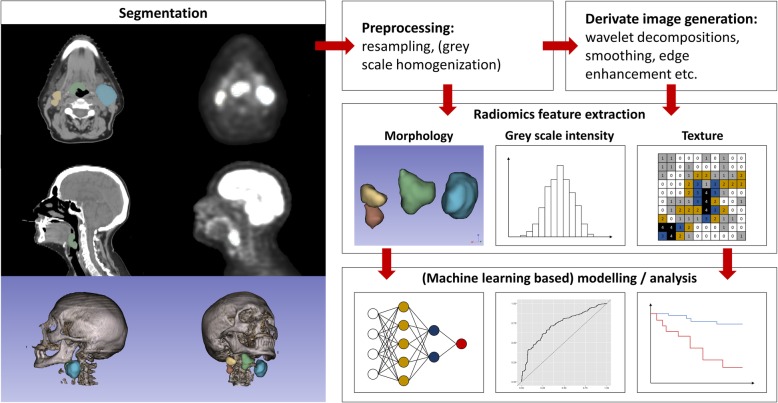
Recent advancements in computational power, machine learning, and artificial intelligence technology have enabled automated evaluation of medical images to generate quantitative diagnostic and prognostic biomarkers. Such objective biomarkers are readily available and have the potential to improve personalized treatment, precision medicine, and patient selection for clinical trials. In this article, we explore the merits of the most recent addition to the "-omics" concept for the broader field of head and neck cancer - "Radiomics". This review discusses radiomics studies focused on (molecular) characterization, classification, prognostication and treatment guidance for head and neck squamous cell carcinomas (HNSCC). We review the underlying hypothesis, general concept and typical workflow of radiomic analysis, and elaborate on current and future challenges to be addressed before routine clinical application.
计算能力、机器学习和人工智能技术的最新进展使得对医学图像进行自动评估以生成定量诊断和预后生物标志物成为可能。此类客观生物标志物易于获取,并且有可能改善个性化治疗、精准医学以及临床试验的患者选择。在本文中,我们探讨了头颈部癌更广泛领域中最新加入“组学”概念的“放射组学”的优点。本综述讨论了专注于头颈部鳞状细胞癌(HNSCC)的(分子)特征描述、分类、预后评估和治疗指导的放射组学研究。我们回顾了放射组学分析的基本假设、一般概念和典型工作流程,并阐述了在常规临床应用之前需要解决的当前和未来挑战。