Bhatia Sugandha, Wang Peiyu, Toh Alan, Thompson Erik W
Institute of Health and Biomedical Innovation and School of Biomedical Sciences, Queensland University of Technology, Brisbane, QLD, Australia.
Translational Research Institute, Brisbane, QLD, Australia.
Front Mol Biosci. 2020 Apr 23;7:71. doi: 10.3389/fmolb.2020.00071. eCollection 2020.
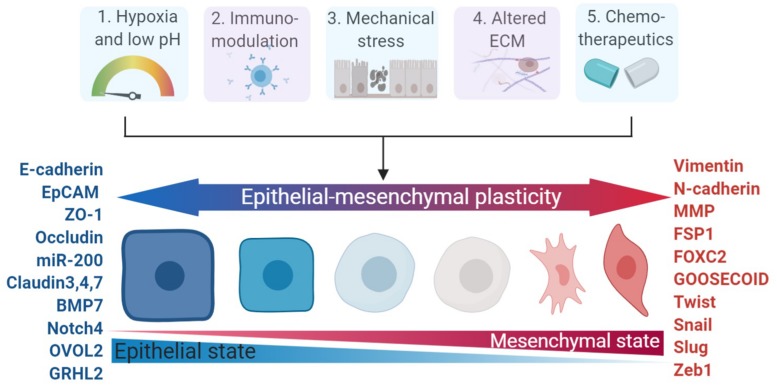
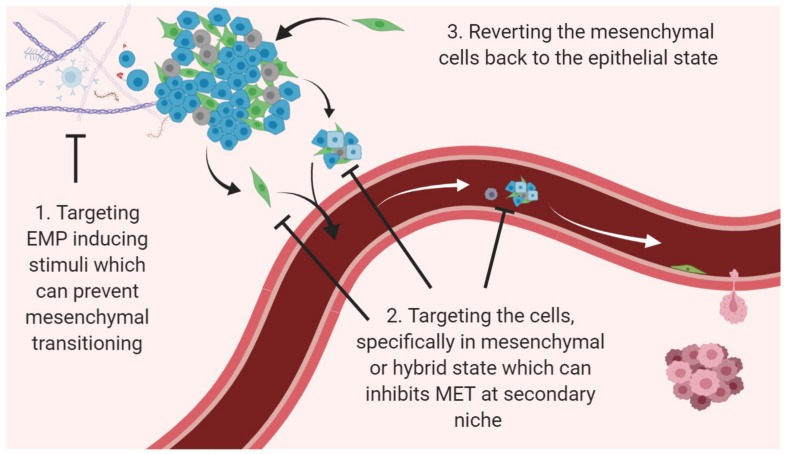
Tumor cells demonstrate substantial plasticity in their genotypic and phenotypic characteristics. Epithelial-mesenchymal plasticity (EMP) can be characterized into dynamic intermediate states and can be orchestrated by many factors, either intercellularly via epigenetic reprograming, or extracellularly via growth factors, inflammation and/or hypoxia generated by the tumor stromal microenvironment. EMP has the capability to alter phenotype and produce heterogeneity, and thus by changing the whole cancer landscape can attenuate oncogenic signaling networks, invoke anti-apoptotic features, defend against chemotherapeutics and reprogram angiogenic and immune recognition functions. We discuss here the role of phenotypic plasticity in tumor initiation, progression and metastasis and provide an update of the modalities utilized for the molecular characterization of the EMT states and attributes of cellular behavior, including cellular metabolism, in the context of EMP. We also summarize recent findings in dynamic EMP studies that provide new insights into the phenotypic plasticity of EMP flux in cancer and propose therapeutic strategies to impede the metastatic outgrowth of phenotypically heterogeneous tumors.
肿瘤细胞在其基因型和表型特征方面表现出显著的可塑性。上皮-间质可塑性(EMP)可分为动态中间状态,并且可由许多因素调控,这些因素既可以通过表观遗传重编程在细胞间发挥作用,也可以通过肿瘤基质微环境产生的生长因子、炎症和/或缺氧在细胞外发挥作用。EMP有能力改变表型并产生异质性,因此通过改变整个癌症格局,可以减弱致癌信号网络,引发抗凋亡特征,抵御化疗药物,并重新编程血管生成和免疫识别功能。我们在此讨论表型可塑性在肿瘤起始、进展和转移中的作用,并提供用于分子表征EMT状态和细胞行为属性(包括细胞代谢)的方法的最新进展,这些均处于EMP的背景下。我们还总结了动态EMP研究中的最新发现,这些发现为癌症中EMP通量的表型可塑性提供了新见解,并提出了阻碍表型异质性肿瘤转移生长的治疗策略。