• 文献检索
  • 文档翻译
  • 深度研究
  • 学术资讯
  • Suppr Zotero 插件Zotero 插件
  • 邀请有礼
  • 套餐&价格
  • 历史记录
应用&插件
Suppr Zotero 插件Zotero 插件浏览器插件Mac 客户端Windows 客户端微信小程序
定价
高级版会员购买积分包购买API积分包
服务
文献检索文档翻译深度研究API 文档MCP 服务
关于我们
关于 Suppr公司介绍联系我们用户协议隐私条款
关注我们

Suppr 超能文献

核心技术专利:CN118964589B侵权必究
粤ICP备2023148730 号-1Suppr @ 2026

文献检索

告别复杂PubMed语法,用中文像聊天一样搜索,搜遍4000万医学文献。AI智能推荐,让科研检索更轻松。

立即免费搜索

文件翻译

保留排版,准确专业,支持PDF/Word/PPT等文件格式,支持 12+语言互译。

免费翻译文档

深度研究

AI帮你快速写综述,25分钟生成高质量综述,智能提取关键信息,辅助科研写作。

立即免费体验

利用有限数据对尼日利亚新冠肺炎病例进行在线预测

ONLINE FORECASTING OF COVID-19 CASES IN NIGERIA USING LIMITED DATA.

作者信息

Abdulmajeed Kabir, Adeleke Monsuru, Popoola Labode

机构信息

Georgia Institute of Technology, Atlanta, GA, USA.

Osun State University, Osogbo, Nigeria.

出版信息

Data Brief. 2020 May 8;30:105683. doi: 10.1016/j.dib.2020.105683. eCollection 2020 Jun.

DOI:10.1016/j.dib.2020.105683
PMID:32391409
原文链接:https://pmc.ncbi.nlm.nih.gov/articles/PMC7206427/
Abstract

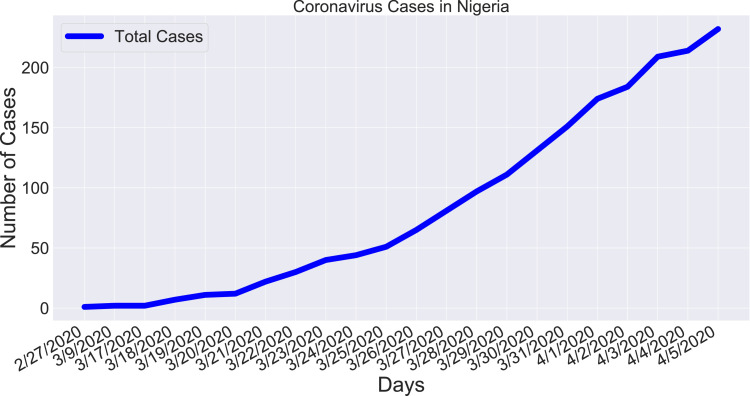
The novel Coronavirus disease (COVID-19) was first identified in Wuhan, China in December 2019 but later spread to other parts of the world. The disease as at the point of writing this paper has been declared a pandemic by the World Health Organization (WHO). The application of mathematical models, artificial intelligence, big data, and similar methodologies are potential tools to predict the extent of the spread and effectiveness of containment strategies to stem the transmission of this disease. In societies with constrained data infrastructures, modeling and forecasting COVID-19 becomes an extremely difficult endeavor. Nonetheless, we propose an online forecasting mechanism that streams data from the Nigeria Center for Disease Control to update the parameters of an ensemble model which in turn provides updated COVID-19 forecasts every 24 hours. The ensemble combines an Auto-Regressive Integrated Moving Average model (ARIMA), Prophet - an additive regression model developed by Facebook, and a Holt-Winters Exponential Smoothing model combined with Generalized Autoregressive Conditional Heteroscedasticity (GARCH). The outcomes of these efforts are expected to provide academic thrust in guiding the policymakers in the deployment of containment strategies and/or assessment of containment interventions in stemming the spread of the disease in Nigeria.

摘要

新型冠状病毒病(COVID-19)于2019年12月在中国武汉首次被发现,随后传播到世界其他地区。在撰写本文时,该疾病已被世界卫生组织(WHO)宣布为大流行病。应用数学模型、人工智能、大数据及类似方法是预测疾病传播范围和遏制策略有效性以阻止该疾病传播的潜在工具。在数据基础设施有限的社会中,对COVID-19进行建模和预测是一项极其困难的工作。尽管如此,我们提出一种在线预测机制,该机制从尼日利亚疾病控制中心流式传输数据,以更新一个集成模型的参数,该模型进而每24小时提供一次更新后的COVID-19预测。该集成模型结合了自回归积分移动平均模型(ARIMA)、由Facebook开发的加法回归模型Prophet以及结合广义自回归条件异方差(GARCH)的霍尔特-温特斯指数平滑模型。这些努力的成果有望为指导政策制定者部署遏制策略和/或评估遏制干预措施以阻止该疾病在尼日利亚传播提供学术支持。
https://cdn.ncbi.nlm.nih.gov/pmc/blobs/54c0/7240207/f9794e9d7d83/gr5.jpg
https://cdn.ncbi.nlm.nih.gov/pmc/blobs/54c0/7240207/45f279d4b04c/gr1.jpg
https://cdn.ncbi.nlm.nih.gov/pmc/blobs/54c0/7240207/f4b9fc41181b/gr2.jpg
https://cdn.ncbi.nlm.nih.gov/pmc/blobs/54c0/7240207/f9ec09680c46/gr3.jpg
https://cdn.ncbi.nlm.nih.gov/pmc/blobs/54c0/7240207/608bc41fc8af/gr4.jpg
https://cdn.ncbi.nlm.nih.gov/pmc/blobs/54c0/7240207/f9794e9d7d83/gr5.jpg
https://cdn.ncbi.nlm.nih.gov/pmc/blobs/54c0/7240207/45f279d4b04c/gr1.jpg
https://cdn.ncbi.nlm.nih.gov/pmc/blobs/54c0/7240207/f4b9fc41181b/gr2.jpg
https://cdn.ncbi.nlm.nih.gov/pmc/blobs/54c0/7240207/f9ec09680c46/gr3.jpg
https://cdn.ncbi.nlm.nih.gov/pmc/blobs/54c0/7240207/608bc41fc8af/gr4.jpg
https://cdn.ncbi.nlm.nih.gov/pmc/blobs/54c0/7240207/f9794e9d7d83/gr5.jpg

相似文献

1
ONLINE FORECASTING OF COVID-19 CASES IN NIGERIA USING LIMITED DATA.利用有限数据对尼日利亚新冠肺炎病例进行在线预测
Data Brief. 2020 May 8;30:105683. doi: 10.1016/j.dib.2020.105683. eCollection 2020 Jun.
2
Time series prediction of under-five mortality rates for Nigeria: comparative analysis of artificial neural networks, Holt-Winters exponential smoothing and autoregressive integrated moving average models.尼日利亚五岁以下儿童死亡率的时间序列预测:人工神经网络、Holt-Winters 指数平滑和自回归综合移动平均模型的比较分析。
BMC Med Res Methodol. 2020 Dec 3;20(1):292. doi: 10.1186/s12874-020-01159-9.
3
Application of one-, three-, and seven-day forecasts during early onset on the COVID-19 epidemic dataset using moving average, autoregressive, autoregressive moving average, autoregressive integrated moving average, and naïve forecasting methods.使用移动平均、自回归、自回归移动平均、自回归积分移动平均和朴素预测方法,对COVID-19疫情数据集早期发病情况进行1天、3天和7天预测的应用。
Data Brief. 2021 Apr;35:106759. doi: 10.1016/j.dib.2021.106759. Epub 2021 Jan 15.
4
COVID-19 prevalence estimation: Four most affected African countries.新冠病毒病流行率估计:四个受影响最严重的非洲国家。
Infect Dis Model. 2020;5:827-838. doi: 10.1016/j.idm.2020.10.002. Epub 2020 Oct 12.
5
Forecasting COVID-19 confirmed cases, deaths and recoveries: Revisiting established time series modeling through novel applications for the USA and Italy.预测 COVID-19 确诊病例、死亡和康复人数:通过美国和意大利的新应用重新审视既定时间序列模型。
PLoS One. 2021 Jan 7;16(1):e0244173. doi: 10.1371/journal.pone.0244173. eCollection 2021.
6
Impact of COVID-19 pandemic in the Brazilian maternal mortality ratio: A comparative analysis of Neural Networks Autoregression, Holt-Winters exponential smoothing, and Autoregressive Integrated Moving Average models.COVID-19 大流行对巴西母婴死亡率的影响:神经网络自回归、Holt-Winters 指数平滑和自回归综合移动平均模型的比较分析。
PLoS One. 2024 Jan 31;19(1):e0296064. doi: 10.1371/journal.pone.0296064. eCollection 2024.
7
Empirical Evaluation of Alternative Time-Series Models for COVID-19 Forecasting in Saudi Arabia.沙特阿拉伯COVID-19预测替代时间序列模型的实证评估
Int J Environ Res Public Health. 2021 Aug 16;18(16):8660. doi: 10.3390/ijerph18168660.
8
Forecasting the prevalence of COVID-19 outbreak in Egypt using nonlinear autoregressive artificial neural networks.使用非线性自回归人工神经网络预测埃及新冠疫情的流行情况。
Process Saf Environ Prot. 2020 Sep;141:1-8. doi: 10.1016/j.psep.2020.05.029. Epub 2020 May 20.
9
ARIMA modelling and forecasting of irregularly patterned COVID-19 outbreaks using Japanese and South Korean data.使用日本和韩国数据对COVID-19不规则爆发模式进行自回归整合移动平均(ARIMA)建模与预测。
Data Brief. 2020 Aug;31:105779. doi: 10.1016/j.dib.2020.105779. Epub 2020 May 26.
10
Machine learning and automatic ARIMA/Prophet models-based forecasting of COVID-19: methodology, evaluation, and case study in SAARC countries.基于机器学习和自动ARIMA/Prophet模型的COVID-19预测:方法、评估及在南亚区域合作联盟国家的案例研究
Stoch Environ Res Risk Assess. 2023;37(1):345-359. doi: 10.1007/s00477-022-02307-x. Epub 2022 Oct 5.

引用本文的文献

1
syN-BEATS for robust pollutant forecasting in data-limited context.用于在数据有限的情况下进行稳健污染物预测的同步节拍法。
Environ Monit Assess. 2024 Oct 2;196(11):1002. doi: 10.1007/s10661-024-13164-2.
2
CNN-LSTM deep learning based forecasting model for COVID-19 infection cases in Nigeria, South Africa and Botswana.基于CNN-LSTM深度学习的尼日利亚、南非和博茨瓦纳新冠肺炎感染病例预测模型。
Health Technol (Berl). 2022;12(6):1259-1276. doi: 10.1007/s12553-022-00711-5. Epub 2022 Nov 15.
3
Time-Series Prediction for the Epidemic Trends of COVID-19 Using Conditional Generative Adversarial Networks Regression on Country-Wise Case Studies.
基于国家层面案例研究,使用条件生成对抗网络回归对COVID-19疫情趋势进行时间序列预测。
SN Comput Sci. 2022;3(5):352. doi: 10.1007/s42979-022-01225-7. Epub 2022 Jun 29.
4
A data-driven hybrid ensemble AI model for COVID-19 infection forecast using multiple neural networks and reinforced learning.基于多神经网络和强化学习的 COVID-19 感染预测数据驱动混合集成人工智能模型。
Comput Biol Med. 2022 Jul;146:105560. doi: 10.1016/j.compbiomed.2022.105560. Epub 2022 Apr 27.
5
Mathematical model of COVID-19 in Nigeria with optimal control.具有最优控制的尼日利亚新冠肺炎数学模型
Results Phys. 2021 Sep;28:104598. doi: 10.1016/j.rinp.2021.104598. Epub 2021 Jul 30.
6
Analysis and forecasts for trends of COVID-19 in Pakistan using Bayesian models.使用贝叶斯模型对巴基斯坦新冠肺炎趋势进行分析与预测。
PeerJ. 2021 Jul 7;9:e11537. doi: 10.7717/peerj.11537. eCollection 2021.
7
Deming least square regressed feature selection and Gaussian neuro-fuzzy multi-layered data classifier for early COVID prediction.用于早期新冠预测的戴明最小二乘回归特征选择与高斯神经模糊多层数据分类器
Expert Syst. 2022 May;39(4):e12694. doi: 10.1111/exsy.12694. Epub 2021 Mar 26.
8
Data Sharing in Southeast Asia During the First Wave of the COVID-19 Pandemic.东南亚在 COVID-19 大流行第一波期间的数据共享。
Front Public Health. 2021 Jun 16;9:662842. doi: 10.3389/fpubh.2021.662842. eCollection 2021.
9
Estimating the impacts of lockdown on Covid-19 cases in Nigeria.评估封锁措施对尼日利亚新冠肺炎病例的影响。
Transp Res Interdiscip Perspect. 2020 Sep;7:100217. doi: 10.1016/j.trip.2020.100217. Epub 2020 Sep 6.
10
How do we share data in COVID-19 research? A systematic review of COVID-19 datasets in PubMed Central Articles.我们如何在 COVID-19 研究中共享数据?对 PubMed Central 文章中 COVID-19 数据集的系统评价。
Brief Bioinform. 2021 Mar 22;22(2):800-811. doi: 10.1093/bib/bbaa331.