Department of Internal Medicine II, Medical University of Vienna, Vienna, Austria.
The Ludwig Boltzmann Cluster for Cardiovascular Research, Vienna, Austria.
PLoS One. 2020 May 11;15(5):e0232483. doi: 10.1371/journal.pone.0232483. eCollection 2020.
Percutaneous coronary intervention represents the most important treatment modality of coronary artery stenosis. In-stent restenosis (ISR) is still a limitation for the long-term outcome despite the introduction of drug eluting stents. It has been shown that adipokines directly influence vessel wall homeostasis by influencing the function of endothelial cells and arterial smooth muscle cells. Visceral adipose tissue-derived serpin vaspin was recently identified as a member of serine protease inhibitor family and serveral studies could demonstrate a relation to metabolic diseases. The aim of this study was to investigate a role of vaspin in the development of in-stent restenosis in vivo and on migration of smooth muscle cells and endothelial cells in vitro.
We studied 85 patients with stable coronary artery disease who underwent elective and successful PCI with implatation of drug eluting stents. Blood samples were taken directly before PCI. Vaspin plasma levels were measured by specific ELISA. ISR was evaluated eight months later by coronary angiography. Human coronary artery smooth muscle cells (HCASMC) and human umbilical vein endothelial cells (HUVEC) migration was analyzed by an in-vitro migration assay with different concentrations (0.004ng/mL up to 40ng/mL) of vaspin as well as by an scratch assay. For proliferation an impedance measurement with specialiced E-Plates was performed.
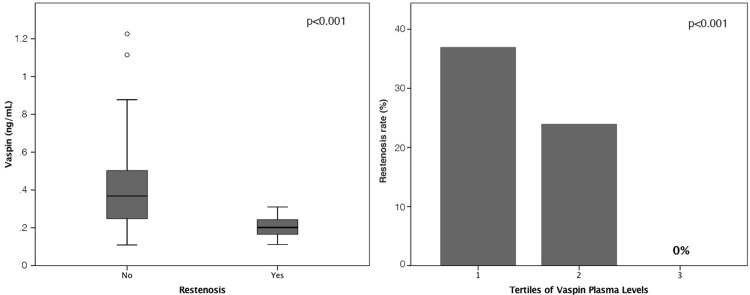
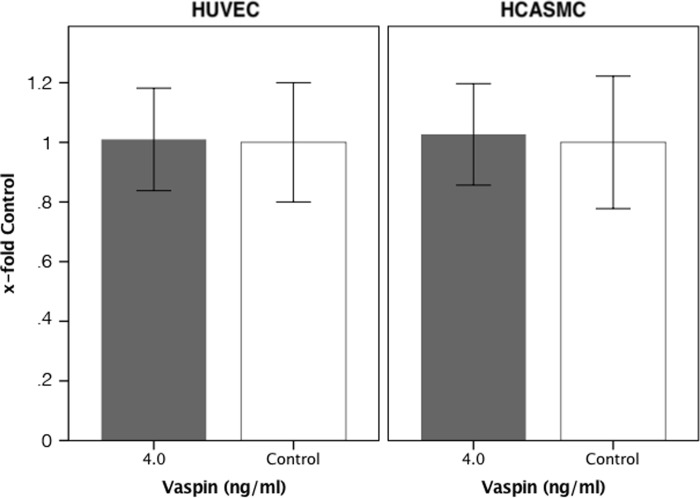
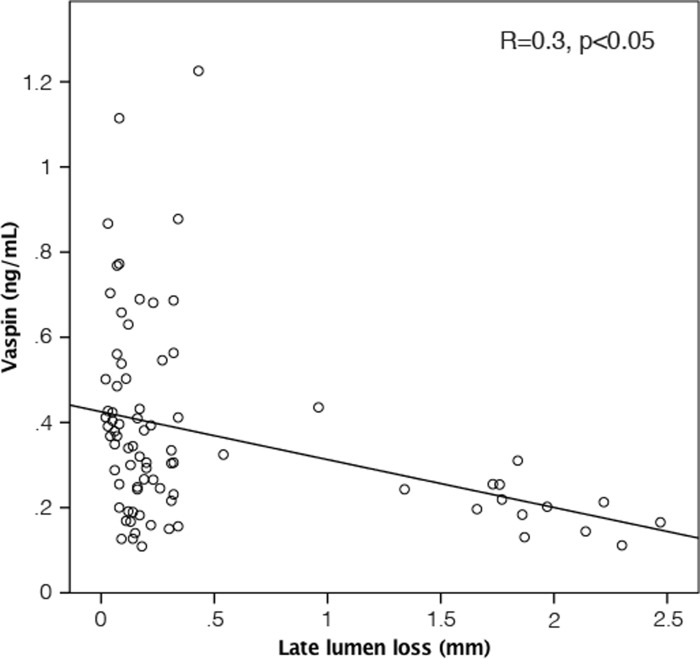
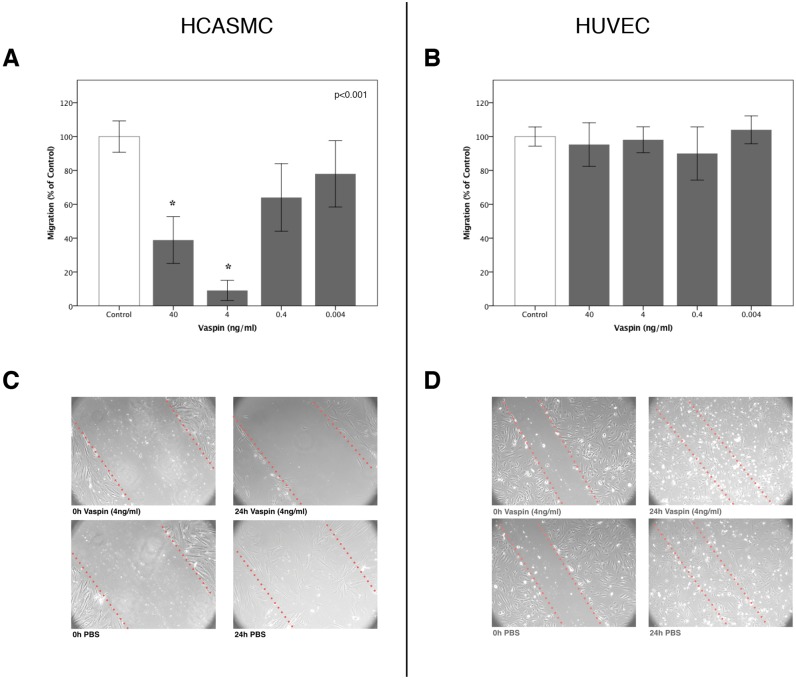
During the follow up period, 14 patients developed ISR. Patients with ISR had significantly lower vaspin plasma levels compared to patients without ISR (0.213 ng/ml vs 0.382 ng/ml; p = 0.001). In patients with plasma vaspin levels above 1.35 ng/ml we could not observe any restenosis. There was also a significant correlation of plasma vaspin levels and late lumen loss in the stented coronary segments. Further we could demonstrate that vaspin nearly abolishes serum induced migration of HCASMC (100% vs. 9%; p<0.001) in a biphasic manner but not migration of HUVEC. Proliferation of HCASMC and HUVEC was not modulated by vaspin treatment.
We were able to show that the adipokine vaspin selectively inhibits human coronary SMC migration in vitro and has no effect on HUVEC migration. Vaspin had no effect on proliferation of HUVEC which is an important process of the healing of the stented vessel. In addition, the occurrence of ISR after PCI with implantation of drug eluting stents was significantly associated with low vaspin plasma levels before intervention. Determination of vaspin plasma levels before PCI might be helpful in the identification of patients with high risk for development of ISR after stent implantation. In addition, the selective effects of vaspin on smooth muscle cell migration could potentially be used to reduce ISR without inhibition of re-endothelialization of the stented segment.
经皮冠状动脉介入治疗是治疗冠状动脉狭窄的最重要手段。尽管已经引入了药物洗脱支架,但支架内再狭窄(ISR)仍然是长期预后的一个限制。已经表明,脂肪细胞因子通过影响内皮细胞和动脉平滑肌细胞的功能直接影响血管壁稳态。内脏脂肪组织来源的丝氨酸蛋白酶抑制剂 vaspin 最近被鉴定为丝氨酸蛋白酶抑制剂家族的成员,几项研究表明它与代谢疾病有关。本研究的目的是研究 vaspin 在体内支架内再狭窄发展中的作用以及在体外平滑肌细胞和内皮细胞迁移中的作用。
我们研究了 85 例患有稳定型冠状动脉疾病的患者,这些患者接受了选择性和成功的经皮冠状动脉介入治疗,并植入了药物洗脱支架。在经皮冠状动脉介入治疗前直接采集血样。通过特异性 ELISA 测量 vaspin 血浆水平。在 8 个月后通过冠状动脉造影评估 ISR。通过不同浓度(0.004ng/mL 至 40ng/mL)的 vaspin 以及划痕试验分析人冠状动脉平滑肌细胞(HCASMC)和人脐静脉内皮细胞(HUVEC)的迁移。通过特殊的 E-Plates 进行阻抗测量来分析增殖。
在随访期间,14 名患者发生了 ISR。与无 ISR 患者相比,ISR 患者的 vaspin 血浆水平显著降低(0.213ng/ml 与 0.382ng/ml;p=0.001)。在血浆 vaspin 水平高于 1.35ng/ml 的患者中,我们没有观察到任何再狭窄。在支架置入的冠状动脉段,血浆 vaspin 水平与晚期管腔丢失也存在显著相关性。此外,我们还证明 vaspin 以双相方式几乎完全抑制了人冠状动脉平滑肌细胞的血清诱导迁移(100%与 9%;p<0.001),但对 HUVEC 迁移没有影响。血管紧张素 II 对 HUVEC 和 HCASMC 的增殖没有影响。
我们能够证明脂肪细胞因子 vaspin 选择性抑制体外人冠状动脉 SMC 迁移,对 HUVEC 迁移没有影响。血管紧张素 II 对 HUVEC 的增殖没有影响,这是支架血管愈合的一个重要过程。此外,药物洗脱支架置入后经皮冠状动脉介入治疗后 ISR 的发生与介入前低 vaspin 血浆水平显著相关。在经皮冠状动脉介入治疗前测定 vaspin 血浆水平可能有助于识别支架置入后发生 ISR 风险较高的患者。此外,vaspin 对平滑肌细胞迁移的选择性作用可能有助于降低 ISR,而不会抑制支架段的再内皮化。