Department of Psychology and Logopedics, Faculty of Medicine, University of Helsinki, Helsinki, Finland.
Department of Psychology, Durham University, Durham, UK.
J Vis. 2020 May 11;20(5):1. doi: 10.1167/jov.20.5.1.
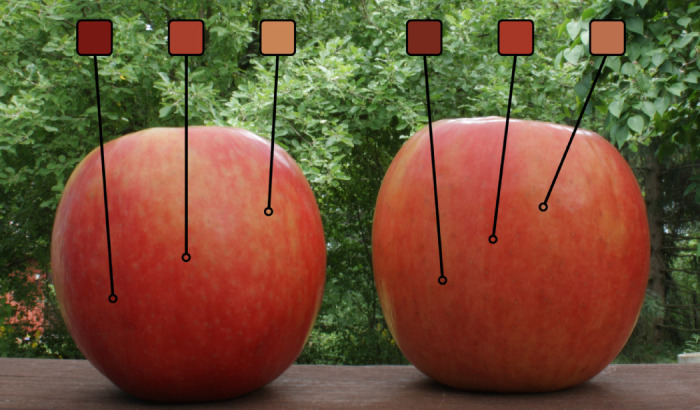
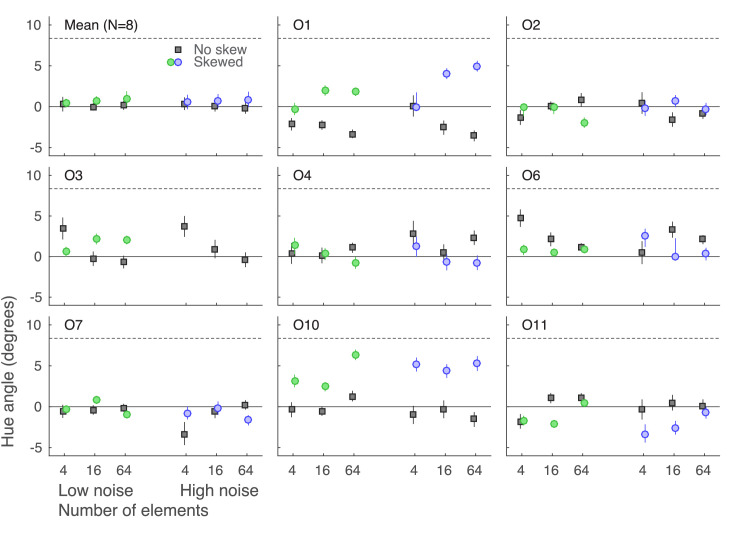
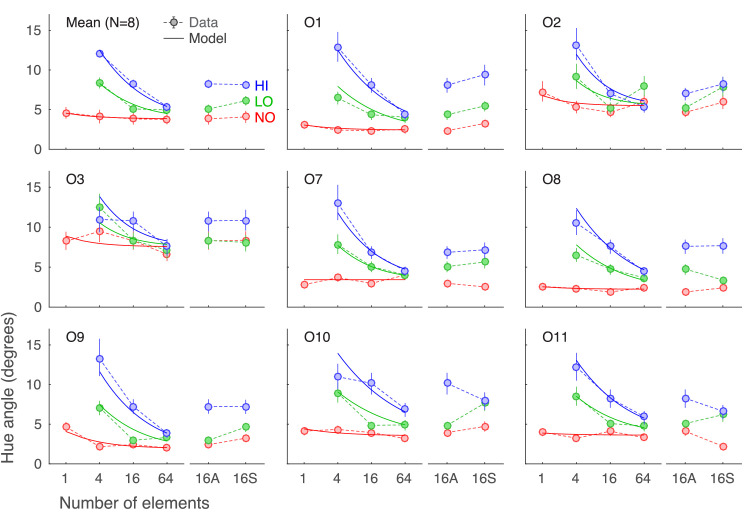
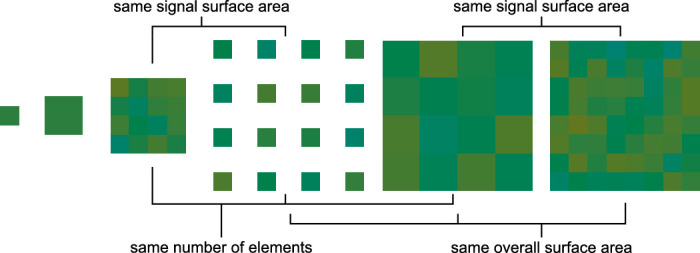
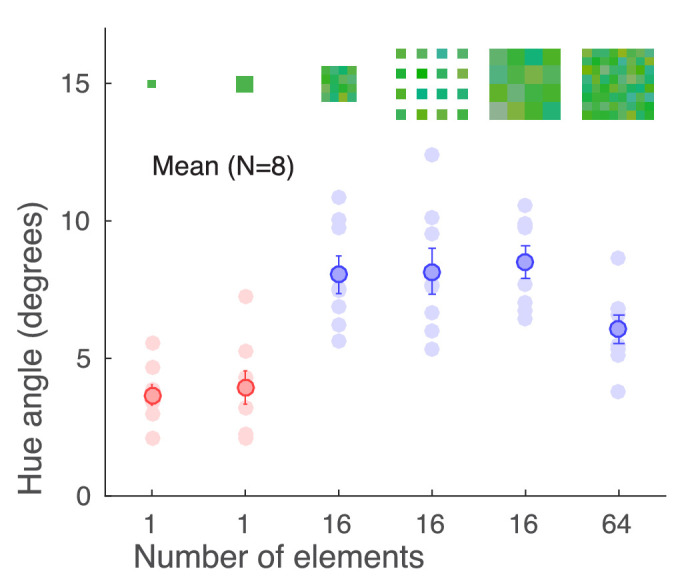
Color serves both to segment a scene into objects and background and to identify objects. Although objects and surfaces usually contain multiple colors, humans can readily extract a representative color description, for instance, that tomatoes are red and bananas yellow. The study of color discrimination and identification has a long history, yet we know little about the formation of summary representations of multicolored stimuli. Here, we characterize the human ability to integrate hue information over space for simple color stimuli varying in the amount of information, stimulus size, and spatial configuration of stimulus elements. We show that humans are efficient at integrating hue information over space beyond what has been shown before for color stimuli. Integration depends only on the amount of information in the display and not on spatial factors such as element size or spatial configuration in the range measured. Finally, we find that observers spontaneously prefer a simple averaging strategy even with skewed color distributions. These results shed light on how human observers form summary representations of color and make a link between the perception of polychromatic surfaces and the broader literature of ensemble perception.
颜色既可以将场景分割成物体和背景,也可以用来识别物体。尽管物体和表面通常包含多种颜色,但人类可以很容易地提取出代表性的颜色描述,例如,西红柿是红色的,香蕉是黄色的。颜色辨别和识别的研究历史悠久,但我们对多色刺激的综合表示的形成知之甚少。在这里,我们描述了人类在简单颜色刺激下整合空间中色调信息的能力,这些刺激在信息量、刺激大小和刺激元素的空间配置方面有所不同。我们表明,人类在整合空间中的色调信息方面非常高效,超过了之前对颜色刺激的研究。整合仅取决于显示中的信息量,而不取决于元素大小或所测量范围内的空间配置等空间因素。最后,我们发现即使在颜色分布偏斜的情况下,观察者也会自发地偏好简单的平均策略。这些结果揭示了人类观察者如何形成颜色的综合表示,并将多色表面的感知与更广泛的集合感知文献联系起来。