Department of Pharmacology and Chemical Biology, Emory University School of Medicine, Atlanta, GA, 30322, USA.
Department of Reproductive Genetics, Hebei General Hospital, Shijiazhuang, Hebei Province, 050051, People's Republic of China.
Transl Neurodegener. 2020 May 11;9(1):17. doi: 10.1186/s40035-020-00196-0.
Lysosomes digest extracellular material from the endocytic pathway and intracellular material from the autophagic pathway. This process is performed by the resident hydrolytic enzymes activated by the highly acidic pH within the lysosomal lumen. Lysosome pH gradients are mainly maintained by the vacuolar (H) ATPase (or V-ATPase), which pumps protons into lysosomal lumen by consuming ATP. Dysfunction of V-ATPase affects lysosomal acidification, which disrupts the clearance of substrates and leads to many disorders, including neurodegenerative diseases.
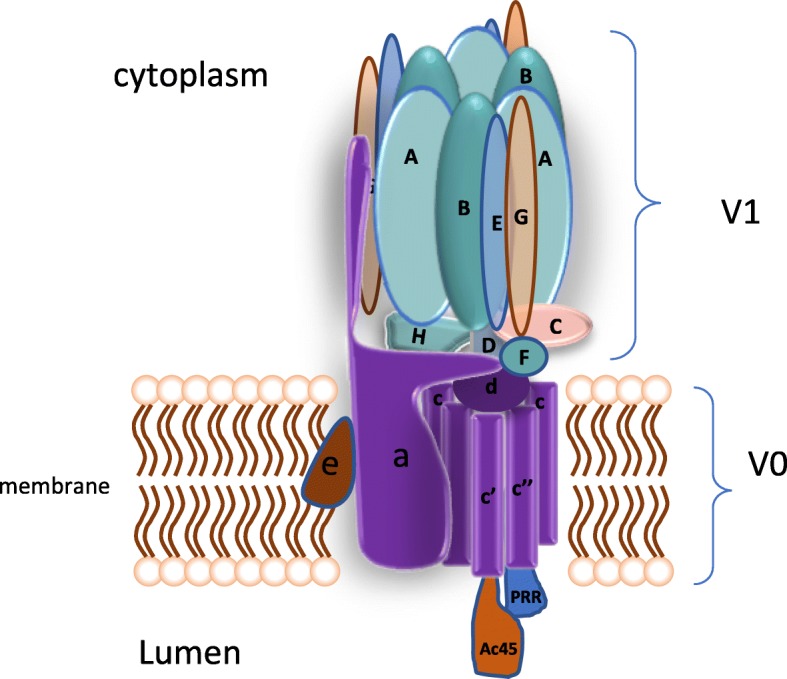
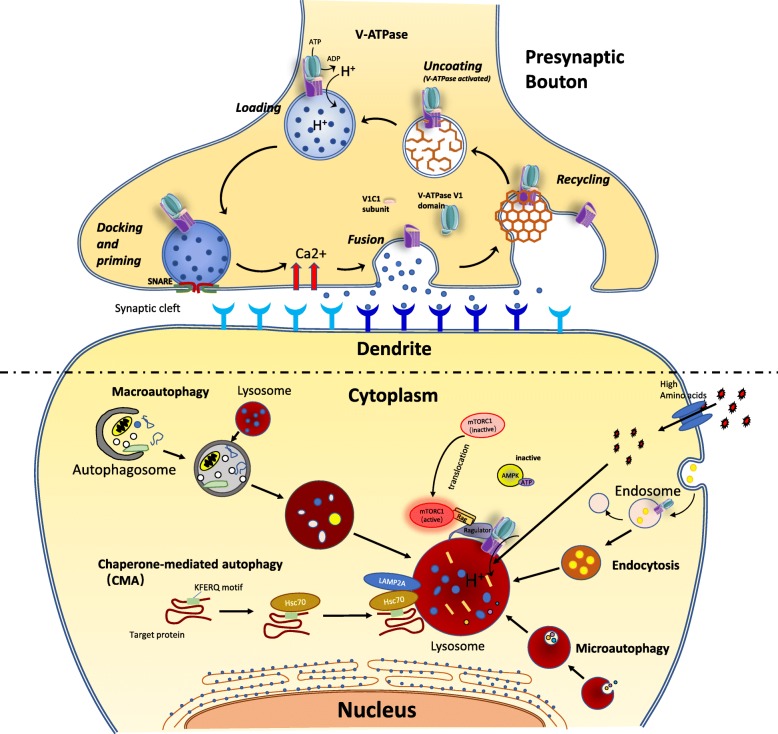
As a large multi-subunit complex, the V-ATPase is composed of an integral membrane V0 domain involved in proton translocation and a peripheral V1 domain catalyzing ATP hydrolysis. The canonical functions of V-ATPase rely on its H-pumping ability in multiple vesicle organelles to regulate endocytic traffic, protein processing and degradation, synaptic vesicle loading, and coupled transport. The other non-canonical effects of the V-ATPase that are not readily attributable to its proton-pumping activity include membrane fusion, pH sensing, amino-acid-induced activation of mTORC1, and scaffolding for protein-protein interaction. In response to various stimuli, V-ATPase complex can reversibly dissociate into V1 and V0 domains and thus close ATP-dependent proton transport. Dysregulation of pH and lysosomal dysfunction have been linked to many human diseases, including neurodegenerative disorders such as Alzheimer disease, Parkinson's disease, amyotrophic lateral sclerosis as well as neurodegenerative lysosomal storage disorders.
V-ATPase complex is a universal proton pump and plays an important role in lysosome acidification in all types of cells. Since V-ATPase dysfunction contributes to the pathogenesis of multiple neurodegenerative diseases, further understanding the mechanisms that regulate the canonical and non-canonical functions of V-ATPase will reveal molecular details of disease process and help assess V-ATPase or molecules related to its regulation as therapeutic targets.
溶酶体消化胞吞途径中的细胞外物质和自噬途径中的细胞内物质。这一过程是通过溶酶体腔内的高度酸性 pH 激活驻留水解酶来完成的。溶酶体 pH 梯度主要由液泡(H)ATP 酶(或 V-ATPase)维持,该酶通过消耗 ATP 将质子泵入溶酶体腔。V-ATPase 功能障碍会影响溶酶体酸化,从而破坏底物的清除,导致许多疾病,包括神经退行性疾病。
作为一个大型多亚基复合物,V-ATPase 由参与质子转运的整合膜 V0 结构域和催化 ATP 水解的外围 V1 结构域组成。V-ATPase 的典型功能依赖于其在多个囊泡细胞器中质子泵的能力,以调节胞吞运输、蛋白质加工和降解、突触囊泡加载和偶联运输。V-ATPase 的其他非典型作用,不能轻易归因于其质子泵活性,包括膜融合、pH 感应、氨基酸诱导的 mTORC1 激活以及蛋白质-蛋白质相互作用的支架。对各种刺激的反应,V-ATPase 复合物可可逆地解聚为 V1 和 V0 结构域,从而关闭 ATP 依赖性质子转运。pH 和溶酶体功能障碍的失调与许多人类疾病有关,包括神经退行性疾病,如阿尔茨海默病、帕金森病、肌萎缩侧索硬化症以及神经退行性溶酶体贮积症。
V-ATPase 复合物是一种通用的质子泵,在所有类型的细胞中都对溶酶体酸化起着重要作用。由于 V-ATPase 功能障碍导致多种神经退行性疾病的发病机制,进一步了解调节 V-ATPase 的典型和非典型功能的机制将揭示疾病过程的分子细节,并有助于评估 V-ATPase 或与其调节相关的分子作为治疗靶点。