Ishkhanyan Byurakn, Michel Lange Violaine, Boye Kasper, Mogensen Jesper, Karabanov Anke, Hartwigsen Gesa, Siebner Hartwig Roman
Department of Nordic Studies and Linguistics, University of Copenhagen, Copenhagen, Denmark.
Danish Research Centre for Magnetic Resonance, Copenhagen University Hospital Hvidovre, Hvidovre, Denmark.
Front Psychol. 2020 Apr 27;11:685. doi: 10.3389/fpsyg.2020.00685. eCollection 2020.
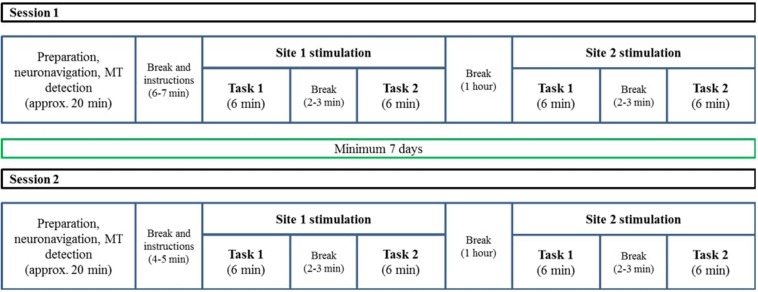
The left inferior frontal gyrus (IFG) is a key region for language comprehension and production. Previous studies point to a preferential involvement of left anterior IFG (aIFG) in lexical and semantic processes, while the posterior IFG (pIFG) has been implicated in supporting syntactic and phonological processes. Here we used focal neuronavigated transcranial magnetic stimulation (TMS) to probe the functional involvement of left IFG in lexical and grammatical processing at the sentence level. We applied 10 Hz TMS effective or sham bursts to left aIFG and pIFG, while healthy volunteers performed an adjective-noun production task contrasting grammatical and lexical determiners. For each trial, we measured the time from the stimulus onset to the moment of articulation (response time) and the time from articulation onset to the end of articulation (duration). Focal TMS of IFG generally delayed response times. The TMS-induced delay in response times was relatively stronger for the grammatical condition compared to the lexical condition, when TMS targeted aIFG. Articulation of the determiner was generally shorter in trials presenting grammatical determiners relative to lexical determiners. The shorter articulation time for grammar determiners was facilitated by effective TMS to pIFG. Together, the effects of TMS on task performance provide novel evidence for a joint involvement of anterior and posterior parts of left IFG in implementing grammatical determiners during language production, suggesting an involvement of aIFG in the initiation and pIFG in the production of grammatically appropriate verbal responses at the sentence level.
左额下回(IFG)是语言理解和生成的关键区域。先前的研究指出,左前额下回(aIFG)在词汇和语义处理中具有优先参与作用,而后额下回(pIFG)则与支持句法和语音处理有关。在此,我们使用聚焦式神经导航经颅磁刺激(TMS)来探究左额下回在句子层面的词汇和语法处理中的功能参与情况。我们对左aIFG和pIFG施加10赫兹的有效或伪刺激脉冲,同时让健康志愿者执行一项形容词 - 名词生成任务,该任务对比了语法和词汇限定词。对于每次试验,我们测量从刺激开始到发音时刻的时间(反应时间)以及从发音开始到发音结束的时间(持续时间)。额下回的聚焦式TMS通常会延迟反应时间。当TMS靶向aIFG时,与词汇条件相比,语法条件下TMS引起的反应时间延迟相对更强。相对于词汇限定词,在呈现语法限定词的试验中,限定词的发音通常更短。对pIFG的有效TMS促进了语法限定词更短的发音时间。总之,TMS对任务表现的影响为左额下回的前部和后部在语言生成过程中共同参与实施语法限定词提供了新的证据,表明aIFG参与启动,而pIFG参与句子层面语法恰当言语反应的生成。