Guirado Damián, Ruiz-Arrebola Samuel, Tornero-López Ana M, de la Vega Jose M, Prada Pedro J, Lallena Antonio M
Unidad de Radiofísica, Hospital Universitario Clínico "San Cecilio", E-18016 Granada, Spain.
Instituto de Investigación Biosanitaria (ibs. GRANADA), Complejo Hospitalario Universitario de Granada/Universidad de Granada, Granada, Spain.
J Contemp Brachytherapy. 2020 Apr;12(2):193-200. doi: 10.5114/jcb.2020.94492. Epub 2020 Apr 18.
Schemes with high doses per fraction and small number of fractions are commonly used in high-dose-rate brachytherapy (HDR-BT) for prostate cancer. Our aim was to analyze the differences between published clinical results and the predictions of radiobiological models for absorbed dose required in a single fraction monotherapy HDR-BT.
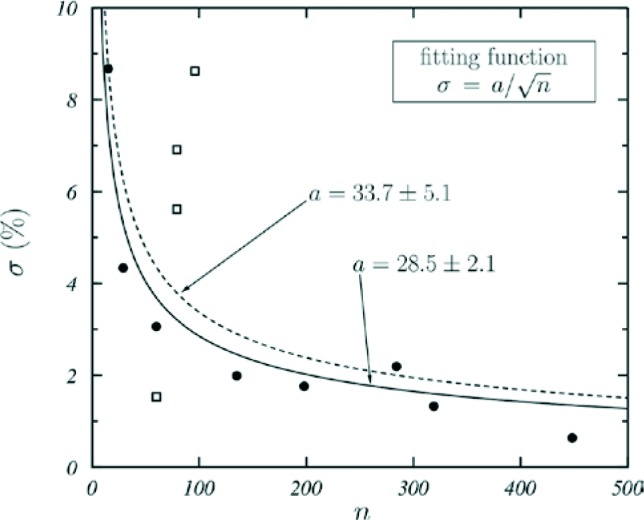
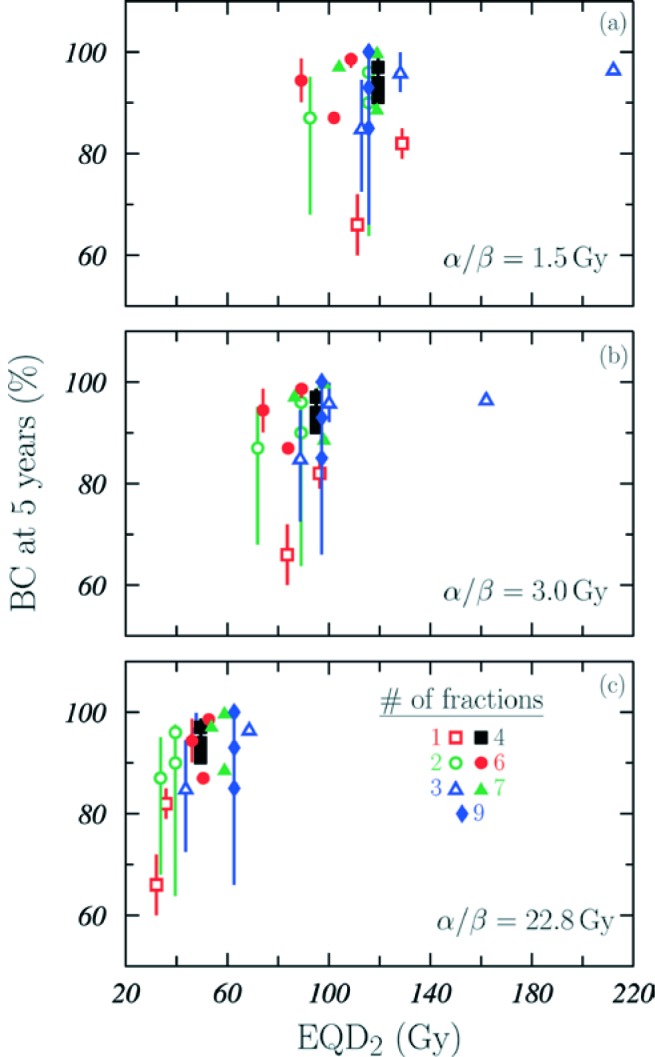
Published HDR-BT clinical results for low- and intermediate-risk patients with prostate cancer were revised. For 13 clinical studies with 16 fractionation schedules between 1 and 9 fractions, a dose-response relation in terms of the biochemical control probability (BC) was established using Monte Carlo-based statistical methods.
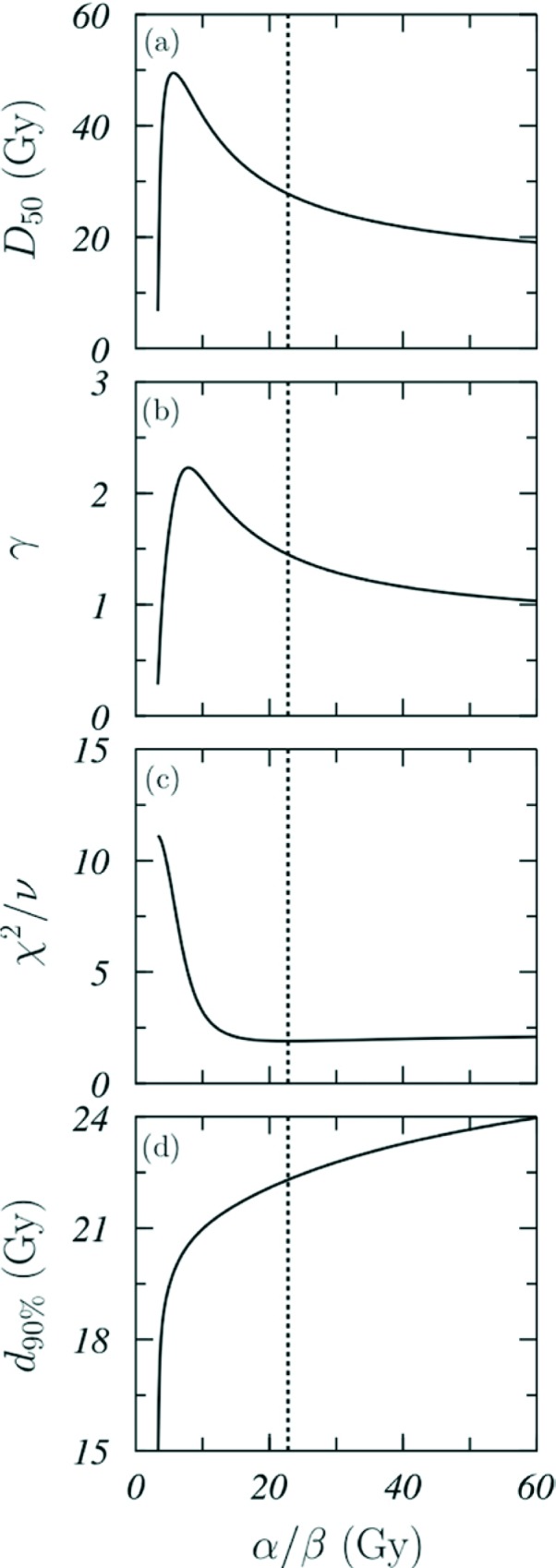
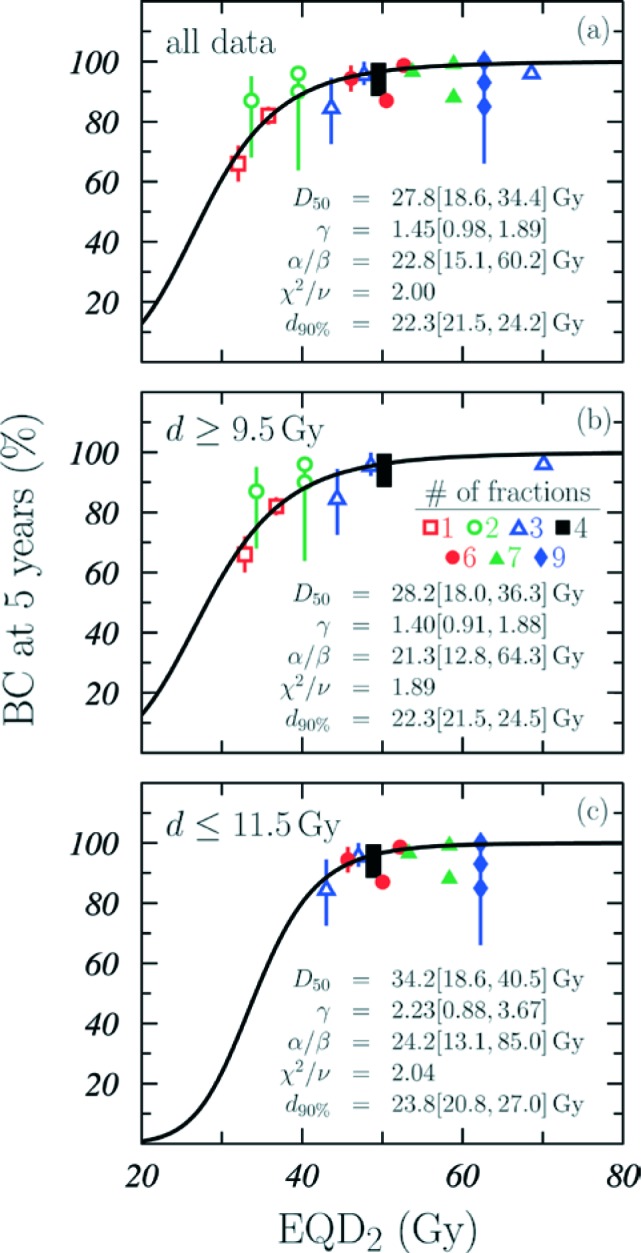
We obtained a value of α/β = 22.8 Gy (15.1-60.2 Gy) (95% CI) much larger than the values in the range 1.5-3.0 Gy that are usually considered to compare the results of different fractionation schemes in prostate cancer radiotherapy using doses per fraction below 6 Gy. The doses in a single fraction producing BC = 90% and 95% were 22.3 Gy (21.5-24.2 Gy) and 24.3 Gy (23.0-27.9 Gy), respectively.
The α/β obtained in our analysis of 22.8 Gy for a range of dose per fraction between 6 and 20.5 Gy was much greater than the one currently estimated for prostate cancer using low doses per fraction. This high value of α/β explains reasonably well the data available in the region of high doses per fraction considered.
高剂量率近距离放射治疗(HDR - BT)用于前列腺癌时,通常采用每次高剂量少分次的方案。我们的目的是分析已发表的临床结果与单分次治疗HDR - BT中吸收剂量的放射生物学模型预测之间的差异。
修订已发表的前列腺癌低危和中危患者的HDR - BT临床结果。对于13项临床研究中的16种分次方案(1至9次),使用基于蒙特卡罗的统计方法建立了生化控制概率(BC)方面的剂量反应关系。
我们得到α/β值为22.8 Gy(15.1 - 60.2 Gy)(95%置信区间),远大于通常认为用于比较前列腺癌放疗中不同分次方案结果(每次剂量低于6 Gy)时1.5 - 3.0 Gy范围内的值。产生BC = 90%和95%的单次剂量分别为22.3 Gy(21.5 - 24.2 Gy)和24.3 Gy(23.0 - 27.9 Gy)。
我们在分析中得到的α/β值为22.8 Gy(每次剂量范围为6至20.5 Gy),远大于目前对前列腺癌使用低单次剂量时估计的值。这个高α/β值相当合理地解释了所考虑的高分次剂量区域的现有数据。