Richard Seidu A
Department of Medicine, Princefield University, Ho, Ghana, West Africa.
Oncol Rev. 2020 Apr 30;14(1):446. doi: 10.4081/oncol.2020.446. eCollection 2020 Feb 18.
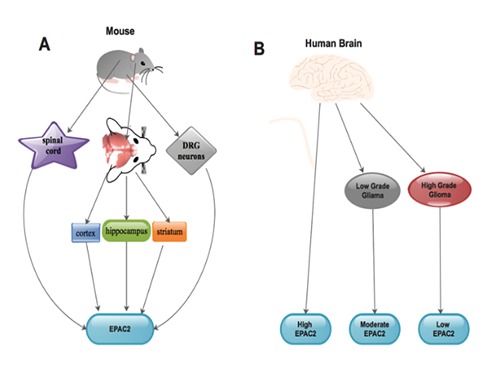
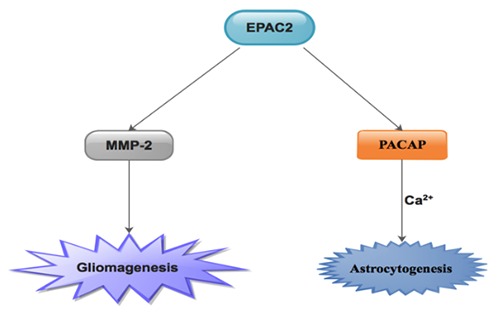
Gliomas are prime brain cancers which are initiated by malignant modification of neural stem cells, progenitor cells and differentiated glial cells such as astrocyte, oligodendrocyte as well as ependymal cells. Exchange proteins directly activated by cAMP (EPACs) are crucial cyclic adenosine 3',5'-monophosphate (cAMP)-determined signaling pathways. Cyclic AMP-intermediated signaling events were utilized to transduce protein kinase A (PKA) leading to the detection of EPACs or cAMP-guanine exchange factors (cAMP-GEFs). EPACs have been detected as crucial proteins associated with the pathogenesis of neurological disorders as well as numerous human diseases. EPAC proteins have two isoforms. These isoforms are EPAC1 and EPAC2. EPAC2 also known as Rap guanine nucleotide exchange factor 4 (RAPGEF4) is generally expression in all neurites. Higher EAPC2 levels was detected in the cortex, hippocampus as well as striatum of adult mouse brain. Activation as well as over-secretion of EPAC2 triggers apoptosis in neurons and EPAC-triggered apoptosis was intermediated via the modulation of Bcl-2 interacting member protein (BIM). EPAC2 secretory levels has proven to be more in low-grade clinical glioma than high-grade clinical glioma. This review therefore explores the effects of EPAC2/RAPGEF4 on the pathogenesis of glioma instead of EPAC1 because EPAC2 and not EPAC1 is predominately expressed in the brain. Therefore, EPAC2 is most likely to modulate glioma pathogenesis rather than EPAC1.
胶质瘤是原发性脑癌,由神经干细胞、祖细胞以及分化的神经胶质细胞(如星形胶质细胞、少突胶质细胞和室管膜细胞)的恶性转化引发。直接由环磷酸腺苷(cAMP)激活的交换蛋白(EPACs)是至关重要的cAMP介导的信号通路。利用cAMP介导的信号事件来转导蛋白激酶A(PKA),从而检测到EPACs或cAMP鸟嘌呤交换因子(cAMP-GEFs)。EPACs已被检测为与神经疾病以及众多人类疾病发病机制相关的关键蛋白。EPAC蛋白有两种异构体。这些异构体是EPAC1和EPAC2。EPAC2也被称为Rap鸟嘌呤核苷酸交换因子4(RAPGEF4),通常在所有神经突中表达。在成年小鼠大脑的皮质、海马体以及纹状体中检测到较高水平的EAPC2。EPAC2的激活和过度分泌会触发神经元凋亡,且EPAC触发的凋亡是通过调节Bcl-2相互作用蛋白(BIM)介导的。已证实,在低级别临床胶质瘤中EPAC2的分泌水平高于高级别临床胶质瘤。因此,本综述探讨EPAC2/RAPGEF4对胶质瘤发病机制的影响,而非EPAC1,因为EPAC2而非EPAC1在大脑中占主导表达。所以,EPAC2最有可能调节胶质瘤的发病机制,而非EPAC1。