Department of Rheumatology, Leiden University Medical Center, Leiden, the Netherlands.
NOVA Medical School, Universidade Nova de Lisboa, Lisbon, Portugal.
RMD Open. 2020 Feb;6(1). doi: 10.1136/rmdopen-2019-001093.
To study changes on MRI of the spine and sacroiliac joint (SIJ) in early axial spondyloarthritis (axSpA) over time.
In the Devenir des Spondyloarthropathies Indifférenciées Récentes cohort, MRI-spine and MRI-SIJ at baseline and 2 and 5 years were scored by central readers for bone marrow oedema (BME), fatty lesions, erosions, sclerosis, ankylosis and spinal bone spurs. The average mean number of lesions was reported or the agreement of ≥2 out of 3 readers for binary outcomes. Net progression was calculated by subtracting the patients that 'improved' from those that 'worsened' divided by the total number of patients.
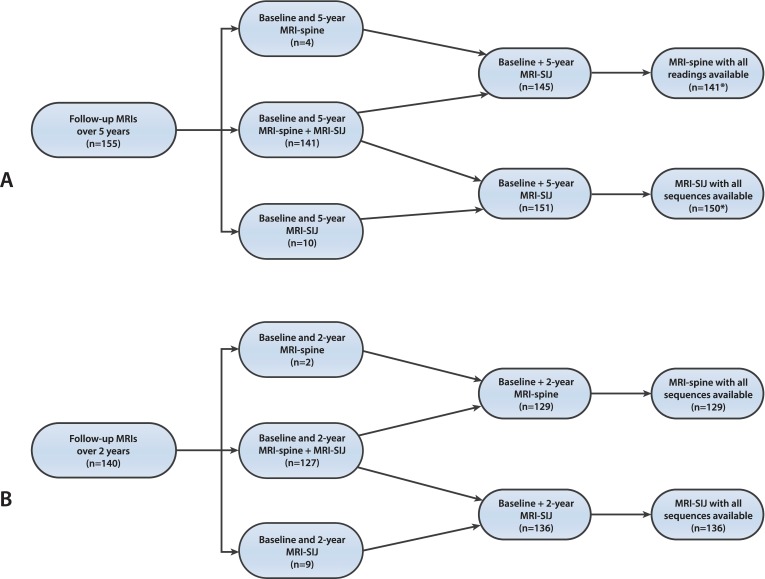
Over 5 years, in 155 patients with axSpA (mean age 33.5 (SD 8.9) years, symptom duration 1.4 (0.8) years, 63% human leucocyte antigen+, 14% modified New York+), BME on MRI-SIJ decreased by a mean Spondyloarthritis Research Consortium of Canada score of 1.4 (SD 6.5) (p=0.009). The largest BME decrease was observed in patients using biological disease-modifying antirheumatic drugs at 5 years. Spinal BME increased by 0.3 (4.6) (p=0.41). Fatty lesions and/or erosions on MRI-SIJ increased by a mean of 1.0 (SD 2.6) (p<0.001). Spinal fatty lesions and/or erosions increased by 0.2 (SD 0.5) (p<0.001). Compared with baseline, at 5 years, 7.3% less patients had BME on MRI-SIJ according to the Assessment of Spondyloarthritis International Society definition, while 6.6% more patients had ≥5 fatty lesions and/or erosions. At 5 years, 0.7% less patients had ≥5 spinal BME lesions and 0.7% less patients had ≥5 spinal fatty lesions.
Over 5 years, BME on MRI-SIJ decreased and spinal BME remained similar, but numerically, little progression of structural lesions on MRI of the SIJ and spine was seen.
研究早期中轴型脊柱关节炎(axSpA)患者脊柱和骶髂关节(SIJ)MRI 随时间的变化。
在新近发病的未分化脊柱关节病队列中,由中心阅片者对基线、2 年和 5 年时的脊柱 MRI 和骶髂关节 MRI 进行骨髓水肿(BME)、脂肪病变、侵蚀、硬化、强直和脊柱骨刺的评分。报告平均病变数量,或对于二进制结果,报告 3 位阅片者中≥2 位的一致性。通过从“改善”的患者中减去“恶化”的患者,再除以总患者数,计算净进展。
在 155 例 axSpA 患者(平均年龄 33.5(8.9)岁,症状持续时间 1.4(0.8)年,63%人白细胞抗原阳性,14%改良纽约阳性)中,5 年内,骶髂关节 MRI 的 BME 平均减少了 Spondyloarthritis Research Consortium of Canada 评分 1.4(6.5)分(p=0.009)。在使用生物改善病情抗风湿药物的患者中,BME 减少最大。脊柱 BME 增加了 0.3(4.6)分(p=0.41)。骶髂关节 MRI 的脂肪病变和/或侵蚀增加了 1.0(2.6)分(p<0.001)。脊柱的脂肪病变和/或侵蚀增加了 0.2(0.5)分(p<0.001)。与基线相比,5 年后,根据评估脊柱关节炎国际协会的定义,有 7.3%的患者骶髂关节 MRI 的 BME 减少,而有 6.6%的患者出现≥5 个脂肪病变和/或侵蚀。5 年后,有 0.7%的患者脊柱 BME 病变数减少≥5 个,有 0.7%的患者脊柱脂肪病变数减少≥5 个。
5 年内,骶髂关节 MRI 的 BME 减少,脊柱 BME 保持相似,但在数量上,SIJ 和脊柱 MRI 的结构病变仍有进展。