Quirino-Teixeira Anna Cecíllia, Rozini Stephane Vicente, Barbosa-Lima Giselle, Coelho Diego Rodrigues, Carneiro Pedro Henrique, Mohana-Borges Ronaldo, Bozza Patrícia T, Hottz Eugenio D
Laboratory of Immunothrombosis and.
Laboratory of Glycoconjugates Analysis, Department of Biochemistry, Federal University of Juiz de Fora (UFJF), Juiz de Fora, Brazil.
Blood Adv. 2020 May 12;4(9):2018-2031. doi: 10.1182/bloodadvances.2019001169.
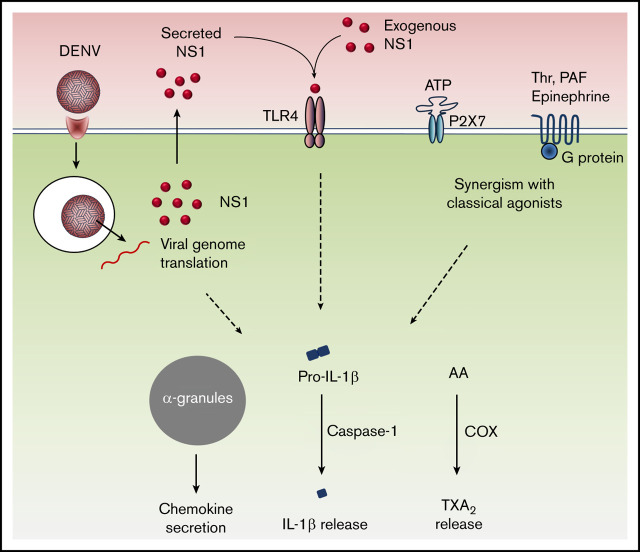
Emerging evidence identifies major contributions of platelets to inflammatory amplification in dengue, but the mechanisms of infection-driven platelet activation are not completely understood. Dengue virus nonstructural protein-1 (DENV NS1) is a viral protein secreted by infected cells with recognized roles in dengue pathogenesis, but it remains unknown whether NS1 contributes to the inflammatory phenotype of infected platelets. This study shows that recombinant DENV NS1 activated platelets toward an inflammatory phenotype that partially reproduced DENV infection. NS1 stimulation induced translocation of α-granules and release of stored factors, but not of newly synthesized interleukin-1β (IL-1β). Even though both NS1 and DENV were able to induce pro-IL-1β synthesis, only DENV infection triggered caspase-1 activation and IL-1β release by platelets. A more complete thromboinflammatory phenotype was achieved by synergistic activation of NS1 with classic platelet agonists, enhancing α-granule translocation and inducing thromboxane A2 synthesis (thrombin and platelet-activating factor), or activating caspase-1 for IL-1β processing and secretion (adenosine triphosphate). Also, platelet activation by NS1 partially depended on toll-like receptor-4 (TLR-4), but not TLR-2/6. Finally, the platelets sustained viral genome translation and replication, but did not support the release of viral progeny to the extracellular milieu, characterizing an abortive viral infection. Although DENV infection was not productive, translation of the DENV genome led to NS1 expression and release by platelets, contributing to the activation of infected platelets through an autocrine loop. These data reveal distinct, new mechanisms for platelet activation in dengue, involving DENV genome translation and NS1-induced platelet activation via platelet TLR4.
新出现的证据表明血小板在登革热炎症放大过程中起主要作用,但感染驱动血小板激活的机制尚未完全明确。登革病毒非结构蛋白1(DENV NS1)是一种由受感染细胞分泌的病毒蛋白,在登革热发病机制中具有公认的作用,但NS1是否促成受感染血小板的炎症表型仍不清楚。本研究表明,重组DENV NS1可使血小板向炎症表型激活,部分重现了DENV感染。NS1刺激诱导α颗粒移位并释放储存因子,但不释放新合成的白细胞介素-1β(IL-1β)。尽管NS1和DENV都能够诱导前IL-1β合成,但只有DENV感染能触发血小板的半胱天冬酶-1激活和IL-1β释放。NS1与经典血小板激动剂协同激活可实现更完整的血栓炎症表型,增强α颗粒移位并诱导血栓素A2合成(凝血酶和血小板激活因子),或激活半胱天冬酶-1以进行IL-1β加工和分泌(三磷酸腺苷)。此外,NS1介导的血小板激活部分依赖于Toll样受体4(TLR-4),而非TLR-2/6。最后,血小板维持病毒基因组的翻译和复制,但不支持病毒子代释放到细胞外环境,表现为一种顿挫性病毒感染。尽管DENV感染没有产生子代病毒,但DENV基因组的翻译导致血小板表达并释放NS1,通过自分泌环路促成受感染血小板的激活。这些数据揭示了登革热中血小板激活的独特新机制,涉及DENV基因组翻译以及NS1通过血小板TLR4诱导的血小板激活。