Department of Environmental Sciences, Jožef Stefan Institute, Jamova 39, 1000 Ljubljana, Slovenia.
Jožef Stefan International Postgraduate School, Jamova 39, 1000 Ljubljana, Slovenia.
Molecules. 2020 May 8;25(9):2217. doi: 10.3390/molecules25092217.
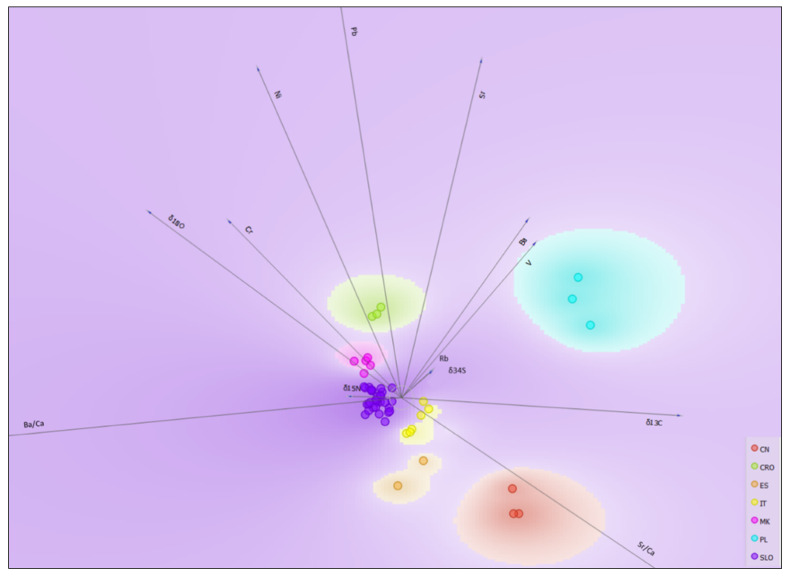
This study used elemental and stable isotope composition to characterize Slovenian truffles and used multi-variate statistical analysis to classify truffles according to species and geographical origin. Despite the fact that the Slovenian truffles shared some similar characteristics with the samples originating from other countries, differences in the element concentrations suggest that respective truffle species may respond selectively to nutrients from a certain soil type under environmental and soil conditions. Cross-validation resulted in a 77% correct classification rate for determining the geographical origin and a 74% correct classification rate to discriminate between species. The critical parameters for geographical origin discriminations were Sr, Ba, V, Pb, Ni, Cr, Ba/Ca and Sr/Ca ratios, while from stable isotopes O and δC values are the most important. The key variables that distinguish from other species are the levels of V and Zn and δN values. can be separated based on the levels of Ni, Cr, Mn, Mg, As, and Cu. This preliminary study indicates the possibility to differentiate truffles according to their variety and geographical origin and suggests widening the scope to include stable strontium isotopes.
本研究采用元素和稳定同位素组成来表征斯洛文尼亚块菌,并采用多元统计分析根据物种和地理起源对块菌进行分类。尽管斯洛文尼亚块菌与来自其他国家的样本具有一些相似特征,但元素浓度的差异表明,各自的块菌物种可能会根据环境和土壤条件下的特定土壤类型对养分做出选择性响应。交叉验证确定地理起源的正确分类率为 77%,区分物种的正确分类率为 74%。地理起源判别最重要的参数是 Sr、Ba、V、Pb、Ni、Cr、Ba/Ca 和 Sr/Ca 比值,而从稳定同位素来看,O 和 δC 值是最重要的。区分 和其他物种的关键变量是 V 和 Zn 的水平和 δN 值。 可以根据 Ni、Cr、Mn、Mg、As 和 Cu 的水平进行区分。这项初步研究表明,根据品种和地理起源对块菌进行区分是可能的,并建议扩大范围以包括稳定的锶同位素。