Department of Human Epigenetics, Mossakowski Medical Research Centre, Polish Academy of Sciences, 5 Pawinskiego Street, 02-106 Warsaw, Poland.
Molecules. 2020 May 9;25(9):2224. doi: 10.3390/molecules25092224.
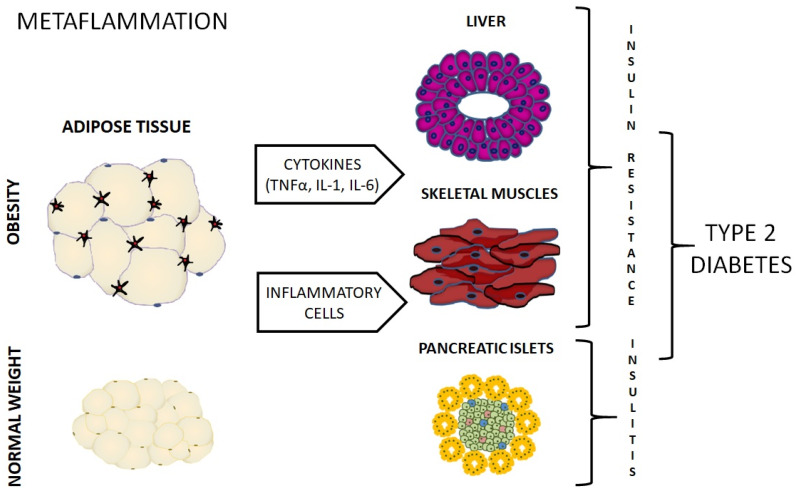
One of the concepts explaining the coincidence of obesity and type 2 diabetes (T2D) is the metaflammation theory. This chronic, low-grade inflammatory state originating from metabolic cells in response to excess nutrients, contributes to the development of T2D by increasing insulin resistance in peripheral tissues (mainly in the liver, muscles, and adipose tissue) and by targeting pancreatic islets and in this way impairing insulin secretion. Given the role of this not related to infection inflammation in the development of both: insulin resistance and insulitis, anti-inflammatory strategies could be helpful not only to control T2D symptoms but also to treat its causes. This review presents current concepts regarding the role of metaflammation in the development of T2D in obese individuals as well as data concerning possible application of different anti-inflammatory strategies (including lifestyle interventions, the extra-glycemic potential of classical antidiabetic compounds, nonsteroidal anti-inflammatory drugs, immunomodulatory therapies, and bariatric surgery) in the management of T2D.
解释肥胖和 2 型糖尿病(T2D)同时发生的概念之一是代谢性炎症理论。这种源于代谢细胞对过量营养物质的慢性、低度炎症状态,通过增加外周组织(主要是肝脏、肌肉和脂肪组织)的胰岛素抵抗,以及通过靶向胰岛并损害胰岛素分泌,导致 T2D 的发展。鉴于这种与感染无关的炎症在胰岛素抵抗和胰岛炎发展中的作用,抗炎策略不仅有助于控制 T2D 症状,而且有助于治疗其病因。本文综述了代谢性炎症在肥胖个体中导致 T2D 发展中的作用的最新概念,以及关于不同抗炎策略(包括生活方式干预、经典抗糖尿病化合物的血糖外潜力、非甾体抗炎药、免疫调节疗法和减重手术)在 T2D 管理中的可能应用的数据。