Pikula Konstantin, Chaika Vladimir, Zakharenko Alexander, Savelyeva Anastasia, Kirsanova Irina, Anisimova Anna, Golokhvast Kirill
Education and Scientific Center of Nanotechnology, School of Engineering, Far Eastern Federal University, Sukhanova 8, 690950 Vladivostok, Russia.
N.I. Vavilov All-Russian Institute of Plant Genetic Resources, B.Morskaya 42-44, 190000 Saint-Petersburg, Russia.
Animals (Basel). 2020 May 10;10(5):827. doi: 10.3390/ani10050827.
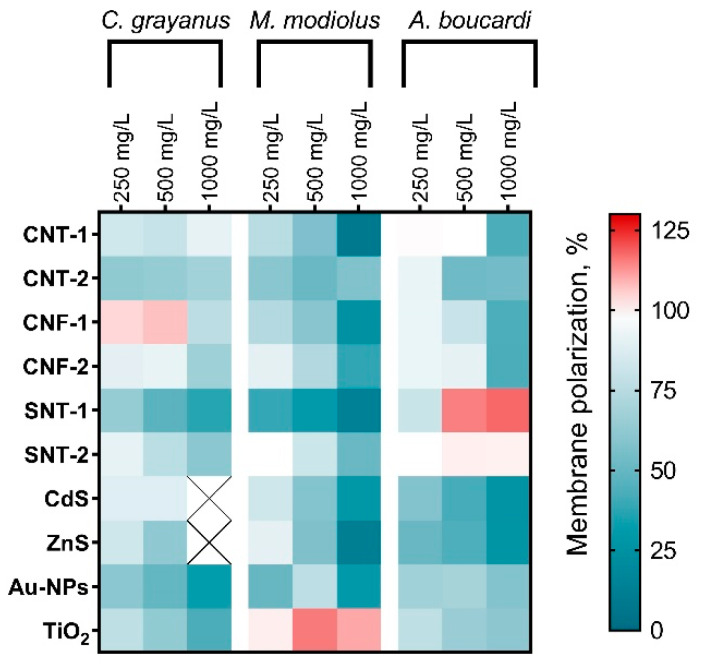
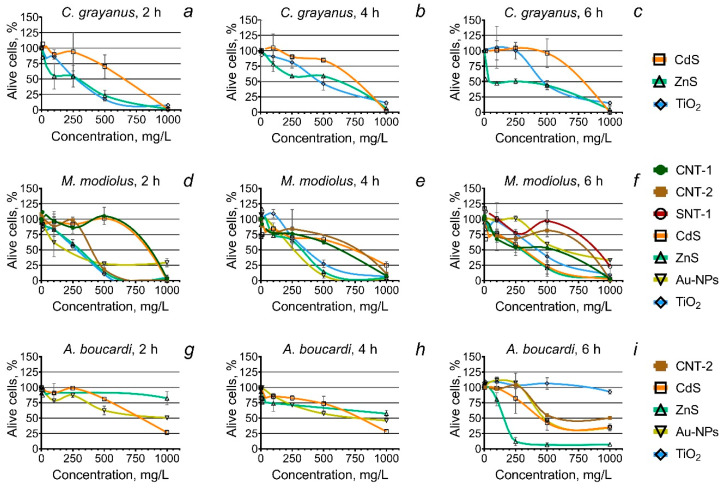
Nanoparticles (NPs) have broad applications in medicine, cosmetics, optics, catalysis, environmental purification, and other areas nowadays. With increasing annual production of NPs, the risks of their harmful influence on the environment and human health are also increasing. Currently, our knowledge about the mechanisms of the interaction between NPs and living organisms is limited. The marine species and their habitat environment are under continuous stress owing to the anthropogenic activities, which result in the release of NPs in the aquatic environment. We used a bioassay model with hemocytes of three bivalve mollusc species, namely, , , and , to evaluate the toxicity of 10 different types of NPs. Specifically, we compared the cytotoxic effects and cell-membrane polarization changes in the hemocytes exposed to carbon nanotubes, carbon nanofibers, silicon nanotubes, cadmium and zinc sulfides, Au-NPs, and TiO NPs. Viability and the changes in hemocyte membrane polarization were measured by the flow cytometry method. The highest aquatic toxicity was registered for metal-based NPs, which caused cytotoxicity to the hemocytes of all the studied bivalve species. Our results also highlighted different sensitivities of the used tested mollusc species to specific NPs.
如今,纳米颗粒(NPs)在医学、化妆品、光学、催化、环境净化及其他领域有着广泛应用。随着纳米颗粒年产量的增加,其对环境和人类健康产生有害影响的风险也在上升。目前,我们对纳米颗粒与生物体相互作用机制的了解有限。由于人为活动,海洋物种及其栖息环境持续受到压力,这导致纳米颗粒在水生环境中释放。我们使用了一种生物测定模型,以三种双壳贝类软体动物(即 、 和 )的血细胞来评估10种不同类型纳米颗粒的毒性。具体而言,我们比较了暴露于碳纳米管、碳纳米纤维、硅纳米管、硫化镉和硫化锌、金纳米颗粒及二氧化钛纳米颗粒的血细胞中的细胞毒性效应和细胞膜极化变化。通过流式细胞术方法测量血细胞活力和细胞膜极化变化。金属基纳米颗粒的水生毒性最高,对所有研究的双壳贝类物种的血细胞均造成细胞毒性。我们的结果还突出了所使用的受试软体动物物种对特定纳米颗粒的不同敏感性。