Agarwal Komal, Sahay Rahul, Baji Avinash
Xtreme Materials Laboratory (XML), Singapore University of Technology and Design, Singapore 487372, Singapore.
Department of Engineering, School of Engineering and Mathematical Sciences (SEMS), La Trobe University, Bundoora 3086, Australia.
Polymers (Basel). 2020 May 10;12(5):1089. doi: 10.3390/polym12051089.
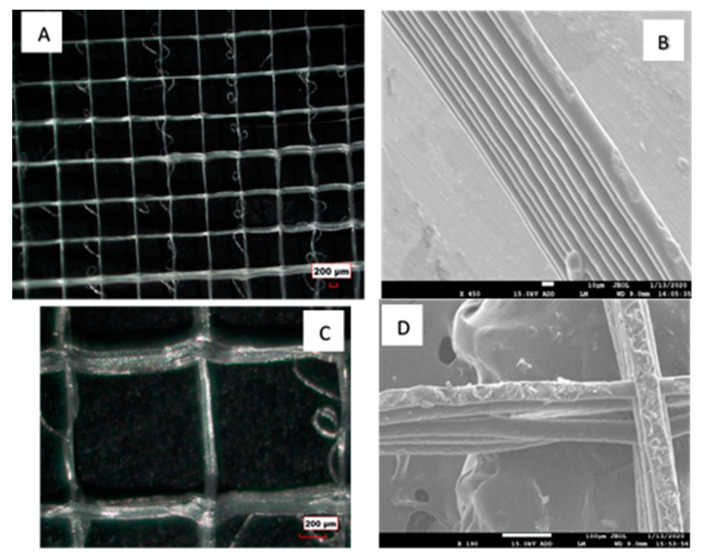
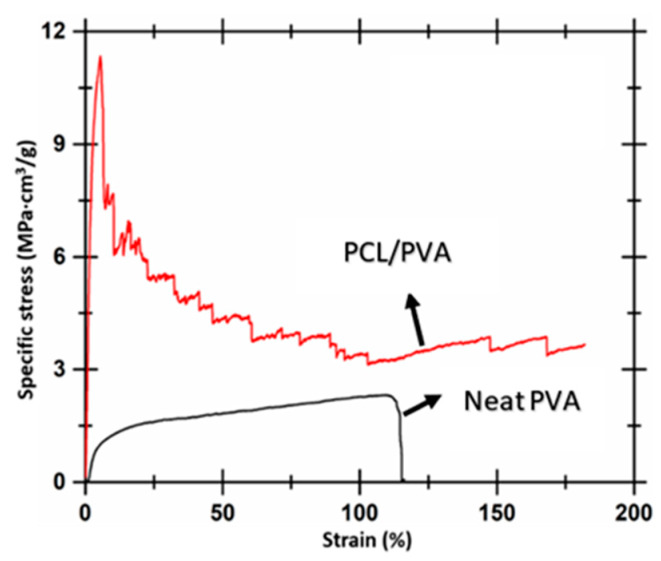
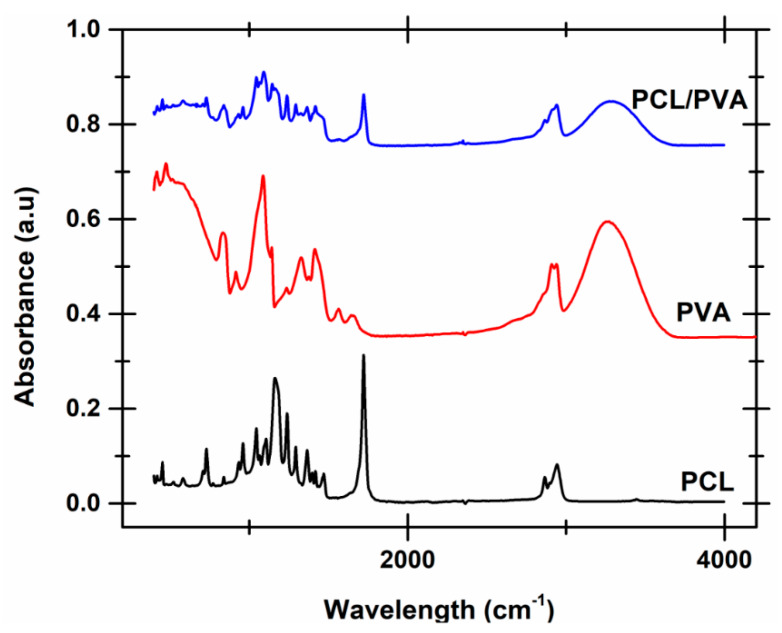
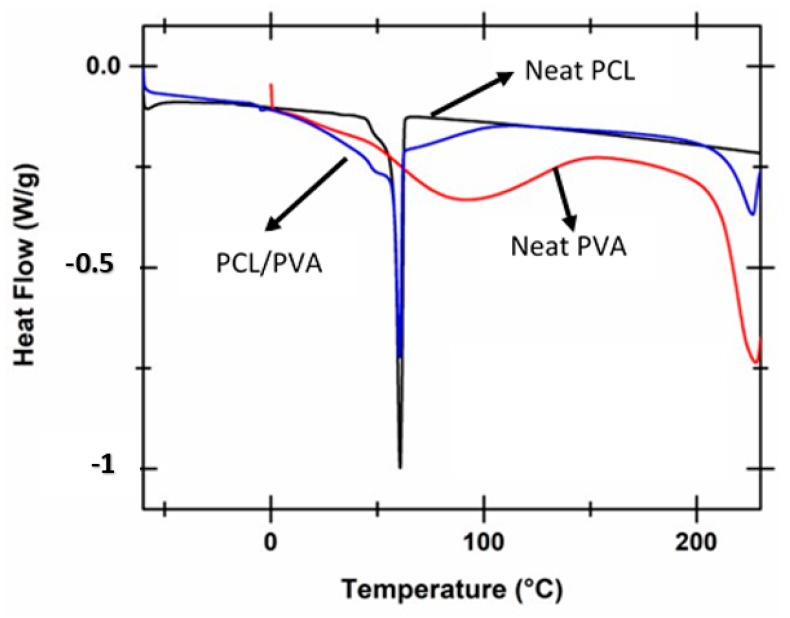
This study used melt-electrospinning writing to fabricate three-dimensional fiber constructs by embedding them in a polyvinyl alcohol (PVA) matrix to obtain thin composite films. Fourier transform infrared spectroscopy (FTIR) and dynamic scanning calorimetry (DSC) were used to demonstrate an interaction between the polycaprolactone (PCL) fibrous phase and the PVA matrix phase. Following this, the mechanical deformation behavior of the composite was investigated, and the effect of reinforcement with three-dimensional fibrous constructs was illustrated. The specific strength of the composite was found to be five times higher than the specific strength of the neat PVA matrix. Additionally, the specific toughness of the composite was determined to be roughly four times higher than the specific toughness determined for the neat PVA matrix. These results demonstrate the potential of using melt-electrospinning writing for producing three-dimensional fibrous constructs for composite reinforcement purposes.
本研究采用熔体静电纺丝书写技术,通过将三维纤维结构嵌入聚乙烯醇(PVA)基质中来制备复合薄膜。利用傅里叶变换红外光谱(FTIR)和动态扫描量热法(DSC)来证明聚己内酯(PCL)纤维相和PVA基质相之间的相互作用。在此之后,研究了复合材料的机械变形行为,并阐述了三维纤维结构增强的效果。发现该复合材料的比强度比纯PVA基质的比强度高五倍。此外,该复合材料的比韧性被确定为比纯PVA基质的比韧性高约四倍。这些结果证明了使用熔体静电纺丝书写技术制备用于复合增强目的的三维纤维结构的潜力。