Department of Radiation Biology, Faculty of Preventive Medicine, Fourth Military Medical University, Xi'an, 710032, China.
Ministry of Education Key Lab of Hazard Assessment and Control in Special Operational Environment, 169# Chang Le West Road, Xi'an, 710032, China.
BMC Neurosci. 2020 May 12;21(1):21. doi: 10.1186/s12868-020-00570-8.
Transcranial direct current stimulation (tDCS) is a non-invasive brain modulation technique that has been proved to exert beneficial effects in the acute phase of stroke. To explore the underlying mechanism, we investigated the neuroprotective effects of cathodal tDCS on brain injury caused by middle cerebral artery occlusion (MCAO).
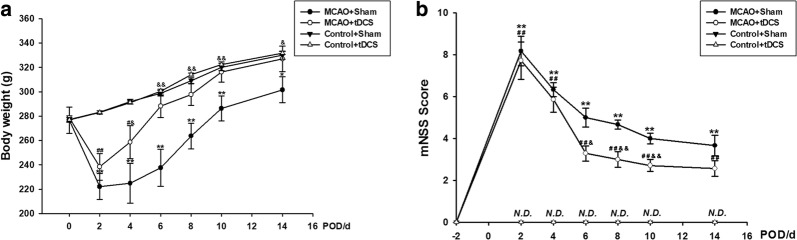
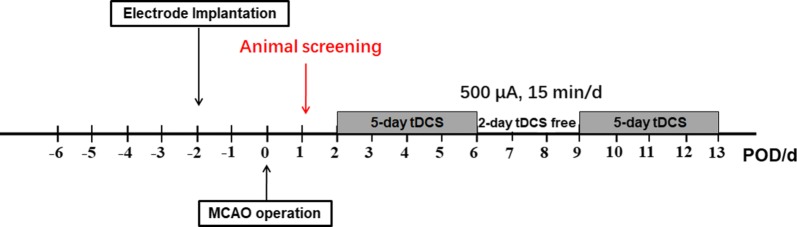
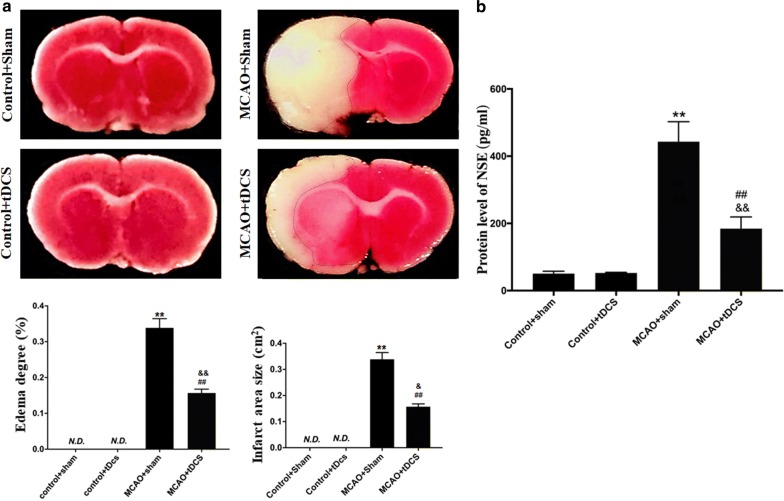
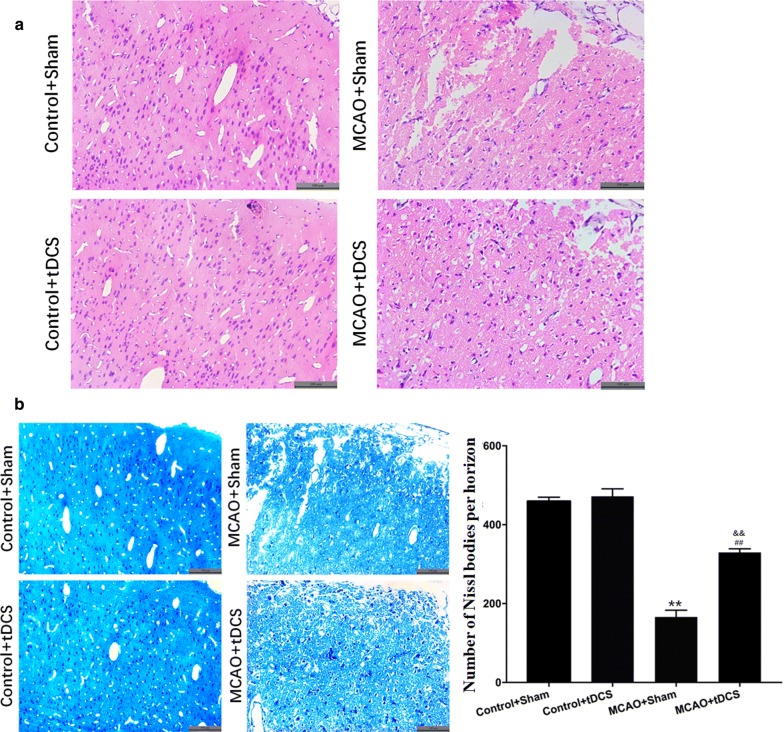
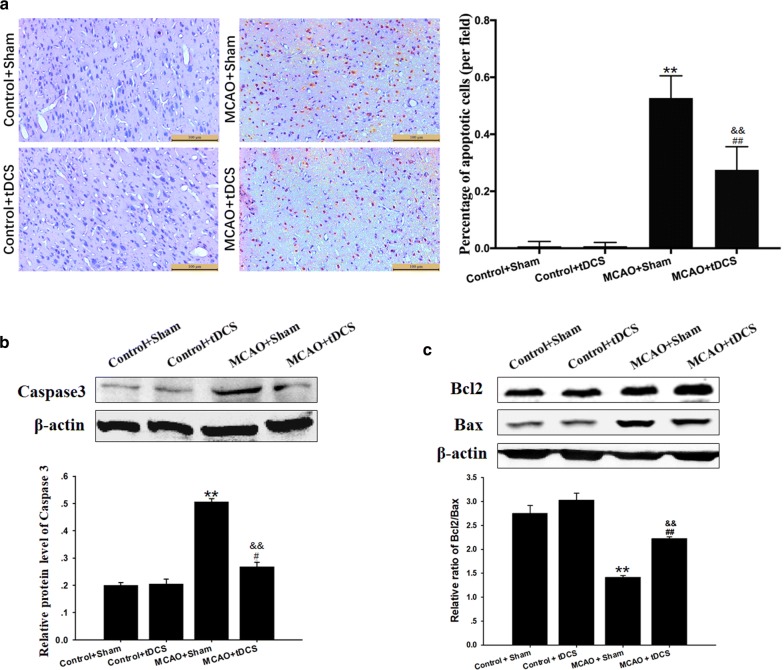
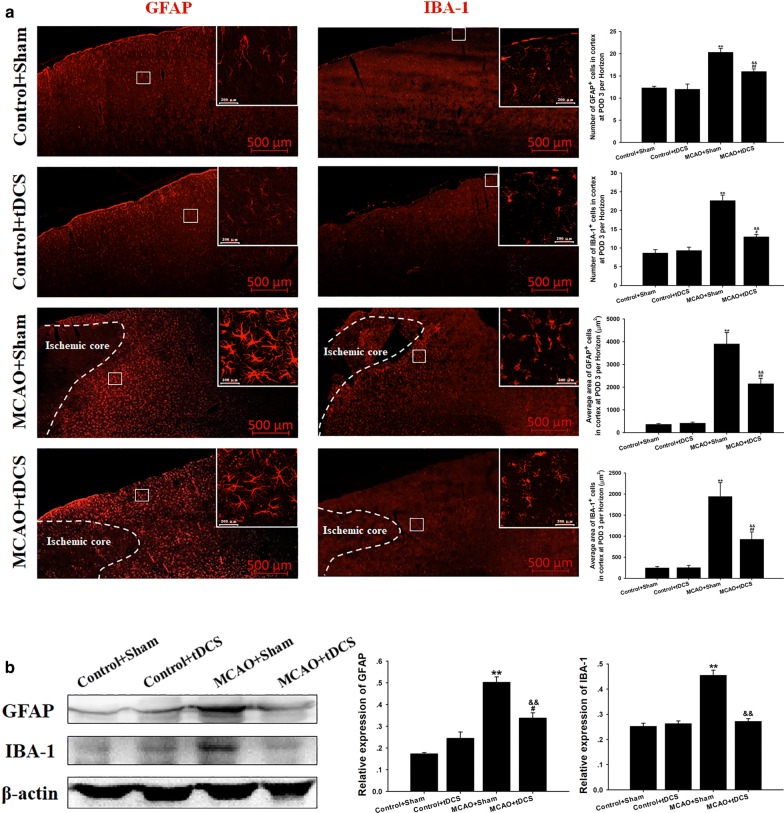
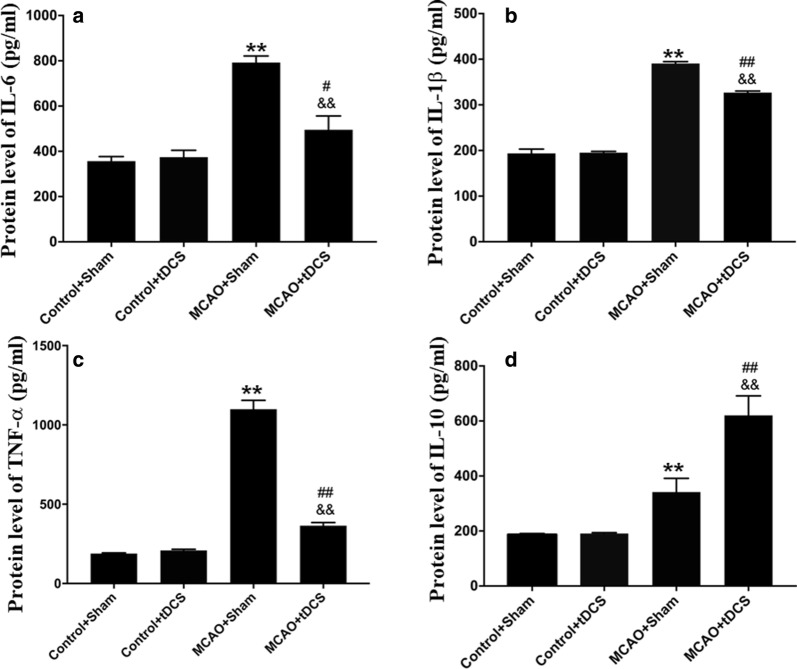
We established the MCAO model and sham MCAO model with an epicranial electrode implanted adult male Sprague-Dawley rats, and then they were randomly divided into four groups (MCAO + tDCS, MCAO + sham tDCS (Sham), Control + tDCS and Control + Sham group). In this study, the severity degree of neurological deficit, the morphology of brain damage, the apoptosis, the level of neuron-specific enolase and inflammatory factors, the activation of glial cells was detected. The results showed that cathodal tDCS significantly improved the level of neurological deficit and the brain morphology, reduced the brain damage area and apoptotic index, and increased the number of Nissl body in MCAO rats, compared with MCAO + Sham group. Meanwhile, the high level of NSE, inflammatory factors, Caspase 3 and Bax/Bcl2 ratio in MCAO rats was reduced by cathodal tDCS. Additionally, cathodal tDCS inhibited the activation of astrocyte and microglia induced by MCAO. No difference was found in two Control groups.
Our results suggested that cathodal tDCS could accelerate the recovery of neurologic deficit and brain damage caused by MCAO. The inhibition of neuroinflammation and apoptosis resulted from cathodal tDCS may be involved in the neuroprotective process.
经颅直流电刺激(tDCS)是一种非侵入性的脑调制技术,已被证明在中风急性期发挥有益作用。为了探索其潜在机制,我们研究了阴极 tDCS 对大脑中动脉闭塞(MCAO)引起的脑损伤的神经保护作用。
我们建立了经颅电极植入成年雄性 Sprague-Dawley 大鼠的 MCAO 模型和假 MCAO 模型,然后将它们随机分为四组(MCAO+tDCS、MCAO+假 tDCS(Sham)、对照+tDCS 和对照+Sham 组)。在这项研究中,检测了神经功能缺损严重程度、脑损伤形态、细胞凋亡、神经元特异性烯醇化酶和炎症因子水平、神经胶质细胞的激活。结果表明,与 MCAO+Sham 组相比,阴极 tDCS 显著改善了 MCAO 大鼠的神经功能缺损和脑形态,减少了脑损伤面积和凋亡指数,增加了 MCAO 大鼠的尼氏小体数量。同时,阴极 tDCS 降低了 MCAO 大鼠中 NSE、炎症因子、Caspase 3 和 Bax/Bcl2 比值的高水平。此外,阴极 tDCS 抑制了 MCAO 引起的星形胶质细胞和小胶质细胞的激活。两个对照组成员之间没有差异。
我们的结果表明,阴极 tDCS 可以加速 MCAO 引起的神经功能缺损和脑损伤的恢复。阴极 tDCS 抑制神经炎症和细胞凋亡可能参与了神经保护过程。