Grupo de Biología y Toxicología Ambiental. Facultad de Ciencias. Universidad Nacional de Educación a Distancia, UNED. Senda del Rey 9, 28040, Madrid, Spain.
Sci Rep. 2020 May 12;10(1):7847. doi: 10.1038/s41598-020-64554-8.
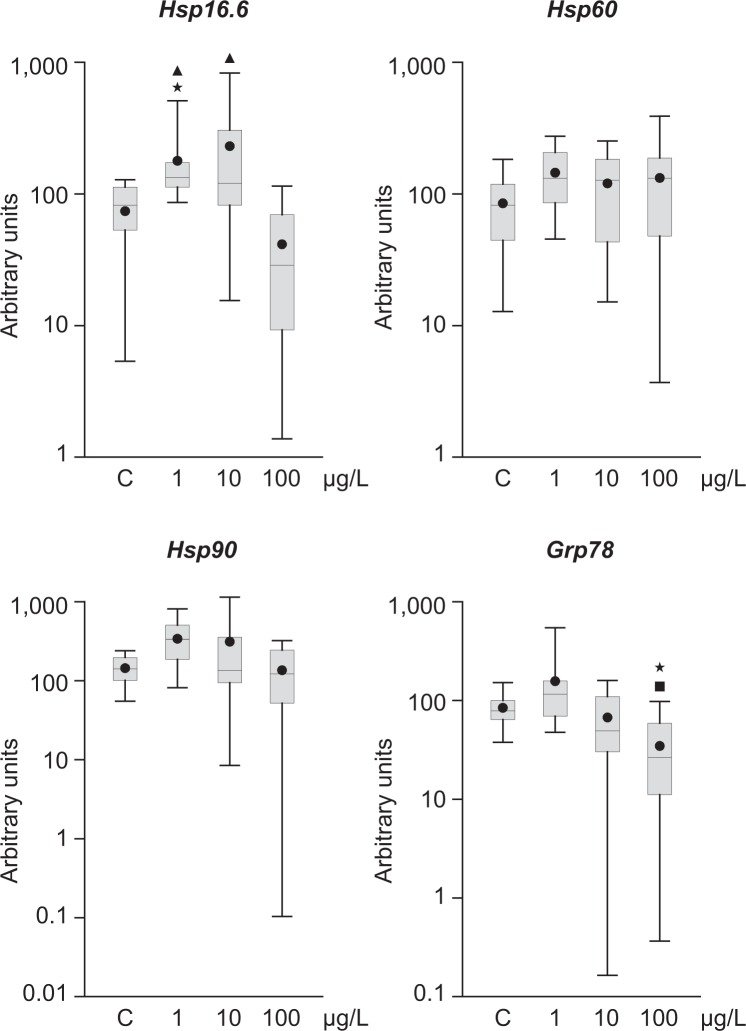
Endosulfan is a persistent pesticide that has been in use for more than five decades. During this time, it has contaminated soil, air, and water reservoirs worldwide. It is extremely toxic and harmful to beneficial non-target invertebrates, aquatic life, and even humans upon consumption, which is one of the many dangers of this pesticide since it biomagnifies in the food chain. The effects of three endosulfan concentrations (1, 10, and 100 µg/L) on the freshwater snail Physella acuta, an invasive cosmopolitan species, were examined over a week-long exposure period. Alterations in the expression of ten genes related to stress and xenobiotic detoxification were measured against the endogenous controls rpL10 and GAPDH by Real-Time polymerase chain reaction. Four genes are described here for the first time in this species, namely Hsp60, Grp78, GSTk1, and GSTm1. The rest of genes were Hsp90, sHsp16.6, cyp2u1, cyp3a7, cyp4f22, and MRP1. cyp2u1, sHsp16.6, and Grp78 expression were all altered by endosulfan. These results suggest a low pesticide concentration activates the acute response in P. acuta by affecting detoxification and stress responses and alter endoplasmic reticulum function and lipid metabolism. Furthermore, the newly identified genes extend the number of processes and cellular locations that can be analyzed in this organism.
硫丹是一种持久性农药,已经使用了五十多年。在此期间,它已经污染了世界各地的土壤、空气和水库。它对有益的非目标无脊椎动物、水生生物甚至人类都具有极高的毒性和危害性,这是这种农药的许多危险之一,因为它在食物链中生物放大。研究了一周暴露期内三种硫丹浓度(1、10 和 100μg/L)对入侵世界性淡水蜗牛 Physella acuta 的影响。通过实时聚合酶链反应,用内参 rpL10 和 GAPDH 测量了与应激和外来物质解毒相关的十个基因的表达变化。这里首次在该物种中描述了四个基因,即 Hsp60、Grp78、GSTk1 和 GSTm1。其余基因是 Hsp90、sHsp16.6、cyp2u1、cyp3a7、cyp4f22 和 MRP1。cyp2u1、sHsp16.6 和 Grp78 的表达均受硫丹影响。这些结果表明,低浓度的农药通过影响解毒和应激反应以及改变内质网功能和脂质代谢来激活 P. acuta 的急性反应。此外,新鉴定的基因扩展了可以在该生物中分析的过程和细胞位置的数量。