DiagNodus Ltd, Babraham Research Campus, Cambridge, UK.
DiagNodus Ltd, St John's Innovation Centre, Cowley Road, Cambridge, UK.
Br J Cancer. 2020 Jul;123(2):252-260. doi: 10.1038/s41416-020-0893-8. Epub 2020 May 13.
Faecal tests are widely applied for colorectal cancer (CRC) screening and considered for triaging symptomatic patients with suspected CRC. However, faecal tests can be inconvenient, complex and expensive. Colorectal mucus (CM) sampled using our new patient-friendly non-invasive technique is rich in CRC biomarkers. This study aimed to evaluate diagnostic accuracy of CRC detection by measuring protein biomarkers in CM.
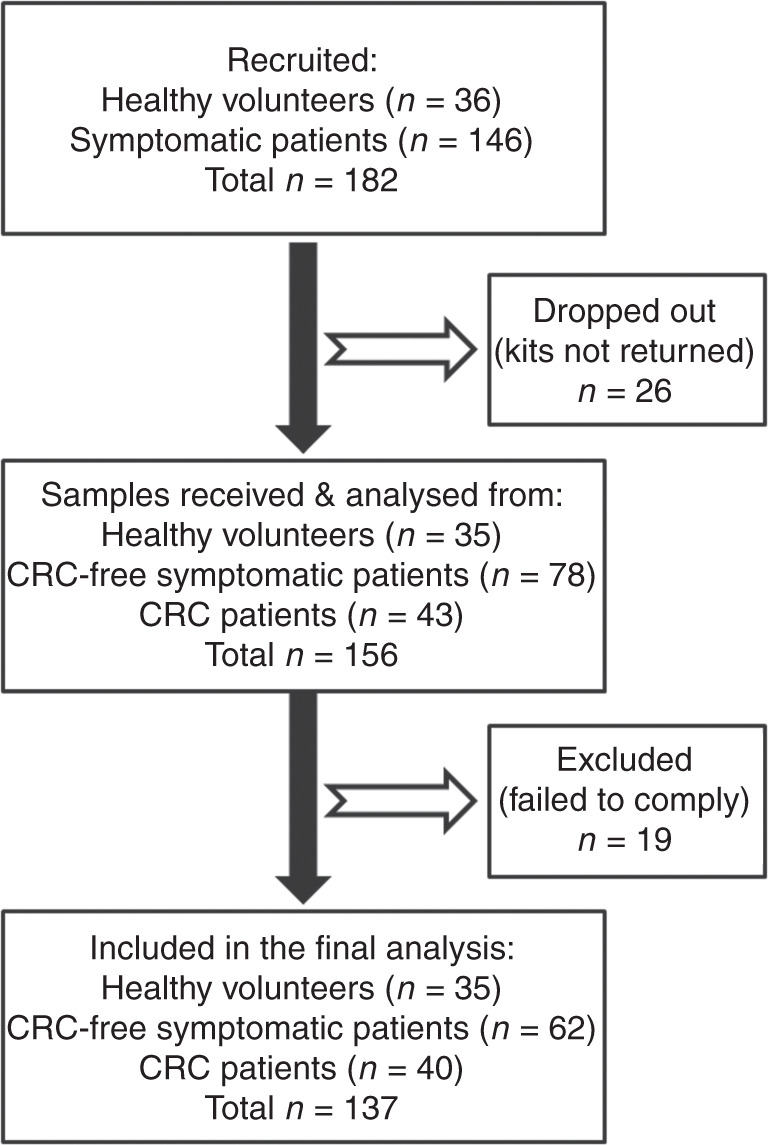
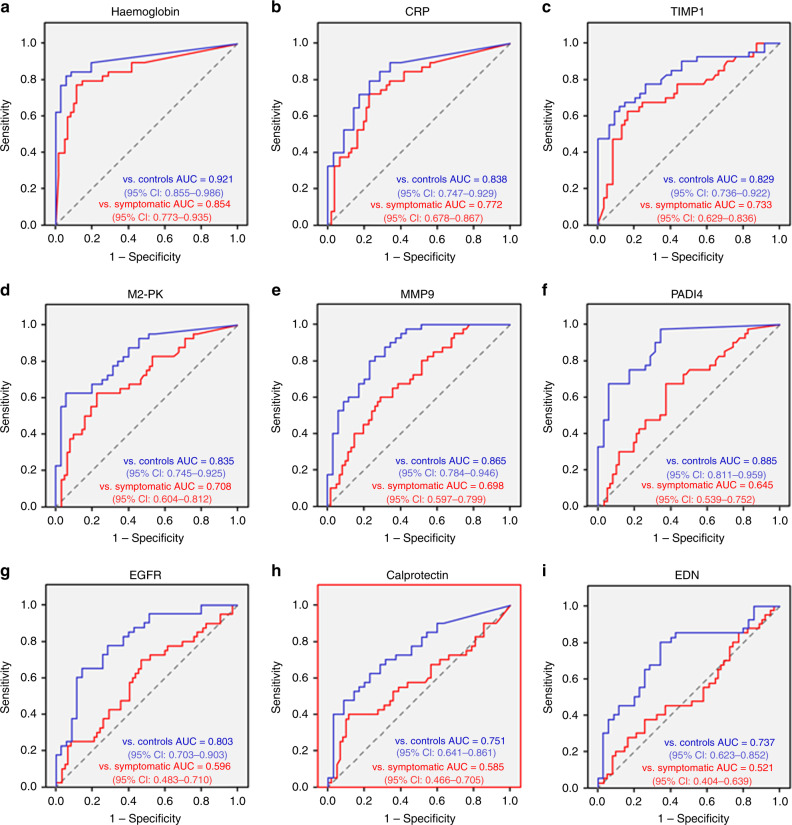
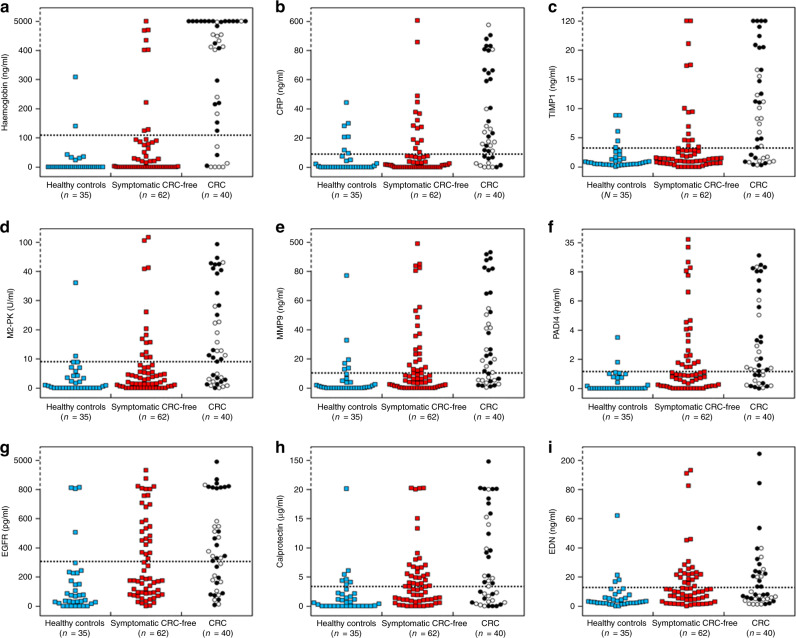
Colorectal mucus samples were provided by 35 healthy controls, 62 CRC-free symptomatic patients and 40 CRC patients. Biomarkers were quantified by ELISA. Diagnostic performances of haemoglobin, C-reactive protein, tissue inhibitor of metalloproteinases-1, M2-pyruvate kinase, matrix metalloproteinase-9, peptidyl arginine deiminase-4, epidermal growth factor receptor, calprotectin and eosinophil-derived neurotoxin were assessed using receiver operating characteristic (ROC) curve analysis.
Colorectal mucus haemoglobin was superior compared to other biomarkers. For haemoglobin, the areas under the curve for discriminating between CRC and healthy groups ('screening') and between CRC and symptomatic patients ('triage') were 0.921 and 0.854 respectively. The sensitivity of 80.0% and specificities of 94.3% and 85.5% for the two settings respectively were obtained.
Haemoglobin quantification in CM reliably detects CRC. This patient-friendly approach presents an attractive alternative to faecal immunochemical test; however, the two methods need to be directly compared in larger studies.
粪便检测广泛应用于结直肠癌(CRC)筛查,并被认为可用于对疑似 CRC 的有症状患者进行分诊。然而,粪便检测可能不方便、复杂且昂贵。我们新的患者友好型非侵入性技术采集的结直肠黏液(CM)富含 CRC 生物标志物。本研究旨在通过测量 CM 中的蛋白质生物标志物来评估 CRC 检测的诊断准确性。
35 名健康对照者、62 名无 CRC 的有症状患者和 40 名 CRC 患者提供了结直肠黏液样本。通过 ELISA 定量生物标志物。使用受试者工作特征(ROC)曲线分析评估血红蛋白、C 反应蛋白、金属蛋白酶组织抑制剂-1、M2-丙酮酸激酶、基质金属蛋白酶-9、肽基精氨酸脱亚氨酶-4、表皮生长因子受体、钙卫蛋白和嗜酸性粒细胞衍生神经毒素的诊断性能。
与其他生物标志物相比,结直肠黏液中的血红蛋白更具优势。对于血红蛋白,区分 CRC 与健康组(“筛查”)和 CRC 与有症状患者(“分诊”)的曲线下面积分别为 0.921 和 0.854。两种设置的灵敏度分别为 80.0%和特异性分别为 94.3%和 85.5%。
CM 中血红蛋白的定量可靠地检测 CRC。这种患者友好型方法为粪便免疫化学检测提供了一种有吸引力的替代方法;然而,这两种方法需要在更大的研究中直接比较。