Reiner Željko, Hatamipour Mahdi, Banach Maciej, Pirro Matteo, Al-Rasadi Khalid, Jamialahmadi Tannaz, Radenkovic Dina, Montecucco Fabrizio, Sahebkar Amirhossein
Department of Internal Medicine, University Hospital Centre Zagreb, Zagreb, Croatia.
Nanotechnology Research Centre, Pharmaceutical Technology Institute, Mashhad University of Medical Sciences, Mashhad, Iran.
Arch Med Sci. 2020 Apr 25;16(3):490-496. doi: 10.5114/aoms.2020.94655. eCollection 2020.
No proven drug and no immunisation are yet available for COVID-19 disease. The SARS-CoV-2 main protease (Mpro), a key coronavirus enzyme, which is a potential drug target, has been successfully crystallised. There is evidence suggesting that statins exert anti-viral activity and may block the infectivity of enveloped viruses. The aim of this study was to assess whether statins are potential COVID-19 Mpro inhibitors, using a molecular docking study.
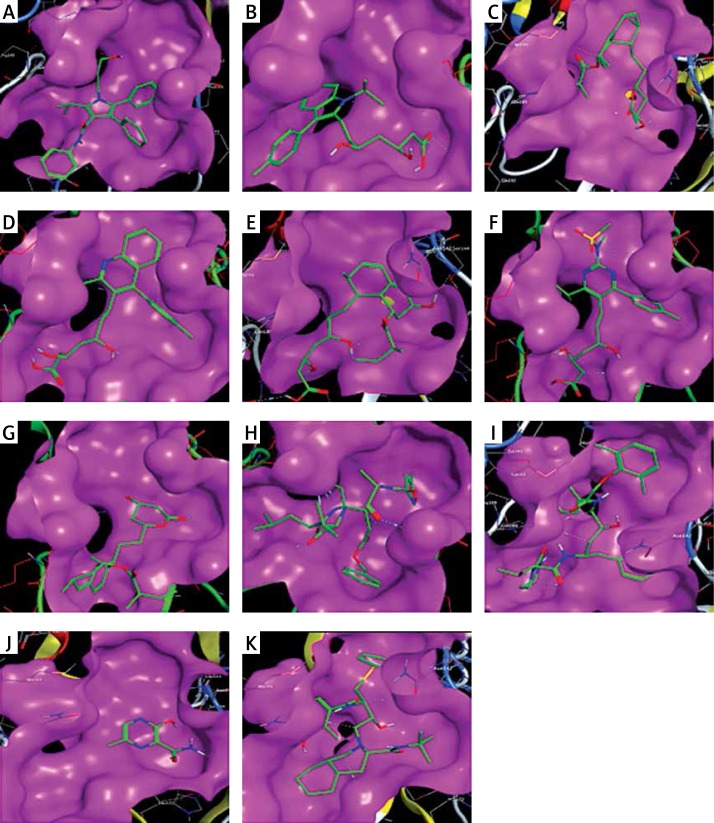
Molecular docking was performed using AutoDock/Vina, a computational docking program. SARS-CoV-2 Mpro was docked with all statins, while antiviral and antiretroviral drugs - favipiravir, nelfinavir, and lopinavir - were used as standards for comparison.
The binding energies obtained from the docking of 6LU7 with native ligand favipiravir, nelfinavir, lopinavir, simvastatin, rosuvastatin, pravastatin, pitavastatin, lovastatin, fluvastatin, and atorvastatin were -6.8, -5.8, -7.9, -7.9, -7.0, -7.7, -6.6, -8.2, -7.4, -7.7, and -6.8 kcal/mol, respectively. The number of hydrogen bonds between statins and amino acid residues of Mpro were 7, 4, and 3 for rosuvastatin, pravastatin, and atorvastatin, respectively, while other statins had two hydrogen bonds.
These results indicate, based upon the binding energy of pitavastatin, rosuvastatin, lovastatin, and fluvastatin, that statins could be efficient SARS-CoV-2 Mpro inhibitors. This is supported by the fact that the effects of some statins, especially pitavastatin, have a binding energy that is even greater than that of protease or polymerase inhibitors. However, further research is necessary to investigate their potential use as drugs for COVID-19.
目前尚无经证实可用于治疗新型冠状病毒肺炎(COVID-19)的药物,也没有针对该疾病的疫苗。严重急性呼吸综合征冠状病毒2(SARS-CoV-2)主要蛋白酶(Mpro)是冠状病毒的一种关键酶,是潜在的药物靶点,已成功结晶。有证据表明他汀类药物具有抗病毒活性,可能会阻断包膜病毒的感染性。本研究的目的是通过分子对接研究评估他汀类药物是否为潜在的COVID-19 Mpro抑制剂。
使用计算对接程序AutoDock/Vina进行分子对接。将SARS-CoV-2 Mpro与所有他汀类药物进行对接,同时将抗病毒和抗逆转录病毒药物——法匹拉韦、奈非那韦和洛匹那韦用作比较标准。
6LU7与天然配体法匹拉韦、奈非那韦、洛匹那韦、辛伐他汀、瑞舒伐他汀、普伐他汀、匹伐他汀、洛伐他汀、氟伐他汀和阿托伐他汀对接得到的结合能分别为-6.8、-5.8、-7.9、-7.9、-7.0、-7.7、-6.6、-8.2、-7.4、-7.7和-6.8千卡/摩尔。瑞舒伐他汀、普伐他汀和阿托伐他汀与Mpro氨基酸残基之间的氢键数量分别为7个、4个和3个,而其他他汀类药物有两个氢键。
基于匹伐他汀、瑞舒伐他汀、洛伐他汀和氟伐他汀的结合能,这些结果表明他汀类药物可能是有效的SARS-CoV-2 Mpro抑制剂。一些他汀类药物,尤其是匹伐他汀,其结合能甚至大于蛋白酶或聚合酶抑制剂,这一事实支持了上述结论。然而,有必要进一步研究它们作为COVID-19治疗药物的潜在用途。