Yesigat Tibebu, Jemal Mohabaw, Birhan Wubet
Hulet Ejju Enessie Woreda Health Office, Motta, Ethiopia.
University of Gondar, College of Medicine and Health Sciences, School of Biomedical and Laboratory Sciences, Department of Medical Microbiology, Gondar, Ethiopia.
Can J Infect Dis Med Microbiol. 2020 Jan 13;2020:6425946. doi: 10.1155/2020/6425946. eCollection 2020.
Intestinal parasite, , and infections are the main public health concerns in the world, especially in developing countries due to inaccessibility of safe water and unhygienic food handling practices of food handlers.
A cross-sectional study was conducted in food handlers in Motta town, from February 2019 to April 2019. The study was undertaken to determine the prevalence and associated risk factors of , and intestinal parasites among 243 food handlers. Sociodemographic and risk factors were collected using pretested structured questionnaire. The stool sample was collected and examined with direct wet mount and concentration techniques. Culture was performed using xylose lysine deoxycholate agar and MacConkey agar and biochemical tests like Klinger iron agar (KIA), lysine iron agar (LIA), Simmons citrate agar, sulphide indole motility test, citrate utilization, and urease production test were conducted to isolate species and species. An antibiotics susceptibility test was performed with Mueller-Hinton agar using the disk diffusion method. Data were entered using statistical package Epi-Data Version 3.1 and analysed with logistic regression using SPSS version 25 and Fisher's exact test. A < 0.05 at 95% CI was considered as statistically significant.
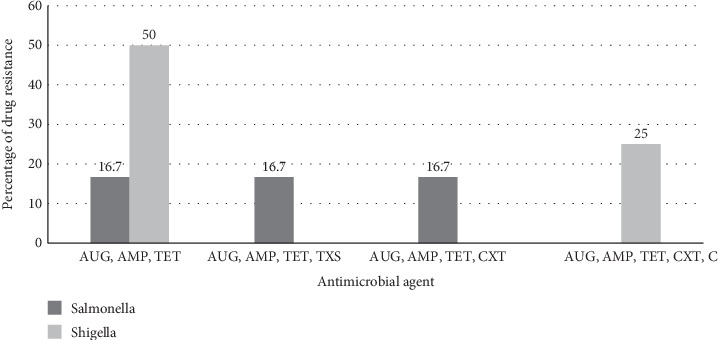
The prevalence of intestinal parasite, , and was 27.6%, 2.5%, and 1.6%, respectively, and hookworm was the predominant intestinal parasite detected in the stool. Antimicrobial resistance was observed in ampicillin and tetracycline (100%) in species and species. Risk factors like fingernail status, fruit washing before eating, cleaning utensils, and regular shoe wearing habit were associated with intestinal parasite, whereas fingernail status and wearing kitchen gown during food service were significantly associated with and infections.
The prevalence of intestinal parasitic infections, , and infections in this study indicates the importance of food handlers as probable sources of enteropathogenic infections. Food handlers should have follow-up on the order of food safety rules and keep their personal hygiene. Hotel owners are responsible to control the health status and their created awareness by given food hygiene training for food handlers. Therefore, policy-makers and implementers should focus on the risk factors to reduce the prevalence below the level of public health importance.
肠道寄生虫、[具体寄生虫1]和[具体寄生虫2]感染是全球主要的公共卫生问题,尤其是在发展中国家,原因在于难以获得安全饮用水以及食品处理人员不卫生的食品处理习惯。
于2019年2月至2019年4月在莫塔镇的食品处理人员中开展了一项横断面研究。该研究旨在确定243名食品处理人员中[具体寄生虫1]、[具体寄生虫2]和肠道寄生虫的患病率及相关危险因素。使用经过预测试的结构化问卷收集社会人口统计学和危险因素信息。采集粪便样本,采用直接湿片法和浓缩技术进行检查。使用木糖赖氨酸脱氧胆酸盐琼脂和麦康凯琼脂进行培养,并进行克林格铁琼脂(KIA)、赖氨酸铁琼脂(LIA)、西蒙斯柠檬酸盐琼脂、硫化氢吲哚动力试验、柠檬酸盐利用和脲酶产生试验等生化试验,以分离[具体细菌1]菌种和[具体细菌2]菌种。使用穆勒-欣顿琼脂通过纸片扩散法进行抗生素敏感性试验。数据使用统计软件Epi-Data 3.1版本录入,并使用SPSS 25版本进行逻辑回归分析和费舍尔精确检验。95%置信区间下P < 0.05被认为具有统计学意义。
肠道寄生虫病、[具体寄生虫1]和[具体寄生虫2]的患病率分别为27.6%、2.5%和1.6%,钩虫是粪便中检测到的主要肠道寄生虫。在[具体细菌1]菌种和[具体细菌2]菌种中观察到对氨苄青霉素和四环素的耐药率为100%。指甲状况、进食前水果清洗、清洁器具和经常穿鞋习惯等危险因素与肠道寄生虫有关,而指甲状况和在食品服务期间穿着厨房工作服与[具体寄生虫1]和[具体寄生虫2]感染显著相关。
本研究中肠道寄生虫感染、[具体寄生虫1]和[具体寄生虫2]感染的患病率表明食品处理人员作为肠道致病感染可能来源的重要性。食品处理人员应遵守食品安全规则并保持个人卫生。酒店老板有责任通过为食品处理人员提供食品卫生培训来控制其健康状况并提高他们的意识。因此,政策制定者和实施者应关注危险因素,以将患病率降低到公共卫生重要性水平以下。