Alzheimer's Disease Research Unit, Yale University School of Medicine, New Haven, Connecticut.
Department of Psychiatry, Yale University School of Medicine, New Haven, Connecticut.
Alzheimers Dement. 2020 Jul;16(7):974-982. doi: 10.1002/alz.12097. Epub 2020 May 13.
Synaptic loss is a robust and consistent pathology in Alzheimer's disease (AD) and the major structural correlate of cognitive impairment. Positron emission tomography (PET) imaging of synaptic vesicle glycoprotein 2A (SV2A) has emerged as a promising biomarker of synaptic density.
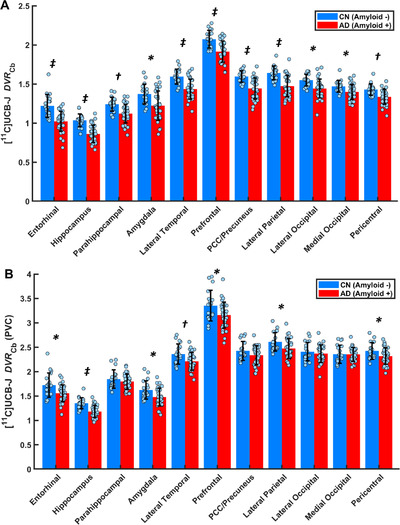
We measured SV2A binding in 34 participants with early AD and 19 cognitively normal (CN) participants using [ C]UCB-J PET and a cerebellar reference region for calculation of the distribution volume ratio.
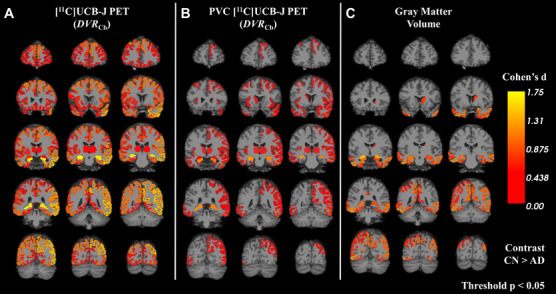
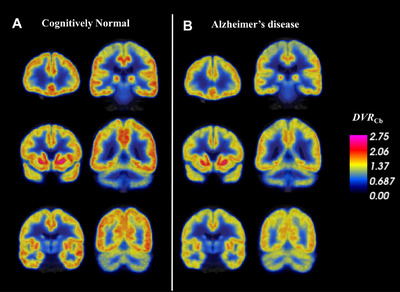
We observed widespread reductions of SV2A binding in medial temporal and neocortical brain regions in early AD compared to CN participants. These reductions were largely maintained after correction for volume loss and were more extensive than decreases in gray matter volume.
We were able to measure widespread synaptic loss due to AD using [ C]UCB-J PET. Future studies will continue to evaluate the utility of SV2A PET for tracking AD progression and for monitoring potential therapies.
突触丢失是阿尔茨海默病(AD)中的一种强大且一致的病理学表现,也是认知障碍的主要结构相关性因素。突触小泡糖蛋白 2A(SV2A)的正电子发射断层扫描(PET)成像是突触密度的有前途的生物标志物。
我们使用 [C]UCB-J PET 和小脑参考区域测量了 34 名早期 AD 患者和 19 名认知正常(CN)参与者的 SV2A 结合情况,以计算分布容积比。
与 CN 参与者相比,我们在早期 AD 患者的内侧颞叶和新皮质脑区观察到广泛的 SV2A 结合减少。这些减少在纠正体积损失后基本保持不变,并且比灰质体积减少更为广泛。
我们能够使用 [C]UCB-J PET 测量由于 AD 导致的广泛的突触丢失。未来的研究将继续评估 SV2A PET 用于跟踪 AD 进展和监测潜在治疗的效用。