• 文献检索
  • 文档翻译
  • 深度研究
  • 学术资讯
  • Suppr Zotero 插件Zotero 插件
  • 邀请有礼
  • 套餐&价格
  • 历史记录
应用&插件
Suppr Zotero 插件Zotero 插件浏览器插件Mac 客户端Windows 客户端微信小程序
定价
高级版会员购买积分包购买API积分包
服务
文献检索文档翻译深度研究API 文档MCP 服务
关于我们
关于 Suppr公司介绍联系我们用户协议隐私条款
关注我们

Suppr 超能文献

核心技术专利:CN118964589B侵权必究
粤ICP备2023148730 号-1Suppr @ 2026

文献检索

告别复杂PubMed语法,用中文像聊天一样搜索,搜遍4000万医学文献。AI智能推荐,让科研检索更轻松。

立即免费搜索

文件翻译

保留排版,准确专业,支持PDF/Word/PPT等文件格式,支持 12+语言互译。

免费翻译文档

深度研究

AI帮你快速写综述,25分钟生成高质量综述,智能提取关键信息,辅助科研写作。

立即免费体验

2020年初新冠疫情期间公共卫生当局在脸书上的宣传努力及公众反应的衡量:跨国比较

Measuring the Outreach Efforts of Public Health Authorities and the Public Response on Facebook During the COVID-19 Pandemic in Early 2020: Cross-Country Comparison.

作者信息

Sesagiri Raamkumar Aravind, Tan Soon Guan, Wee Hwee Lin

机构信息

Saw Swee Hock School of Public Health, National University of Singapore, MD1 #10-0112 Science Drive 2, National University of Singapore, Singapore, SG.

Department of Pharmacy, National University of Singapore, Singapore, SG.

出版信息

J Med Internet Res. 2020 May 19;22(5):e19334. doi: 10.2196/19334.

DOI:10.2196/19334
PMID:32401219
原文链接:https://pmc.ncbi.nlm.nih.gov/articles/PMC7238862/
Abstract

BACKGROUND

The coronavirus disease (COVID-19) pandemic presents one of the most challenging global crises at the dawn of a new decade. Public health authorities (PHAs) are increasingly adopting the use of social media such as Facebook to rapidly communicate and disseminate pandemic response measures to the public. Understanding of communication strategies across different PHAs and examining the public response on the social media landscapes can help improve practices for disseminating information to the public.

OBJECTIVE

This study aims to examine COVID-19-related outreach efforts of PHAs in Singapore, the United States, and England, and the corresponding public response to these outreach efforts on Facebook.

METHODS

Posts and comments from the Facebook pages of the Ministry of Health (MOH) in Singapore, the Centers for Disease Control and Prevention (CDC) in the United States, and Public Health England (PHE) in England were extracted from January 1, 2019, to March 18, 2020. Posts published before January 1, 2020, were categorized as pre-COVID-19, while the remaining posts were categorized as peri-COVID-19 posts. COVID-19-related posts were identified and classified into themes. Metrics used for measuring outreach and engagement were frequency, mean posts per day (PPD), mean reactions per post, mean shares per post, and mean comments per post. Responses to the COVID-19 posts were measured using frequency, mean sentiment polarity, positive to negative sentiments ratio (PNSR), and positive to negative emotions ratio (PNER). Toxicity in comments were identified and analyzed using frequency, mean likes per toxic comment, and mean replies per toxic comment. Trend analysis was performed to examine how the metrics varied with key events such as when COVID-19 was declared a pandemic.

RESULTS

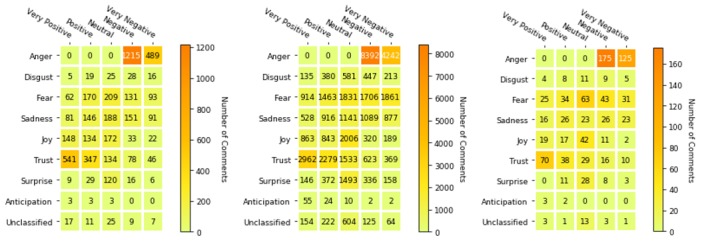
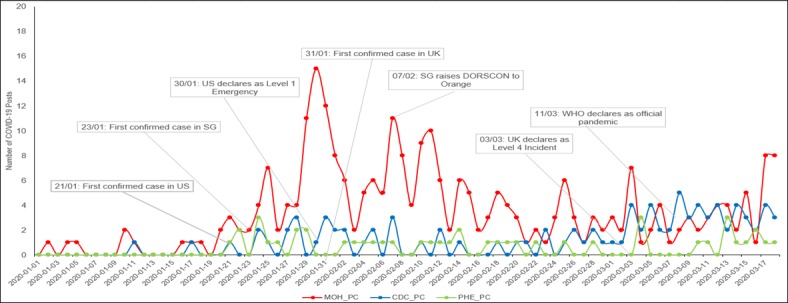
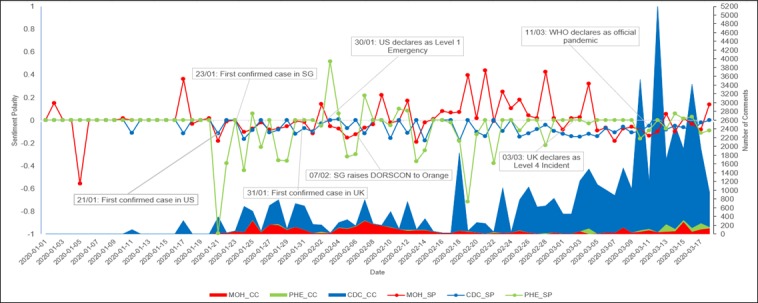
The MOH published more COVID-19 posts (n=271; mean PPD 5.0) compared to the CDC (n=94; mean PPD 2.2) and PHE (n=45; mean PPD 1.4). The mean number of comments per COVID-19 post was highest for the CDC (mean CPP 255.3) compared to the MOH (mean CPP 15.6) and PHE (mean CPP 12.5). Six major themes were identified, with posts about prevention and safety measures and situation updates being prevalent across the three PHAs. The themes of the MOH's posts were diverse, while the CDC and PHE posts focused on a few themes. Overall, response sentiments for the MOH posts (PNSR 0.94) were more favorable compared to response sentiments for the CDC (PNSR 0.57) and PHE (PNSR 0.55) posts. Toxic comments were rare (0.01%) across all PHAs.

CONCLUSIONS

PHAs' extent of Facebook use for outreach purposes during the COVID-19 pandemic varied among the three PHAs, highlighting the strategies and approaches that other PHAs can potentially adopt. Our study showed that social media analysis was capable of providing insights about the communication strategies of PHAs during disease outbreaks.
https://cdn.ncbi.nlm.nih.gov/pmc/blobs/e1f1/7238862/23ff4a5a73f9/jmir_v22i5e19334_fig3.jpg
https://cdn.ncbi.nlm.nih.gov/pmc/blobs/e1f1/7238862/2c5456337b04/jmir_v22i5e19334_fig1.jpg
https://cdn.ncbi.nlm.nih.gov/pmc/blobs/e1f1/7238862/15d87c7b3c4c/jmir_v22i5e19334_fig2.jpg
https://cdn.ncbi.nlm.nih.gov/pmc/blobs/e1f1/7238862/23ff4a5a73f9/jmir_v22i5e19334_fig3.jpg
https://cdn.ncbi.nlm.nih.gov/pmc/blobs/e1f1/7238862/2c5456337b04/jmir_v22i5e19334_fig1.jpg
https://cdn.ncbi.nlm.nih.gov/pmc/blobs/e1f1/7238862/15d87c7b3c4c/jmir_v22i5e19334_fig2.jpg
https://cdn.ncbi.nlm.nih.gov/pmc/blobs/e1f1/7238862/23ff4a5a73f9/jmir_v22i5e19334_fig3.jpg
摘要

背景

在新十年伊始,冠状病毒病(COVID-19)大流行是最具挑战性的全球危机之一。公共卫生当局(PHA)越来越多地使用Facebook等社交媒体,以便迅速向公众传达和传播应对大流行的措施。了解不同PHA的沟通策略,并研究社交媒体平台上的公众反应,有助于改进向公众传播信息的做法。

目的

本研究旨在考察新加坡、美国和英国的PHA针对COVID-19所开展的宣传工作,以及公众在Facebook上对这些宣传工作的相应反应。

方法

提取了新加坡卫生部(MOH)、美国疾病控制与预防中心(CDC)以及英国公共卫生部(PHE)Facebook页面在2019年1月1日至2020年3月18日期间发布的帖子和评论。2020年1月1日之前发布的帖子归类为COVID-19之前,其余帖子归类为COVID-19期间的帖子。识别出与COVID-19相关的帖子并按主题分类。用于衡量宣传和参与度的指标有频率、日均帖子数(PPD)、每条帖子的平均反应数、每条帖子的平均分享数以及每条帖子的平均评论数。使用频率、平均情感极性、积极与消极情感比率(PNSR)以及积极与消极情绪比率(PNER)来衡量对COVID-19帖子的反应。通过频率、每条有害评论的平均点赞数以及每条有害评论的平均回复数来识别和分析评论中的有害内容。进行趋势分析,以考察这些指标如何随关键事件(如COVID-19被宣布为大流行)而变化。

结果

与CDC(n = 94;平均PPD 2.2)和PHE(n = 45;平均PPD 1.4)相比,MOH发布的COVID-19相关帖子更多(n = 271;平均PPD 5.0)。与MOH(平均每条帖子评论数[CPP] 15.6)和PHE(平均CPP 12.5)相比,CDC的每条COVID-19相关帖子的平均评论数最高(平均CPP 255.3)。识别出六个主要主题,关于预防和安全措施以及情况更新的帖子在这三个PHA中都很普遍。MOH帖子的主题多样,而CDC和PHE的帖子集中在几个主题上。总体而言,MOH帖子的反应情绪(PNSR 0.94)比CDC(PNSR 0.57)和PHE(PNSR 0.55)帖子的反应情绪更积极。所有PHA中有害评论都很少见(0.01%)。

结论

在COVID-19大流行期间,三个PHA利用Facebook进行宣传的程度各不相同,突出了其他PHA可能采用的策略和方法。我们的研究表明,社交媒体分析能够提供有关疾病爆发期间PHA沟通策略的见解。

相似文献

1
Measuring the Outreach Efforts of Public Health Authorities and the Public Response on Facebook During the COVID-19 Pandemic in Early 2020: Cross-Country Comparison.2020年初新冠疫情期间公共卫生当局在脸书上的宣传努力及公众反应的衡量:跨国比较
J Med Internet Res. 2020 May 19;22(5):e19334. doi: 10.2196/19334.
2
Use of Facebook by Academic Medical Centers in Taiwan During the COVID-19 Pandemic: Observational Study.台湾地区学术医学中心在新冠疫情期间对脸书的使用:观察性研究。
J Med Internet Res. 2020 Nov 20;22(11):e21501. doi: 10.2196/21501.
3
Public Engagement and Government Responsiveness in the Communications About COVID-19 During the Early Epidemic Stage in China: Infodemiology Study on Social Media Data.中国疫情早期阶段新冠疫情信息传播中的公众参与和政府回应:基于社交媒体数据的信息流行病学研究
J Med Internet Res. 2020 May 26;22(5):e18796. doi: 10.2196/18796.
4
Grappling With the COVID-19 Health Crisis: Content Analysis of Communication Strategies and Their Effects on Public Engagement on Social Media.应对新冠疫情健康危机:社交媒体上传播策略及其对公众参与度影响的内容分析
J Med Internet Res. 2020 Aug 24;22(8):e21360. doi: 10.2196/21360.
5
Use of Health Belief Model-Based Deep Learning Classifiers for COVID-19 Social Media Content to Examine Public Perceptions of Physical Distancing: Model Development and Case Study.基于健康信念模型的深度学习分类器在社交媒体内容中对公众对物理隔离看法的应用:模型建立与案例研究。
JMIR Public Health Surveill. 2020 Jul 14;6(3):e20493. doi: 10.2196/20493.
6
Top Concerns of Tweeters During the COVID-19 Pandemic: Infoveillance Study.新冠疫情期间推特用户的主要担忧:信息监测研究
J Med Internet Res. 2020 Apr 21;22(4):e19016. doi: 10.2196/19016.
7
Users' Beliefs Toward Physical Distancing in Facebook Pages of Public Health Authorities During COVID-19 Pandemic in Early 2020.2020 年初 COVID-19 大流行期间,用户对公共卫生当局在 Facebook 页面上宣传保持身体距离的看法。
Health Educ Behav. 2021 Aug;48(4):404-411. doi: 10.1177/10901981211014428. Epub 2021 May 20.
8
The Saudi Ministry of Health's Twitter Communication Strategies and Public Engagement During the COVID-19 Pandemic: Content Analysis Study.沙特卫生部在 COVID-19 大流行期间的 Twitter 传播策略和公众参与:内容分析研究。
JMIR Public Health Surveill. 2021 Jul 12;7(7):e27942. doi: 10.2196/27942.
9
Data Mining and Content Analysis of the Chinese Social Media Platform Weibo During the Early COVID-19 Outbreak: Retrospective Observational Infoveillance Study.新冠疫情早期的中文社交媒体平台微博数据挖掘和内容分析:回顾性观察性信息监测研究。
JMIR Public Health Surveill. 2020 Apr 21;6(2):e18700. doi: 10.2196/18700.
10
What's buzzing on your feed? Health authorities' use of Facebook to combat Zika in Singapore.你的动态上都在热议什么?新加坡卫生当局利用脸书抗击寨卡病毒。
J Am Med Inform Assoc. 2017 Nov 1;24(6):1155-1159. doi: 10.1093/jamia/ocx028.

引用本文的文献

1
Receptivity of Governmental Communication and Its Effectiveness During COVID-19 Pandemic Emergency in Vietnam: A Qualitative Study.越南新冠疫情紧急状态期间政府沟通的接受度及其有效性:一项定性研究
Glob J Flex Syst Manag. 2021;22(Suppl 1):45-64. doi: 10.1007/s40171-021-00269-7. Epub 2021 May 10.
2
Estimating the Relative Risks of Spatial Clusters Using a Predictor-Corrector Method.使用预测-校正方法估计空间聚集的相对风险。
Mathematics (Basel). 2025;13(2). doi: 10.3390/math13020180.
3
How science and policy came together and made a global impact: The EU common list of COVID-19 antigen tests.

本文引用的文献

1
Interrupting transmission of COVID-19: lessons from containment efforts in Singapore.阻断 COVID-19 传播:新加坡封控措施的经验教训。
J Travel Med. 2020 May 18;27(3). doi: 10.1093/jtm/taaa039.
2
Lessons for managing high-consequence infections from first COVID-19 cases in the UK.英国首例新冠病毒感染病例带来的高后果感染管理经验教训。
Lancet. 2020 Mar 14;395(10227):e46. doi: 10.1016/S0140-6736(20)30463-3. Epub 2020 Feb 27.
3
COVID-19 in Singapore-Current Experience: Critical Global Issues That Require Attention and Action.新加坡的2019冠状病毒病——当前情况:需要关注和行动的重大全球问题
科学与政策如何携手并产生全球影响:欧盟新冠病毒抗原检测通用清单
Open Res Eur. 2024 Dec 24;4:198. doi: 10.12688/openreseurope.18267.2. eCollection 2024.
4
Cross-Cultural Sense-Making of Global Health Crises: A Text Mining Study of Public Opinions on Social Media Related to the COVID-19 Pandemic in Developed and Developing Economies.全球卫生危机的跨文化意义建构:关于发达经济体和发展中经济体社交媒体上与新冠疫情相关公众舆论的文本挖掘研究
J Med Internet Res. 2025 Jan 27;27:e58656. doi: 10.2196/58656.
5
Finding polarized communities and tracking information diffusion on Twitter: a network approach on the Irish Abortion Referendum.在推特上寻找极化社区并追踪信息传播:关于爱尔兰堕胎公投的网络方法
R Soc Open Sci. 2025 Jan 15;12(1):240454. doi: 10.1098/rsos.240454. eCollection 2025 Jan.
6
Unveiling public perceptions at the beginning of lockdown: an application of structural topic modeling and sentiment analysis in the UK and India.揭示封锁初期的公众看法:英国和印度的结构主题建模和情感分析应用。
BMC Public Health. 2024 Oct 15;24(1):2832. doi: 10.1186/s12889-024-20160-1.
7
Altmetric coverage of health research in Ireland 2017-2023: a protocol for a cross-sectional analysis.2017 - 2023年爱尔兰健康研究的替代计量学覆盖情况:一项横断面分析方案
HRB Open Res. 2024 Oct 22;7:36. doi: 10.12688/hrbopenres.13895.2. eCollection 2024.
8
News Coverage of the COVID-19 Pandemic on Social Media and the Public's Negative Emotions: Computational Study.社交媒体对 COVID-19 大流行的新闻报道与公众的负面情绪:计算研究。
J Med Internet Res. 2024 Jun 6;26:e48491. doi: 10.2196/48491.
9
Harnessing digital technology for COVID-19 response in Uganda: lessons and implications for future public health emergencies.乌干达利用数字技术应对新冠疫情:经验教训及对未来突发公共卫生事件的启示
BMJ Glob Health. 2023 Oct;8(Suppl 6). doi: 10.1136/bmjgh-2023-013288.
10
Public health agencies' use of social media for communication during pandemics: a scoping review of the literature.公共卫生机构在大流行期间利用社交媒体进行沟通:文献综述
Osong Public Health Res Perspect. 2023 Aug;14(4):235-251. doi: 10.24171/j.phrp.2023.0095. Epub 2023 Aug 9.
JAMA. 2020 Apr 7;323(13):1243-1244. doi: 10.1001/jama.2020.2467.
4
First Case of 2019 Novel Coronavirus in the United States.美国首例 2019 新型冠状病毒病例。
N Engl J Med. 2020 Mar 5;382(10):929-936. doi: 10.1056/NEJMoa2001191. Epub 2020 Jan 31.
5
Identifying Key Topics Bearing Negative Sentiment on Twitter: Insights Concerning the 2015-2016 Zika Epidemic.识别推特上带有负面情绪的关键话题:关于2015 - 2016年寨卡疫情的见解
JMIR Public Health Surveill. 2019 Jun 4;5(2):e11036. doi: 10.2196/11036.
6
A hands-on guide to doing content analysis.内容分析实践指南。
Afr J Emerg Med. 2017 Sep;7(3):93-99. doi: 10.1016/j.afjem.2017.08.001. Epub 2017 Aug 21.
7
Strategic Uses of Facebook in Zika Outbreak Communication: Implications for the Crisis and Emergency Risk Communication Model.在寨卡疫情传播中使用 Facebook 的策略:对危机和紧急风险沟通模型的启示。
Int J Environ Res Public Health. 2018 Sep 10;15(9):1974. doi: 10.3390/ijerph15091974.
8
Anyone Can Become a Troll: Causes of Trolling Behavior in Online Discussions.任何人都可能成为网络喷子:在线讨论中喷子行为的成因。
CSCW Conf Comput Support Coop Work. 2017 Feb-Mar;2017:1217-1230. doi: 10.1145/2998181.2998213.
9
Delays in Global Disease Outbreak Responses: Lessons from H1N1, Ebola, and Zika.全球疾病爆发应对中的延误:从 H1N1、埃博拉和寨卡病毒中吸取的教训。
Am J Public Health. 2018 Mar;108(3):329-333. doi: 10.2105/AJPH.2017.304245. Epub 2018 Jan 18.
10
Virtual Zika transmission after the first U.S. case: who said what and how it spread on Twitter.首例美国寨卡病毒病例后出现的虚拟寨卡病毒传播:谁说了什么以及它是如何在 Twitter 上传播的。
Am J Infect Control. 2018 May;46(5):549-557. doi: 10.1016/j.ajic.2017.10.015. Epub 2018 Jan 4.