Department of Kinesiology & Health, Georgia State University, Atlanta, GA, USA.
School of Public Health, Georgia State University, Atlanta, GA, USA.
Physiol Rep. 2020 May;8(9):e14437. doi: 10.14814/phy2.14437.
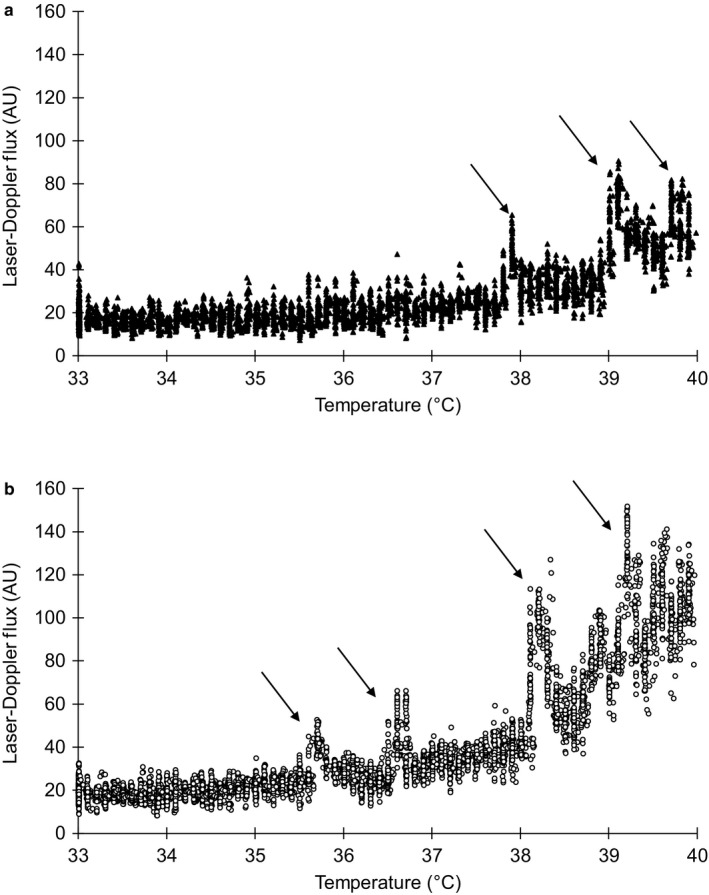
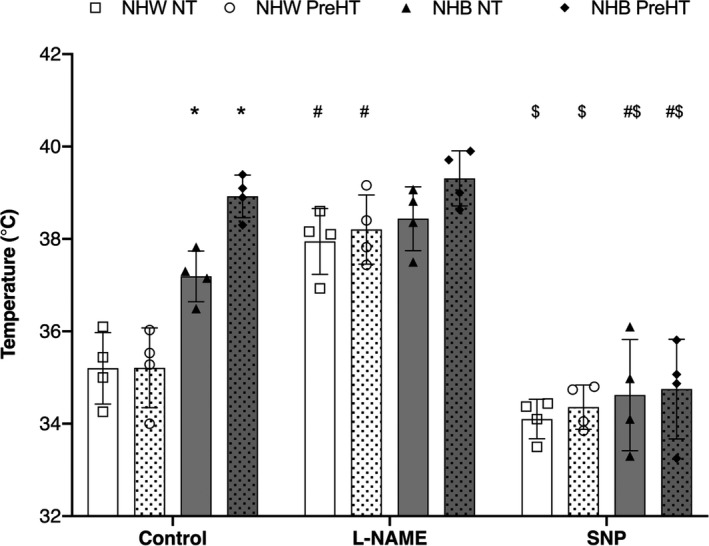
Relative to non-Hispanic Whites, non-Hispanic Blacks are disproportionately affected by elevated blood pressure (BP). It is unknown whether race or subclinical increases in BP affect the ability of cutaneous sensory nerves to induce cutaneous microvascular vasodilation. Sixteen participants who self-identified as non-Hispanic Black (n = 8) or non-Hispanic White (n = 8) were subgrouped as normotensive or prehypertensive. Participants were instrumented with three intradermal microdialysis fibers: (a) control, (b) 1 μM sodium nitroprusside (SNP), an exogenous nitric oxide (NO) donor, and (c) 20 mM N -nitro-l-arginine methyl ester (L-NAME), a non-selective NO synthase inhibitor. A slow local heating protocol (33-40°C, 0.1°C/min) was used to assess the onset of cutaneous sensory nerve-mediated vasodilation (temperature threshold) and skin blood flow was measured using laser-Doppler flowmetry. At control sites, the temperature threshold occurred at a higher temperature in non-Hispanic Blacks (normotensive: 37.2 ± 0.6°C, prehypertensive: 38.9 ± 0.5°C) compared to non-Hispanic Whites (normotensive: 35.2 ± 0.8°C, prehypertensive: 35.2 ± 0.9°C). L-NAME shifted the temperature threshold higher in non-Hispanic Whites (normotensive: 37.8 ± 0.7°C, prehypertensive: 38.2 ± 0.8°C), but there was no observed effect in non-Hispanic Blacks. SNP did not affect temperature threshold in non-Hispanic Whites, but shifted the temperature threshold lower in non-Hispanic Blacks (normotensive: 34.6 ± 1.2°C, prehypertensive: 34.8 ± 1.1°C). SNP mitigated differences in temperature threshold across all groups. There was no effect found for BP status in either the non-Hispanic Black or non-Hispanic White groups. These data suggest that reduced NO bioavailability affects the ability of cutaneous sensory nerves to induce microvascular vasodilation in young, otherwise healthy non-Hispanic Blacks.
与非西班牙裔白人相比,非西班牙裔黑人的血压升高更为普遍。目前尚不清楚是种族还是血压的亚临床升高会影响皮肤感觉神经诱导皮肤微血管扩张的能力。16 名自认为是非西班牙裔黑人(n=8)或非西班牙裔白人(n=8)的参与者被分为正常血压或高血压前期。参与者被植入三根真皮内微透析纤维:(a)对照,(b)1μM 硝普钠(SNP),一种外源性一氧化氮(NO)供体,和(c)20mM N-硝基-L-精氨酸甲酯(L-NAME),一种非选择性一氧化氮合酶抑制剂。使用缓慢的局部加热方案(33-40°C,0.1°C/min)来评估皮肤感觉神经介导的血管扩张的起始(温度阈值),并用激光多普勒血流仪测量皮肤血流。在对照部位,非西班牙裔黑人的温度阈值较高(正常血压:37.2±0.6°C,高血压前期:38.9±0.5°C),而非西班牙裔白人的温度阈值较低(正常血压:35.2±0.8°C,高血压前期:35.2±0.9°C)。L-NAME 使非西班牙裔白种人的温度阈值升高(正常血压:37.8±0.7°C,高血压前期:38.2±0.8°C),但在非西班牙裔黑人中没有观察到这种效应。SNP 对非西班牙裔白人的温度阈值没有影响,但使非西班牙裔黑人的温度阈值降低(正常血压:34.6±1.2°C,高血压前期:34.8±1.1°C)。SNP 缓解了所有组之间的温度阈值差异。在非西班牙裔黑人或非西班牙裔白人组中,血压状况均未发现有影响。这些数据表明,NO 生物利用度降低会影响皮肤感觉神经诱导微血管扩张的能力,在年轻且健康的非西班牙裔黑人中尤其如此。