Department of Kinesiology and Health, Georgia State University, Atlanta, Georgia, United States.
Department of Health and Human Physiology, University of Iowa, Iowa City, Iowa, United States.
J Appl Physiol (1985). 2023 Apr 1;134(4):858-867. doi: 10.1152/japplphysiol.00586.2022. Epub 2023 Mar 2.
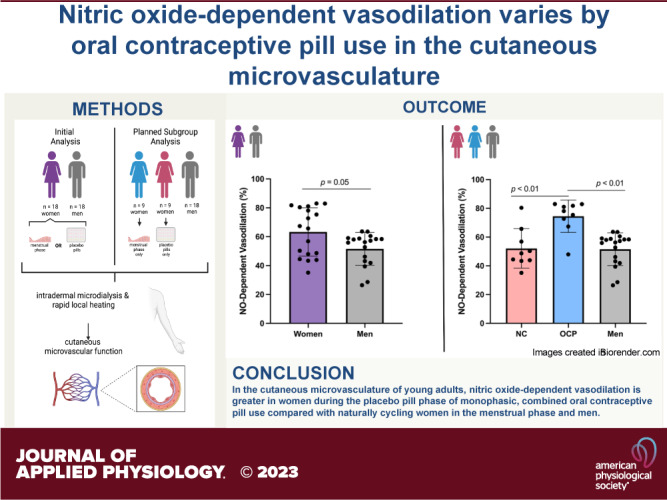
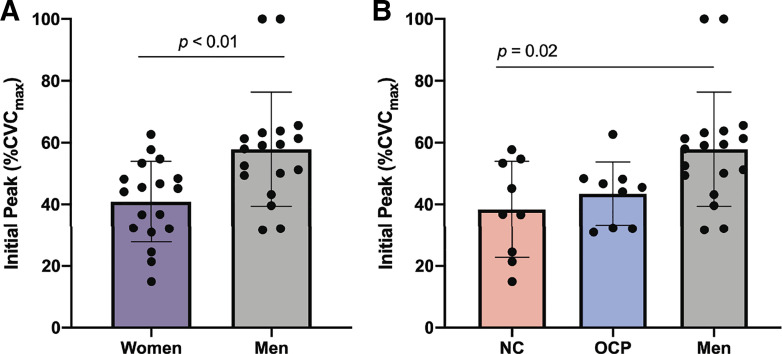
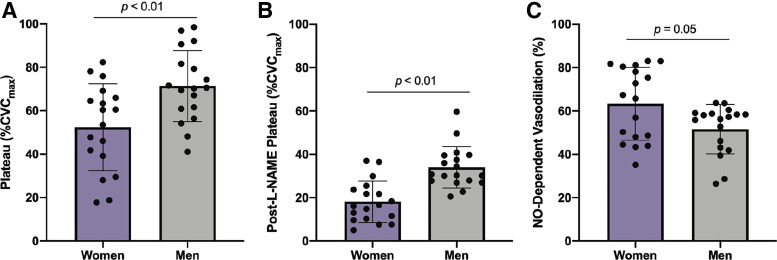
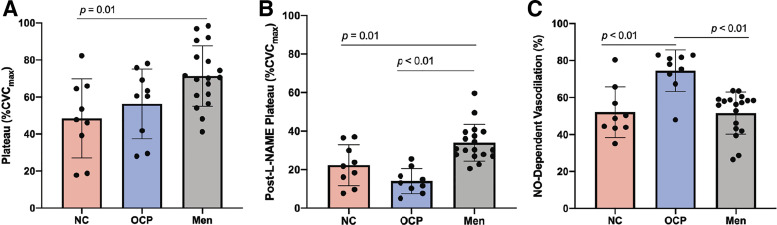
The purpose of this study was to evaluate in vivo endothelial function and nitric oxide (NO)-dependent vasodilation between women in either menstrual or placebo pill phases of their respective hormonal exposure [either naturally cycling (NC) or using oral contraceptive pills (OCPs)] and men. A planned subgroup analysis was then completed to assess endothelial function and NO-dependent vasodilation between NC women, women using OCP, and men. Endothelium-dependent and NO-dependent vasodilation were assessed in the cutaneous microvasculature using laser-Doppler flowmetry, a rapid local heating protocol (39°C, 0.1 °C/s), and pharmacological perfusion through intradermal microdialysis fibers. Data are represented as means ± standard deviation. Men displayed greater endothelium-dependent vasodilation (plateau, men: 71 ± 16 vs. women: 52 ± 20%CVC, < 0.01), but lower NO-dependent vasodilation (men: 52 ± 11 vs. women: 63 ± 17%NO, = 0.05) compared with all women. Subgroup analysis revealed NC women had lower endothelium-dependent vasodilation (plateau, NC women: 48 ± 21%CVC, = 0.01) but similar NO-dependent vasodilation (NC women: 52 ± 14%NO, > 0.99), compared with men. Endothelium-dependent vasodilation did not differ between women using OCP and men ( = 0.12) or NC women ( = 0.64), but NO-dependent vasodilation was significantly greater in women using OCP (74 ± 11%NO) than both NC women and men ( < 0.01 for both). This study highlights the importance of directly quantifying NO-dependent vasodilation in cutaneous microvascular studies. This study also provides important implications for experimental design and data interpretation. This study supports differences in microvascular endothelial function and nitric oxide (NO)-dependent vasodilation between women in low hormone phases of two hormonal exposures and men. However, when separated into subgroups of hormonal exposure, women during placebo pills of oral contraceptive pill (OCP) use have greater NO-dependent vasodilation than naturally cycling women in their menstrual phase and men. These data improve knowledge of sex differences and the effect of OCP use on microvascular endothelial function.
本研究旨在评估处于各自激素暴露周期(自然循环或口服避孕药)的女性(月经或安慰剂期)和男性之间的体内内皮功能和一氧化氮(NO)依赖性血管舒张。然后进行了一项计划的亚组分析,以评估自然循环女性、使用口服避孕药的女性和男性之间的内皮功能和 NO 依赖性血管舒张。使用激光多普勒流量仪、快速局部加热方案(39°C,0.1°C/s)和通过皮内微透析纤维进行的药理学灌注评估皮肤微血管中的内皮依赖性和 NO 依赖性血管舒张。数据表示为平均值±标准偏差。男性显示出更大的内皮依赖性血管舒张(平台,男性:71±16%CVC, < 0.01),但 NO 依赖性血管舒张较低(男性:52±11%NO, = 0.05),与所有女性相比。亚组分析显示,与男性相比,自然循环女性的内皮依赖性血管舒张(平台,NC 女性:48±21%CVC, = 0.01)较低,但 NO 依赖性血管舒张相似(NC 女性:52±14%NO, > 0.99)。与男性相比,使用避孕药的女性和自然循环女性之间的内皮依赖性血管舒张没有差异( = 0.12)或 NC 女性( = 0.64),但使用避孕药的女性的 NO 依赖性血管舒张显著高于 NC 女性和男性(两者均 < 0.01)。这项研究强调了在皮肤微血管研究中直接量化 NO 依赖性血管舒张的重要性。该研究还为实验设计和数据分析提供了重要启示。这项研究支持两种激素暴露的低激素期女性与男性之间的微血管内皮功能和一氧化氮(NO)依赖性血管舒张存在差异。然而,当按激素暴露亚组分开时,与自然循环女性的月经周期和男性相比,使用避孕药的女性在服用安慰剂期间的 NO 依赖性血管舒张更大。这些数据提高了对性别差异和避孕药使用对微血管内皮功能影响的认识。